




Draw a diagrammatic sectional view of a human seminiferous tubule, and label Sertoli cells, primary spermatocyte, spermatogonium, and spermatozoa in it.
Answer
 Verified
631.8k+ views
Hint: In humans, the seminiferous tubules are located within the male testes. These cells are present within testes and it is the location where meiosis and spermatogenesis (the process of producing spermatozoa) occurs.
Complete answer:
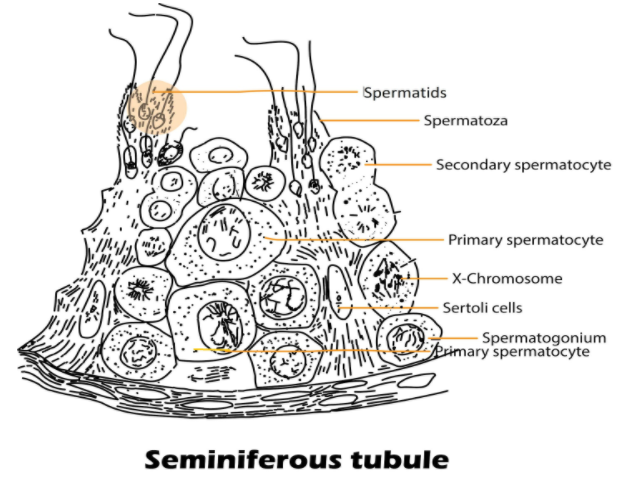
The Sertoli cells are surrounded by spermatogenic cells on the epithelial interior, these cells and stem cells exteriorly make up the seminiferous tubules.
Sertoli cells- is a nurse cell which creates a hemato-testicular barrier and gives nourishment to the spermatozoa. The sperm heads become embedded in these cells after the process of spermiogenesis. They are finally released from the seminiferous tubules by a process called spermiation.
Primary spermatocyte- they are are diploid (2N) cells and after completing the first meiotic divisions leads to the formation of two equal, haploid cells called secondary spermatocytes. These contain half the number of chromosomes and thereby give rise to male gamete-sperm.
Spermatogonia- the spermatogonia (plural Spermatogonium) is an undifferentiated male germ cell and is present on the inside wall of seminiferous tubules. It multiplies by mitotic division and increases in numbers and is diploid and contains 46 chromosomes. There are three types of spermatogonia:
Type A (dark)- they are cells with dark nuclei and are reserve spermatogonial stem cells. They don’t usually go through mitosis.
Type A (pale)- they are cells with pale nuclei and are the spermatogonial stem cells. They undergo active mitosis to produce Type B cells.
Type B cells- they grow to become primary spermatocytes.
Spermatozoa- These are the male sex cells or sperms and are added to the semen before coming out of the body. A spermatogonium undergoes spermatogenesis to form mature spermatozoa.
Note: Sertoli cells of the testicles are activated by follicle-stimulating hormone (FSH) secreted by the adenohypophysis. It has an FSH receptor on its membranes. These cells can only proliferate or divide rapidly in the first year of life.
Complete answer:
The Sertoli cells are surrounded by spermatogenic cells on the epithelial interior, these cells and stem cells exteriorly make up the seminiferous tubules.
Sertoli cells- is a nurse cell which creates a hemato-testicular barrier and gives nourishment to the spermatozoa. The sperm heads become embedded in these cells after the process of spermiogenesis. They are finally released from the seminiferous tubules by a process called spermiation.
Primary spermatocyte- they are are diploid (2N) cells and after completing the first meiotic divisions leads to the formation of two equal, haploid cells called secondary spermatocytes. These contain half the number of chromosomes and thereby give rise to male gamete-sperm.
Spermatogonia- the spermatogonia (plural Spermatogonium) is an undifferentiated male germ cell and is present on the inside wall of seminiferous tubules. It multiplies by mitotic division and increases in numbers and is diploid and contains 46 chromosomes. There are three types of spermatogonia:
Type A (dark)- they are cells with dark nuclei and are reserve spermatogonial stem cells. They don’t usually go through mitosis.
Type A (pale)- they are cells with pale nuclei and are the spermatogonial stem cells. They undergo active mitosis to produce Type B cells.
Type B cells- they grow to become primary spermatocytes.
Spermatozoa- These are the male sex cells or sperms and are added to the semen before coming out of the body. A spermatogonium undergoes spermatogenesis to form mature spermatozoa.
Note: Sertoli cells of the testicles are activated by follicle-stimulating hormone (FSH) secreted by the adenohypophysis. It has an FSH receptor on its membranes. These cells can only proliferate or divide rapidly in the first year of life.
Recently Updated Pages
Match columnI with columnII and choose the correct class 12 biology NEET_UG

Match columnI with columnII and choose the correct class 12 biology NEET_UG
Match columnI with columnII and choose the correct class 12 biology NEET_UG
Which plant will lose its economic value if its fruits class 12 biology NEET_UG
Human insulin is being commercially produced from a class 12 biology NEET_UG
Match columnI with columnII and choose the correct class 12 biology NEET_UG
Trending doubts
Which are the Top 10 Largest Countries of the World?
Draw a labelled sketch of the human eye class 12 physics CBSE
Differentiate between homogeneous and heterogeneous class 12 chemistry CBSE
Draw a well labelled diagram of LS of the human ki class 12 biology CBSE
Modern Homo sapiens arose during the ice age between class 12 biology CBSE
Why is the cell called the structural and functional class 12 biology CBSE