




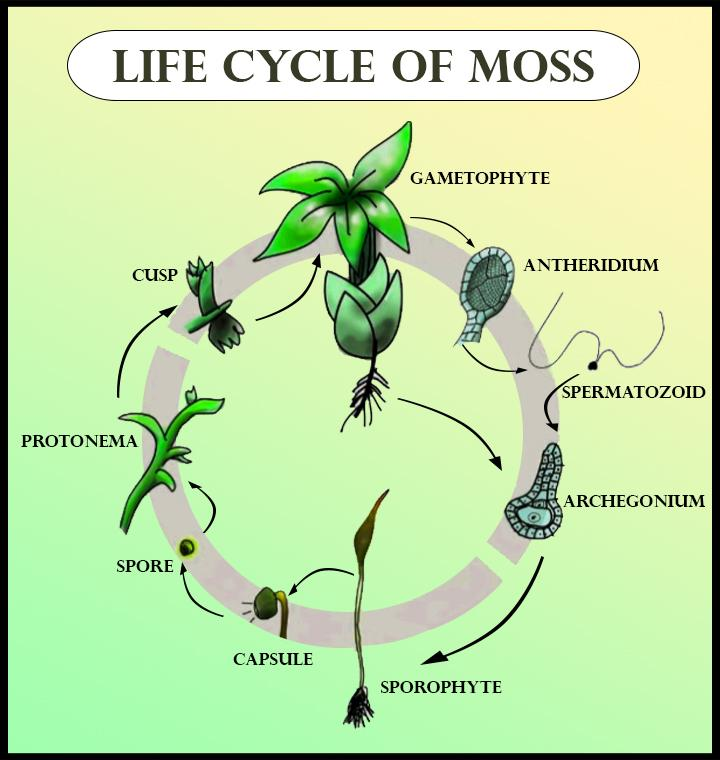
Draw a diagram to describe the life cycle of the moss, pointing out significant features.
Answer
 Verified
636.3k+ views
Hint: They belong to the amphibians of the plant kingdoms and also show the alternation of generation in their life cycle.
Complete answer:
Mosses belong to the division Bryophyta. They are the small, non-vascular plants that are flowerless. They are autotrophic as they undergo photosynthesis. The life cycle of mosses shows alternation of generation. They consist of only a single set of haploid chromosomes. The period when the moss plant has two paired chromosomes is known as the sporophyte stage.
The life cycle starts with the sore, which is haploid and resulting in the production of protonema. Protonema is the thallus-like, flat thread-like filaments. From this stage, gametophore grows, which later forms stems and leaves. The gametophore is the gamete bearers.
From the tips of the gametophore stems, the sex organs are developed. The female organs are known as archegonia (small, flask-shaped cells with an open neck, and male organs are known as antheridia (sperm). In the water, sperm swim towards archegonia, and fertilization occurs. The pollination occurs mainly through the wind.
After fertilization, the immature sporophyte pushed out of the archegonial venter and developed into the mature sporophyte. They consisted of seta (long stalk), and a capsule capped cell called an operculum. In the capsule during meiosis, spore formation occurs and forms haploid spores. After this, the new cycle begins.
Note: Mosses were generally grouped with the hornworts and liverworts. The fossil fuel of moss is studied that they recovered from early Permian later in the Carboniferous and Silurian period. They evolved only about two to three times much slower than ferns, gymnosperms, and angiosperms.
Complete answer:
Mosses belong to the division Bryophyta. They are the small, non-vascular plants that are flowerless. They are autotrophic as they undergo photosynthesis. The life cycle of mosses shows alternation of generation. They consist of only a single set of haploid chromosomes. The period when the moss plant has two paired chromosomes is known as the sporophyte stage.
The life cycle starts with the sore, which is haploid and resulting in the production of protonema. Protonema is the thallus-like, flat thread-like filaments. From this stage, gametophore grows, which later forms stems and leaves. The gametophore is the gamete bearers.
From the tips of the gametophore stems, the sex organs are developed. The female organs are known as archegonia (small, flask-shaped cells with an open neck, and male organs are known as antheridia (sperm). In the water, sperm swim towards archegonia, and fertilization occurs. The pollination occurs mainly through the wind.
After fertilization, the immature sporophyte pushed out of the archegonial venter and developed into the mature sporophyte. They consisted of seta (long stalk), and a capsule capped cell called an operculum. In the capsule during meiosis, spore formation occurs and forms haploid spores. After this, the new cycle begins.
Note: Mosses were generally grouped with the hornworts and liverworts. The fossil fuel of moss is studied that they recovered from early Permian later in the Carboniferous and Silurian period. They evolved only about two to three times much slower than ferns, gymnosperms, and angiosperms.
Recently Updated Pages
Master Class 9 General Knowledge: Engaging Questions & Answers for Success

Master Class 9 Maths: Engaging Questions & Answers for Success
Master Class 9 Science: Engaging Questions & Answers for Success
Master Class 9 English: Engaging Questions & Answers for Success
Master Class 9 Social Science: Engaging Questions & Answers for Success
Class 9 Question and Answer - Your Ultimate Solutions Guide
Trending doubts
One Metric ton is equal to kg A 10000 B 1000 C 100 class 11 physics CBSE
What is cell theory Who formulated it class 11 biology CBSE
Phyllotaxy is the arrangement of ALeaflets BLeaves class 11 biology CBSE
Difference Between Prokaryotic Cells and Eukaryotic Cells
The symbiotic association of fungi and algae is called class 11 biology CBSE
Cell theory was formulated by A Schleiden and Schwann class 11 biology CBSE