




Draw a diagram showing all components of forces acting on a vehicle moving on a curved banked road. Write the necessary equation for maximum safety speed and state the significance of each term involved in it.
Answer
 Verified
633k+ views
Hint:Banking of roads: When a vehicle goes around the curved track at a reasonable speed without skidding, it is managed with it by raising the outer edge of the track a little above the inner edge, this is done to reduce the wear and tear of the car tyres and also the risk of skidding.
Complete step by step answer:
We have been asked to draw a diagram showing all components of forces acting on a vehicle moving on a curved banked road and also to write the necessary equation for maximum safety speed and the significance of each term involved in it. Now, let us consider a car having weight Mg moving round a curved path of radius r with a speed v on a curved banked road through angle $\theta $.
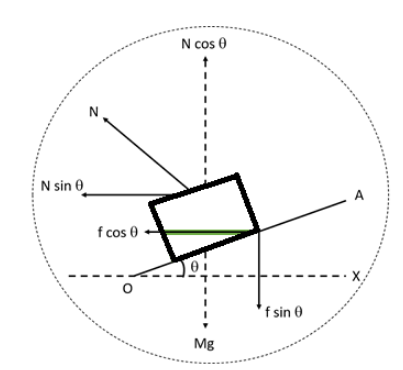
The forces which will act on the vehicle are:
1. The weight Mg which is acting vertically downwards.
2. The normal reaction of the road N, which is perpendicular to the road surface.
3. The frictional force f, which is along the inclined surface of the road.
Necessary equation for maximum safety speed:
Normal N and friction f have perpendicular components \[Ncos\theta \] which is vertically up and \[fsin\theta \] which is vertically down. And the horizontal components \[Nsin\theta \] and \[fcos\theta .\] Now, if is the maximum safe speed is without skidding, then,
$\dfrac{{m{V^2}_{\max }}}{r} = N\sin \theta + {f_s}\cos \theta $
$
\Rightarrow \dfrac{{m{V^2}_{\max }}}{r} = N\sin \theta + {\mu _s}N\cos \theta \\
\Rightarrow\dfrac{{m{V^2}_{\max }}}{r} = N(\sin \theta + {\mu _s}\cos \theta )......eq.(1) \\ $
Also, the $N\cos \theta = mg + {f_s}\sin \theta $
$mg = N(\cos \theta - {\mu _s}\sin \theta ).......eq.(2)$
On dividing equation (1) by (2), we get
$
\dfrac{{m{V^2}_{\max }}}{{r(mg)}} = \dfrac{{N(\sin \theta + {\mu _s}\cos \theta )}}{{N(\
\theta - {\mu _s}\sin \theta )}} \\
\Rightarrow\dfrac{{{V^2}_{\max }}}{{rg}} = \dfrac{{\sin \theta + {\mu _s}\cos \theta }}{{\cos \theta - {\mu _s}\sin \theta }} \\
\Rightarrow\dfrac{{{V^2}_{\max }}}{{rg}} = \dfrac{{\tan \theta + {\mu _s}}}{{1 - {\mu _s}\tan \theta }} \\
$
\[\therefore{V_{\max }} = \sqrt {rg[\dfrac{{{\mu _s} + \tan \theta }}{{1 - {\mu _s}\tan \theta }}]} \]
Thus, the equation for maximum safety speed for the vehicle moving on the curved banked road is, \[{V_{\max }} = \sqrt {rg[\dfrac{{{\mu _s} + \tan \theta }}{{1 - {\mu _s}\tan \theta }}]} \]
where, \[r{\text{ }} = \] radius of curved road
$\theta = $angle of banking
${\mu _s} = $ coefficient of friction between road and tyres
Note: Students should carefully draw the diagram. And don’t forget about the frictional force, as most of the time we neglect the frictional force, but here as we are asked about all the forces we are supposed to consider that also. The maximum safety speed of a vehicle on a curve depends upon friction between tyres and roads. It depends on the angle through which the road is banked. It is independent of the mass of the vehicle.
Complete step by step answer:
We have been asked to draw a diagram showing all components of forces acting on a vehicle moving on a curved banked road and also to write the necessary equation for maximum safety speed and the significance of each term involved in it. Now, let us consider a car having weight Mg moving round a curved path of radius r with a speed v on a curved banked road through angle $\theta $.
The forces which will act on the vehicle are:
1. The weight Mg which is acting vertically downwards.
2. The normal reaction of the road N, which is perpendicular to the road surface.
3. The frictional force f, which is along the inclined surface of the road.
Necessary equation for maximum safety speed:
Normal N and friction f have perpendicular components \[Ncos\theta \] which is vertically up and \[fsin\theta \] which is vertically down. And the horizontal components \[Nsin\theta \] and \[fcos\theta .\] Now, if is the maximum safe speed is without skidding, then,
$\dfrac{{m{V^2}_{\max }}}{r} = N\sin \theta + {f_s}\cos \theta $
$
\Rightarrow \dfrac{{m{V^2}_{\max }}}{r} = N\sin \theta + {\mu _s}N\cos \theta \\
\Rightarrow\dfrac{{m{V^2}_{\max }}}{r} = N(\sin \theta + {\mu _s}\cos \theta )......eq.(1) \\ $
Also, the $N\cos \theta = mg + {f_s}\sin \theta $
$mg = N(\cos \theta - {\mu _s}\sin \theta ).......eq.(2)$
On dividing equation (1) by (2), we get
$
\dfrac{{m{V^2}_{\max }}}{{r(mg)}} = \dfrac{{N(\sin \theta + {\mu _s}\cos \theta )}}{{N(\
\theta - {\mu _s}\sin \theta )}} \\
\Rightarrow\dfrac{{{V^2}_{\max }}}{{rg}} = \dfrac{{\sin \theta + {\mu _s}\cos \theta }}{{\cos \theta - {\mu _s}\sin \theta }} \\
\Rightarrow\dfrac{{{V^2}_{\max }}}{{rg}} = \dfrac{{\tan \theta + {\mu _s}}}{{1 - {\mu _s}\tan \theta }} \\
$
\[\therefore{V_{\max }} = \sqrt {rg[\dfrac{{{\mu _s} + \tan \theta }}{{1 - {\mu _s}\tan \theta }}]} \]
Thus, the equation for maximum safety speed for the vehicle moving on the curved banked road is, \[{V_{\max }} = \sqrt {rg[\dfrac{{{\mu _s} + \tan \theta }}{{1 - {\mu _s}\tan \theta }}]} \]
where, \[r{\text{ }} = \] radius of curved road
$\theta = $angle of banking
${\mu _s} = $ coefficient of friction between road and tyres
Note: Students should carefully draw the diagram. And don’t forget about the frictional force, as most of the time we neglect the frictional force, but here as we are asked about all the forces we are supposed to consider that also. The maximum safety speed of a vehicle on a curve depends upon friction between tyres and roads. It depends on the angle through which the road is banked. It is independent of the mass of the vehicle.
Recently Updated Pages
If x a + bt + ct2 where x is in meters and t is in class 11 physics CBSE

A car covers the first half distance between two places class 11 physics CBSE
The resultant of two vectors overrightarrow P and overrightarrow class 11 physics CBSE
Find the value of cos 135 class 11 maths CBSE
A mass M is held in place by an applied force F and class 11 physics CBSE
A solution of glucose in water is labelled as 10 dfracwv class 11 chemistry CBSE
Trending doubts
One Metric ton is equal to kg A 10000 B 1000 C 100 class 11 physics CBSE
Find the value of the expression given below sin 30circ class 11 maths CBSE
Draw a diagram of nephron and explain its structur class 11 biology CBSE
10 examples of friction in our daily life
Proton was discovered by A Thomson B Rutherford C Chadwick class 11 chemistry CBSE
Bond order ofO2 O2+ O2 and O22 is in order A O2 langle class 11 chemistry CBSE