




Draw a circuit diagram to show how 3bulbs can be lit from a battery so that 2 bulbs are controlled by the same switch while the third bulb has its own switch.
Answer
 Verified
546.3k+ views
Hint: As a first step, one could read the question well and hence note down the two important conditions to be followed while drawing the circuit. Now one could recall how a battery and switch functions and hence apply these points and hence make the required circuit.
Complete step-by-step solution: -
In the question, we are asked to draw a circuit diagram with three bulbs and a battery. We are given two conditions. One being that all three bulbs are lit with a single battery given and the second condition is that two of the bulbs should be controlled by a single switch and the third bulb should have its own switch.
For the three bulbs to be controlled by a single battery we could simply connect the battery parallel to all the three bulbs thus satisfying the first condition.
Now for the second condition; we could connect one switch in series to two of the bulbs and another switch in series with the third bulb, thereby satisfying the third condition.
Hence, we get three branches one with the battery, second with two bulbs and a switch and finally we have the third branch with a bulb and a switch.
The required circuit is drawn below.
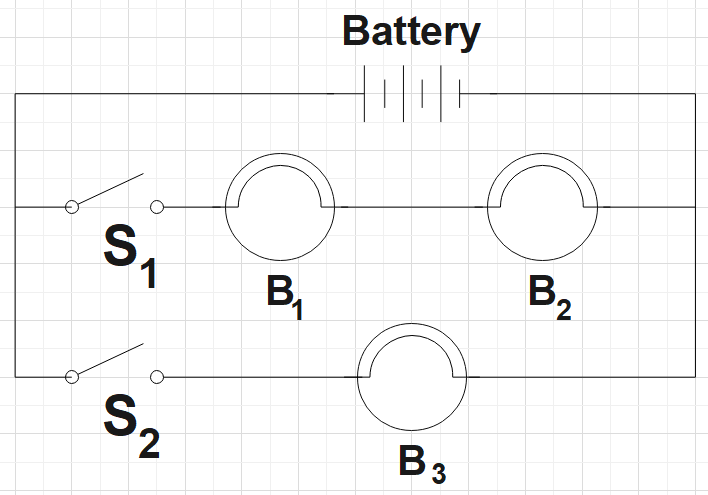
Note: The switch ${{S}_{1}}$is connected exclusively for the bulbs ${{B}_{1}}$and ${{B}_{2}}$. That is switching ON or OFF of this switch doesn’t affect the third bulb ${{B}_{3}}$as the bulb has its own switch ${{S}_{2}}$. The battery provides the same potential difference for every branch as the result of being connected parallel to them.
Complete step-by-step solution: -
In the question, we are asked to draw a circuit diagram with three bulbs and a battery. We are given two conditions. One being that all three bulbs are lit with a single battery given and the second condition is that two of the bulbs should be controlled by a single switch and the third bulb should have its own switch.
For the three bulbs to be controlled by a single battery we could simply connect the battery parallel to all the three bulbs thus satisfying the first condition.
Now for the second condition; we could connect one switch in series to two of the bulbs and another switch in series with the third bulb, thereby satisfying the third condition.
Hence, we get three branches one with the battery, second with two bulbs and a switch and finally we have the third branch with a bulb and a switch.
The required circuit is drawn below.
Note: The switch ${{S}_{1}}$is connected exclusively for the bulbs ${{B}_{1}}$and ${{B}_{2}}$. That is switching ON or OFF of this switch doesn’t affect the third bulb ${{B}_{3}}$as the bulb has its own switch ${{S}_{2}}$. The battery provides the same potential difference for every branch as the result of being connected parallel to them.
Recently Updated Pages
Master Class 12 Business Studies: Engaging Questions & Answers for Success

Master Class 12 Chemistry: Engaging Questions & Answers for Success
Master Class 12 Biology: Engaging Questions & Answers for Success
Class 12 Question and Answer - Your Ultimate Solutions Guide
Master Class 9 General Knowledge: Engaging Questions & Answers for Success
Master Class 9 Maths: Engaging Questions & Answers for Success
Trending doubts
Which are the Top 10 Largest Countries of the World?
Draw a labelled sketch of the human eye class 12 physics CBSE
Name the crygenes that control cotton bollworm and class 12 biology CBSE
Differentiate between homogeneous and heterogeneous class 12 chemistry CBSE
In a transcription unit the promoter is said to be class 12 biology CBSE
Sulphuric acid is known as the king of acids State class 12 chemistry CBSE