




Draw a circuit diagram of an electric circuit containing a cell, a key, an ammeter, a resistor of 4 $\Omega$ in series with a combination of two resistors (8 $\Omega$ each) in parallel and a voltmeter across parallel combination. Each of them dissipates maximum energy and can withstand a maximum power of 16W without melting. Find the maximum current that can flow through the three resistors.
Answer
 Verified
638.7k+ views
Hint We should know that resistors are in the parallel then if their terminals connected to the same two nodes. The equivalent overall resistance is smaller compared to the smallest parallel resistor. Based on this concept we have to solve this question and draw the circuit.
Complete step by step answer:
Here the circuit in which a resistor of resistance 4$\Omega$ is attached in series and two resistors of resistance 8$\Omega$ are attached in parallel. Also, Ammeter and voltmeter attached in the circuit in series and parallel respectively.
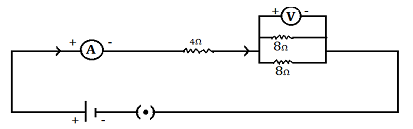
Now, the maximum power of each resistor is 16W
4$\Omega$ resistor is joined in series with the circuit.
So, Power = ${{i}^{2}}R$, here i is current through resistor of resistance R
$16={{i}^{2}}\times 4\Omega$
i = 2A
Now, 2A is passing through parallel resistors of resistance 8$\Omega$.
We know that in parallel potential differences are constant, so the current divides into two parts, due to the same resistance current on each resistance will be half. So, the current passing through each parallel resistor is $\dfrac{2}{2A}=1A$
So, finally current through $4\Omega$ resistor = 2A
Current through each $8\Omega$ resistor = 1A
Note Ammeter is defined as an instrument for the measuring either direct or alternating electric current, in the amperes. An ammeter can measure a wide range of current values because at high values only a small portion of the current is directed through the meter mechanism. A shunt resistance in the parallel connection with the meters carries the major portion.
Complete step by step answer:
Here the circuit in which a resistor of resistance 4$\Omega$ is attached in series and two resistors of resistance 8$\Omega$ are attached in parallel. Also, Ammeter and voltmeter attached in the circuit in series and parallel respectively.
Now, the maximum power of each resistor is 16W
4$\Omega$ resistor is joined in series with the circuit.
So, Power = ${{i}^{2}}R$, here i is current through resistor of resistance R
$16={{i}^{2}}\times 4\Omega$
i = 2A
Now, 2A is passing through parallel resistors of resistance 8$\Omega$.
We know that in parallel potential differences are constant, so the current divides into two parts, due to the same resistance current on each resistance will be half. So, the current passing through each parallel resistor is $\dfrac{2}{2A}=1A$
So, finally current through $4\Omega$ resistor = 2A
Current through each $8\Omega$ resistor = 1A
Note Ammeter is defined as an instrument for the measuring either direct or alternating electric current, in the amperes. An ammeter can measure a wide range of current values because at high values only a small portion of the current is directed through the meter mechanism. A shunt resistance in the parallel connection with the meters carries the major portion.
Recently Updated Pages
Basicity of sulphurous acid and sulphuric acid are

Master Class 12 Economics: Engaging Questions & Answers for Success
Master Class 12 Biology: Engaging Questions & Answers for Success
Master Class 11 English: Engaging Questions & Answers for Success
Master Class 11 Physics: Engaging Questions & Answers for Success
Master Class 11 Computer Science: Engaging Questions & Answers for Success
Trending doubts
Draw a labelled sketch of the human eye class 12 physics CBSE
The chemical formula of tear gas is A CO Cl 2 B C 10 class 12 chemistry CBSE
Draw ray diagrams each showing i myopic eye and ii class 12 physics CBSE
Which are the Top 10 Largest Countries of the World?
Differentiate between homogeneous and heterogeneous class 12 chemistry CBSE
Which is the correct genotypic ratio of mendel dihybrid class 12 biology CBSE