




Draw a circle with centre O and radius 6cm. take a point P outside the circle at a distance of 10cm from O. Draw tangents to the circle from the point P. let the tangents intersect the circle in points A and B, Find BP.
A) 6cm
B) 8cm
C) 8.5cm
D) None of these
Answer
 Verified
640.2k+ views
Hint: To find the value of BP, we’ll first take the help of the property of tangent that it is always perpendicular to the radius of the circle at the point of tangency.
Now, we’ll apply the Pythagoras theorem on the triangle that has BP as it’s one of the sides, using this we’ll get the value of BP as required.
Complete step by step solution: Given data: $radius(r) = 6cm$ and $PO = 10cm$
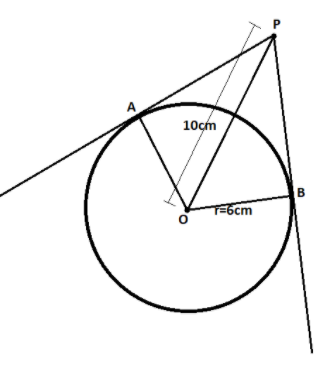
We know that tangents made from any outside point to a circle are always perpendicular to the radius of the circle at the point of tangency.
Therefore we can say that $OB \bot PB$
It is well known that if in triangle LMN $\angle L = {90^ \circ }$ then $M{N^2} = L{M^2} + L{N^2}$
And this is known as Pythagoras theorem
Now, using Pythagoras theorem in triangle PBO as $\angle B = {90^ \circ }$
$ \Rightarrow P{O^2} = O{B^2} + P{B^2}$
Now substituting the value of PO and radius as OB
$ \Rightarrow {10^2} = {6^2} + P{B^2}$
$ \Rightarrow P{B^2} = {10^2} - {6^2}$
Solving the right-hand expression
$ \Rightarrow P{B^2} = 100 - 36$
$ \Rightarrow P{B^2} = 64$
Taking square root on both sides
$\therefore PB = 8cm$
Option(B) is correct.
Note: Here we have given the tangent of the circle, so let us discuss some properties related to the tangent of a circle.
1) A tangent of a circle always touches the circle at a single point.
2) Tangent is always perpendicular to the radius made at the point of tangency.
3) The length of two tangents drawn to a single point to a circle is always equal.
Now, we’ll apply the Pythagoras theorem on the triangle that has BP as it’s one of the sides, using this we’ll get the value of BP as required.
Complete step by step solution: Given data: $radius(r) = 6cm$ and $PO = 10cm$
We know that tangents made from any outside point to a circle are always perpendicular to the radius of the circle at the point of tangency.
Therefore we can say that $OB \bot PB$
It is well known that if in triangle LMN $\angle L = {90^ \circ }$ then $M{N^2} = L{M^2} + L{N^2}$
And this is known as Pythagoras theorem
Now, using Pythagoras theorem in triangle PBO as $\angle B = {90^ \circ }$
$ \Rightarrow P{O^2} = O{B^2} + P{B^2}$
Now substituting the value of PO and radius as OB
$ \Rightarrow {10^2} = {6^2} + P{B^2}$
$ \Rightarrow P{B^2} = {10^2} - {6^2}$
Solving the right-hand expression
$ \Rightarrow P{B^2} = 100 - 36$
$ \Rightarrow P{B^2} = 64$
Taking square root on both sides
$\therefore PB = 8cm$
Option(B) is correct.
Note: Here we have given the tangent of the circle, so let us discuss some properties related to the tangent of a circle.
1) A tangent of a circle always touches the circle at a single point.
2) Tangent is always perpendicular to the radius made at the point of tangency.
3) The length of two tangents drawn to a single point to a circle is always equal.
Recently Updated Pages
Master Class 10 Computer Science: Engaging Questions & Answers for Success

Master Class 10 Social Science: Engaging Questions & Answers for Success
Master Class 10 Science: Engaging Questions & Answers for Success
Class 10 Question and Answer - Your Ultimate Solutions Guide
Master Class 10 Maths: Engaging Questions & Answers for Success
Master Class 10 English: Engaging Questions & Answers for Success
Trending doubts
What is the Total Duration of Football Match?
Explain the Treaty of Vienna of 1815 class 10 social science CBSE
In football, which nation is called "La Roja"?
10 examples of evaporation in daily life with explanations
What is the full form of POSCO class 10 social science CBSE
Define Potential, Developed, Stock and Reserved resources