




Draw a circle of radius 6 cm from a point 10 cm away from its centre, construct the pair of tangents to the circle and measure their lengths.
Answer
 Verified
636k+ views
Hint: Try to do the construction step wise by first constructing the circle and then the pair of tangents with respect to the lengths given.
Complete step-by-step answer:
We can perform asked construction as follows:
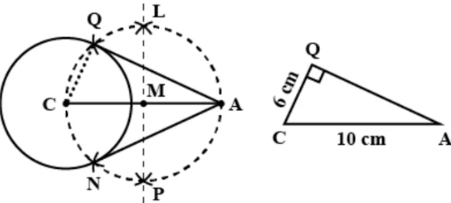
First of all, we’ll construct a circle of 6 cm radius with the help of a compass.
Name the centre as C.
Locate a point A which should be 10 cm away from the centre C.
Draw a perpendicular line bisecting the line, joining points C and A. Let’s name this mid-point as M.
Now, draw another circle with centre at M and radius 5 cm which is nothing but $\dfrac{{AC}}{2}$ .
Let’s say this new circle cuts the previous circle at points N and Q then draw the lines AQ and AN, which are our external tangents.
Since, $\vartriangle CQA$ is right angle triangle at $\angle CQA$ , let’s use the Pythagoras theorem
$
\Rightarrow {(CQ)^2} + {(QA)^2} = {(CA)^2} \\
\Rightarrow {(QA)^2} = {(CA)^2} - {(CQ)^2} \\
\Rightarrow {(QA)^2} = {(10)^2} - {(6)^2} \\
\Rightarrow {(QA)^2} = 100 - 36 \\
\Rightarrow {(QA)^2} = 64 \\
\Rightarrow QA = 8 \\
$
Hence, the length of the tangent is 8 cm.
Note: Here, while taking the square root of QA we have considered only positive signs. One can think why is it so? Why only positive signs? It’s because the reason that QA is a line segment which has its own length and length can’t be negative.
Complete step-by-step answer:
We can perform asked construction as follows:
First of all, we’ll construct a circle of 6 cm radius with the help of a compass.
Name the centre as C.
Locate a point A which should be 10 cm away from the centre C.
Draw a perpendicular line bisecting the line, joining points C and A. Let’s name this mid-point as M.
Now, draw another circle with centre at M and radius 5 cm which is nothing but $\dfrac{{AC}}{2}$ .
Let’s say this new circle cuts the previous circle at points N and Q then draw the lines AQ and AN, which are our external tangents.
Since, $\vartriangle CQA$ is right angle triangle at $\angle CQA$ , let’s use the Pythagoras theorem
$
\Rightarrow {(CQ)^2} + {(QA)^2} = {(CA)^2} \\
\Rightarrow {(QA)^2} = {(CA)^2} - {(CQ)^2} \\
\Rightarrow {(QA)^2} = {(10)^2} - {(6)^2} \\
\Rightarrow {(QA)^2} = 100 - 36 \\
\Rightarrow {(QA)^2} = 64 \\
\Rightarrow QA = 8 \\
$
Hence, the length of the tangent is 8 cm.
Note: Here, while taking the square root of QA we have considered only positive signs. One can think why is it so? Why only positive signs? It’s because the reason that QA is a line segment which has its own length and length can’t be negative.
Recently Updated Pages
Master Class 12 Business Studies: Engaging Questions & Answers for Success

Master Class 12 Biology: Engaging Questions & Answers for Success
Master Class 12 Chemistry: Engaging Questions & Answers for Success
Class 12 Question and Answer - Your Ultimate Solutions Guide
Master Class 11 Social Science: Engaging Questions & Answers for Success
Master Class 11 English: Engaging Questions & Answers for Success
Trending doubts
Explain the Treaty of Vienna of 1815 class 10 social science CBSE
Which Indian city is known as the "City of Victory"?
Which instrument is used to measure the Blood Pressure?
Who Won 36 Oscar Awards? Record Holder Revealed
What is the median of the first 10 natural numbers class 10 maths CBSE
Why is it 530 pm in india when it is 1200 afternoon class 10 social science CBSE