




Draw a circle of radius 6 cm. Draw its diameter and name it AB. Using compasses and ruler, construct the perpendicular bisector of AB. Does it pass through the center of the circle?
Answer
 Verified
614.4k+ views
Hint: Perpendicular bisector of any chord of a circle will pass through the center of the circle. The perpendicular bisector of any chord of a circle must pass through the center of that circle where a circle is a shape consisting of all the points that are at equidistant from a given point, and it can also be defined as a closed, two-dimensional curved shape.
In this question it is asked to draw a circle with a radius of 6 cm, hence use a ruler to draw a diameter AB to take it as a base and then use a compass to bisect the diameter to draw a perpendicular bisector.
Complete step by step solution:
Given the radius of the circle 6 cm.
Step 1: Use a ruler and compass and set the compass at 6 cm to draw a circle of radius 6 cm.
Step 2: Now draw a line passing through the center and joining at the endpoint of the circle at both sides, mark it as AB, which will be the diameter of the circle.
Step 3: Now place the compass at one end of line segment AB and adjust the compass slightly more than the half of the line segment and draw an arc above and below the line.
Step 4: Now draw a line PQ joining both the arc above and below of line segment AB.
Hence the line PQ will be our required line which will be the perpendicular bisector of AB.
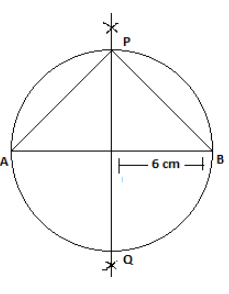
Thus PQ bisects the diameter of a circle.
Hence it passes through the center of the circle.
Note: Students should be aware while using different plotting (or measuring) instruments. If any error even in centi-meters is there while plotting then, your sketch could not be considered as appropriate.
In this question it is asked to draw a circle with a radius of 6 cm, hence use a ruler to draw a diameter AB to take it as a base and then use a compass to bisect the diameter to draw a perpendicular bisector.
Complete step by step solution:
Given the radius of the circle 6 cm.
Step 1: Use a ruler and compass and set the compass at 6 cm to draw a circle of radius 6 cm.
Step 2: Now draw a line passing through the center and joining at the endpoint of the circle at both sides, mark it as AB, which will be the diameter of the circle.
Step 3: Now place the compass at one end of line segment AB and adjust the compass slightly more than the half of the line segment and draw an arc above and below the line.
Step 4: Now draw a line PQ joining both the arc above and below of line segment AB.
Hence the line PQ will be our required line which will be the perpendicular bisector of AB.
Thus PQ bisects the diameter of a circle.
Hence it passes through the center of the circle.
Note: Students should be aware while using different plotting (or measuring) instruments. If any error even in centi-meters is there while plotting then, your sketch could not be considered as appropriate.
Recently Updated Pages
Master Class 10 English: Engaging Questions & Answers for Success

Master Class 10 Social Science: Engaging Questions & Answers for Success
Master Class 10 Computer Science: Engaging Questions & Answers for Success
Class 10 Question and Answer - Your Ultimate Solutions Guide
Master Class 10 General Knowledge: Engaging Questions & Answers for Success
Master Class 10 Maths: Engaging Questions & Answers for Success
Trending doubts
What is the full form of NDA a National Democratic class 10 social science CBSE
Bharatiya Janata Party was founded in the year A 1979 class 10 social science CBSE
What is meant by the term constituency A Place where class 10 social science CBSE
The highest temperature in Karnataka is recorded in class 10 social science CBSE
Fill the blanks with proper collective nouns 1 A of class 10 english CBSE
What is the "grid" in Formula 1 racing?