




Draw a circle of radius 5cm. From a point 8cm away from the centre, construct two tangents to the circle. Measure them. ( write the steps of construction )
Answer
 Verified
666k+ views
Hint: Tangent is that line of a circle that touches at a circle on exactly one point but it never enters the interior circle. Here we must know that the radius and tangent are always perpendicular to each other
Complete step-by-step answer:
Now let us solve this construction problem step by step so that we will understand it properly.
And for that we had to name the centre of circles so let us assume that the circle with radius 5cm centre as P and the circle with radius 8cm centre as Q.
Step 1. First of all, let us draw a circle of radius 5cm ( centre P ) with the help of a compass.
Step 2. Now mark a point outside the circle named Q and remember that the distance of Q from the centre P must be 8cm.
Step 3. Mark an arc from point P and Q to draw a perpendicular bisector of line segment PQ. And then mark the midpoint ( A ) of PQ.
Step 4. Now draw a circle which has A as its centre and AP as its radius and that circle must intersect the circle with P at some points ( let say M and N ).
Step 5. Now join the point that we had taken outside the circle with the intersecting points ( i.e. join QM and QN ).
And so the QM and QN are the required tangents.
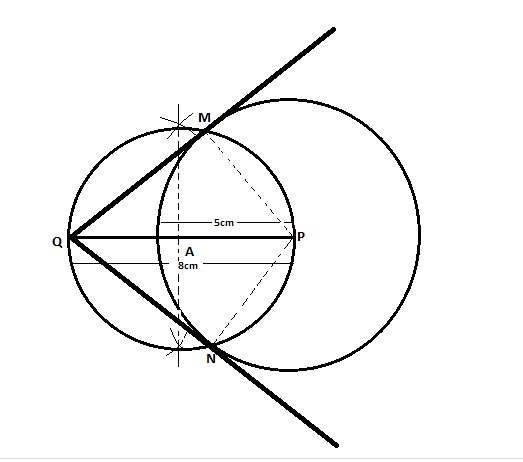
Now we had to measure the tangents QM and QN.
If we join PM and PN so it is equal radius of circle with centre P and as we know that radius of circle is always perpendicular to the tangents so \[QM \bot PM\]and \[QN \bot PN\] and we also know that QP = 8cm
So, now applying Pythagoras theorem in \[\vartriangle PQM\]
\[Q{P^2} = P{M^2} + M{Q^2}\]
\[ \Rightarrow {8^2} = {5^2} + M{Q^2}\]
So, \[ \Rightarrow MQ = \sqrt {{8^2} - {5^2}} = \sqrt {64 - 25} = \sqrt {39} = 6.2cm\]
Hence the tangent MQ = NQ = 6.2cm.
Note:Whenever we had to construct such a type of diagram we must look at the perpendicular bisector of the centre of the circle and the exterior point that we had taken. And with the midpoint of that perpendicular bisector we had to draw another circle and only then we will be able to draw or construct the tangents because the tangents must be from the exterior point that we had taken earlier and also must touch the intersecting points of both the circles.
Complete step-by-step answer:
Now let us solve this construction problem step by step so that we will understand it properly.
And for that we had to name the centre of circles so let us assume that the circle with radius 5cm centre as P and the circle with radius 8cm centre as Q.
Step 1. First of all, let us draw a circle of radius 5cm ( centre P ) with the help of a compass.
Step 2. Now mark a point outside the circle named Q and remember that the distance of Q from the centre P must be 8cm.
Step 3. Mark an arc from point P and Q to draw a perpendicular bisector of line segment PQ. And then mark the midpoint ( A ) of PQ.
Step 4. Now draw a circle which has A as its centre and AP as its radius and that circle must intersect the circle with P at some points ( let say M and N ).
Step 5. Now join the point that we had taken outside the circle with the intersecting points ( i.e. join QM and QN ).
And so the QM and QN are the required tangents.
Now we had to measure the tangents QM and QN.
If we join PM and PN so it is equal radius of circle with centre P and as we know that radius of circle is always perpendicular to the tangents so \[QM \bot PM\]and \[QN \bot PN\] and we also know that QP = 8cm
So, now applying Pythagoras theorem in \[\vartriangle PQM\]
\[Q{P^2} = P{M^2} + M{Q^2}\]
\[ \Rightarrow {8^2} = {5^2} + M{Q^2}\]
So, \[ \Rightarrow MQ = \sqrt {{8^2} - {5^2}} = \sqrt {64 - 25} = \sqrt {39} = 6.2cm\]
Hence the tangent MQ = NQ = 6.2cm.
Note:Whenever we had to construct such a type of diagram we must look at the perpendicular bisector of the centre of the circle and the exterior point that we had taken. And with the midpoint of that perpendicular bisector we had to draw another circle and only then we will be able to draw or construct the tangents because the tangents must be from the exterior point that we had taken earlier and also must touch the intersecting points of both the circles.
Recently Updated Pages
Write any three differences between metals and nonmetals class 10 social science CBSE

Amit standing on a horizontal plane finds a bird flying class 10 maths CBSE
Two circles of radii 5 cm and 3 cm intersect at two class 10 maths CBSE
Solve the following i John and Jivanti together have class 10 maths CBSE
What is the relation between orthocenter circumcentre class 10 maths CBSE
Two plane mirrors are inclined at 70circ A ray incident class 10 physics CBSE
Trending doubts
Explain the Treaty of Vienna of 1815 class 10 social science CBSE
Which country is known as "The land of Fire and Ice"?
1 GB equals how many MB?
10 examples of evaporation in daily life with explanations
What is the full form of POSCO class 10 social science CBSE
Which is the hottest planet in the Solar system A Earth class 10 social science CBSE