




Draw a circle of radius $3cm$ . Take two points $P$ and $Q$ on one of its extended diameters each at a distance of $7cm$ from its centre. Draw tangents to the circle from these two points $P$ and $Q$ . Give justification of the construction.
Answer
 Verified
501.9k+ views
Hint: In this question, we first need to construct a circle of radius $3cm$ , then take two points on any of its diameters and mark them on each side, namely, $P$ and $Q$ , at a distance of $7cm$ .
Then, we will find the perpendicular bisectors of the line segments $PO$ and $OQ$ , and draw a circle with the points where it intersects the line segments as centers. Now, these circles will cut the older circles at four points, mark them and join those points with $P$ and $Q$ .
Complete answer:
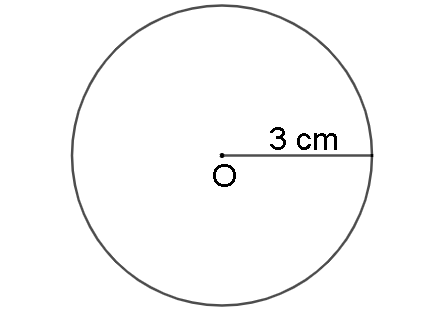
First, mark a point $O$ and draw a circle of radius $3cm$ , taking $O$ as the center.
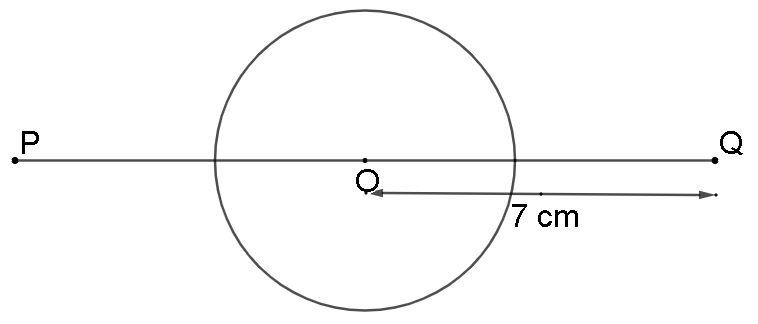
Now, we will take any diameter of this circle and extend outwards by $7cm$ from the center from both directions.
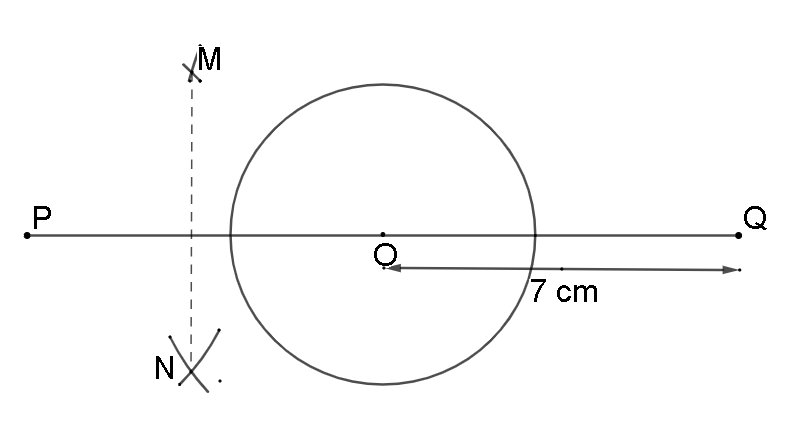
Now, we have to draw tangents, from these two points to the circle, so for that, we draw perpendicular bisector of the line segment $PO$ . For that, first, open the compass mare than half of the line segment and mark an arc above and below by keeping the compass tip first on the point $P$ and then on the point $O$ . Then, join the two points $M$ and $N$ .
Perform, same steps for the line segment $QO$ , we get,
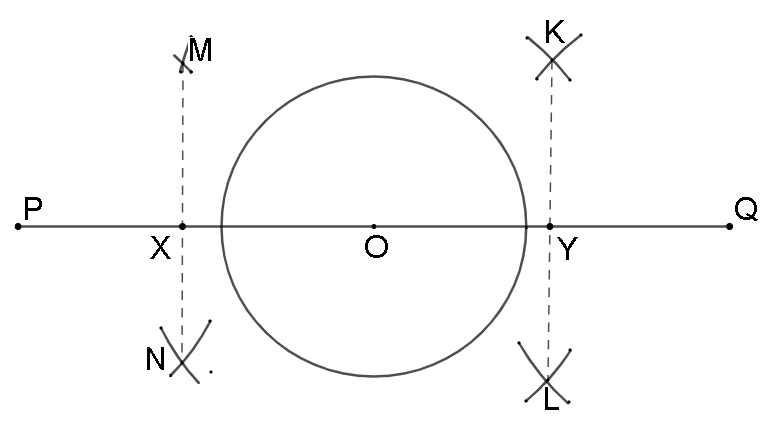
Now, taking $X$ and $Y$ as centers, draw two circles and mark the points where it cuts the older circle as $A,B,C,D$ , which gives,
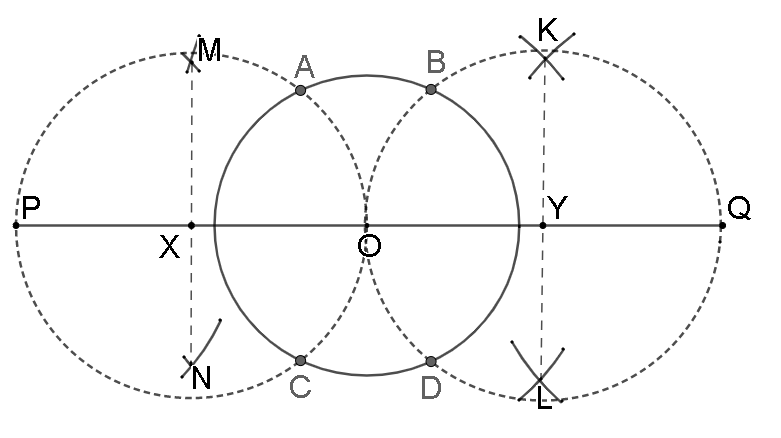
Now, finally join the point $P$ with $A$ and $C$ and point $Q$ with $B$ and $D$ , the figure becomes,
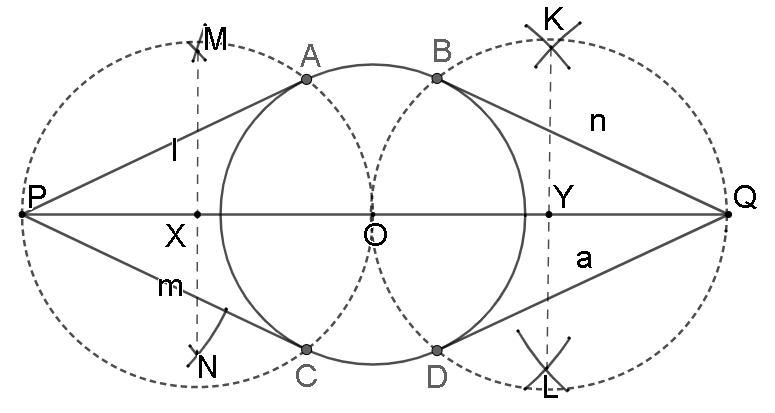
Hence, $PA,PC,QB,QD$ are the required tangents.
Note:
Perpendicular bisector to a line segment is the perpendicular line which cuts the line segment into two halves.
Remember that we do not have to find the perpendicular bisector of the line segment $PQ$ , but we have to find the different perpendicular bisectors of the line segments $PO$ and $OQ$ .
In this question, the perpendicular bisector will not touch the older circle as half of $7cm$ i.e., $3.5cm$ is greater than the radius of the circle.
Then, we will find the perpendicular bisectors of the line segments $PO$ and $OQ$ , and draw a circle with the points where it intersects the line segments as centers. Now, these circles will cut the older circles at four points, mark them and join those points with $P$ and $Q$ .
Complete answer:
First, mark a point $O$ and draw a circle of radius $3cm$ , taking $O$ as the center.
Now, we will take any diameter of this circle and extend outwards by $7cm$ from the center from both directions.
Now, we have to draw tangents, from these two points to the circle, so for that, we draw perpendicular bisector of the line segment $PO$ . For that, first, open the compass mare than half of the line segment and mark an arc above and below by keeping the compass tip first on the point $P$ and then on the point $O$ . Then, join the two points $M$ and $N$ .
Perform, same steps for the line segment $QO$ , we get,
Now, taking $X$ and $Y$ as centers, draw two circles and mark the points where it cuts the older circle as $A,B,C,D$ , which gives,
Now, finally join the point $P$ with $A$ and $C$ and point $Q$ with $B$ and $D$ , the figure becomes,
Hence, $PA,PC,QB,QD$ are the required tangents.
Note:
Perpendicular bisector to a line segment is the perpendicular line which cuts the line segment into two halves.
Remember that we do not have to find the perpendicular bisector of the line segment $PQ$ , but we have to find the different perpendicular bisectors of the line segments $PO$ and $OQ$ .
In this question, the perpendicular bisector will not touch the older circle as half of $7cm$ i.e., $3.5cm$ is greater than the radius of the circle.
Recently Updated Pages
Master Class 12 Business Studies: Engaging Questions & Answers for Success

Master Class 12 Biology: Engaging Questions & Answers for Success
Master Class 12 Chemistry: Engaging Questions & Answers for Success
Class 12 Question and Answer - Your Ultimate Solutions Guide
Master Class 11 Social Science: Engaging Questions & Answers for Success
Master Class 11 English: Engaging Questions & Answers for Success
Trending doubts
Explain the Treaty of Vienna of 1815 class 10 social science CBSE
Which Indian city is known as the "City of Victory"?
Which instrument is used to measure the Blood Pressure?
Who Won 36 Oscar Awards? Record Holder Revealed
What is the median of the first 10 natural numbers class 10 maths CBSE
Why is it 530 pm in india when it is 1200 afternoon class 10 social science CBSE