




What is the domain and range of \[y=\dfrac{3}{x}\]?
Answer
 Verified
560.1k+ views
Hint: We are given with \[y=\dfrac{3}{x}\] which means that it has a variable in the denominator. To compute the domain and range of a function with a variable in the denominator, we must set the denominator equal to zero and then we have to exclude \[x\], we get an equation to be solved.
Complete step by step solution:
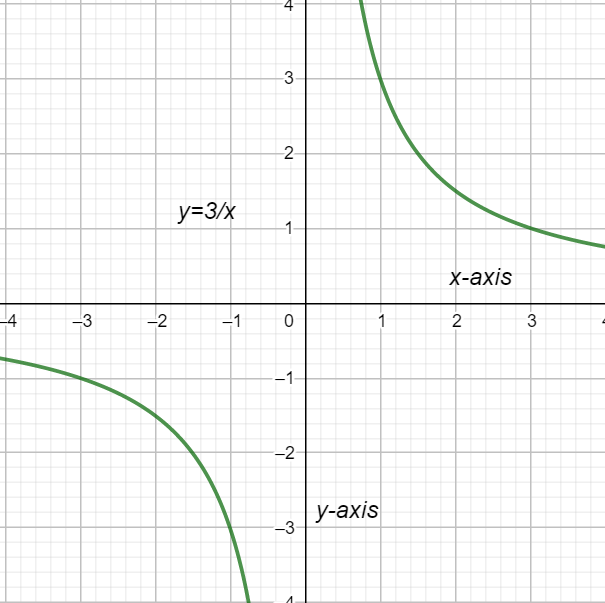
Now let us have a brief regarding the range and domain of functions. The domain means the set of possible input values. The graph of a domain consists of all the values that are shown upon the \[x-axis\]. The range is nothing but the set of possible output values. The graph of range consists of values that are represented upon the \[y-axis\]. We can find the domain and range by using graphs since both of them contain the required values that are to be plotted.
Now let us start finding the domain \[y=\dfrac{3}{x}\].
While finding the domain, we shall not divide by \[0\] because it will give undefined value of y.
Since \[y\] is defined \[\forall x\in R:x\ne 0\]
\[R-\left\{ 0 \right\}\]
\[\therefore \]The domain of \[y=\dfrac{3}{x}\] would be \[\left( -\infty ,0 \right)\cup \left( 0,+\infty \right)\]
Now let us find the range of \[y=\dfrac{3}{x}\].
Let us consider that-
\[\begin{align}
& \underset{x>0-}{\mathop{\lim }}\,y=-\infty \\
& \underset{x<0+}{\mathop{\lim }}\,=+\infty \\
\end{align}\]
\[\therefore \] The range of \[y=\dfrac{3}{x}\] is \[\left( -\infty ,+\infty \right)\]
Note: The rule of the domain is that if a function contains a square root, we must set the equation inside the square root greater or equal to zero and solve. The resulting answer would be the domain. If the function contains a fraction, set the denominator not equal to zero. By solving this, we obtain the domain.
The graph of \[y=\dfrac{3}{x}\] is
Complete step by step solution:
Now let us have a brief regarding the range and domain of functions. The domain means the set of possible input values. The graph of a domain consists of all the values that are shown upon the \[x-axis\]. The range is nothing but the set of possible output values. The graph of range consists of values that are represented upon the \[y-axis\]. We can find the domain and range by using graphs since both of them contain the required values that are to be plotted.
Now let us start finding the domain \[y=\dfrac{3}{x}\].
While finding the domain, we shall not divide by \[0\] because it will give undefined value of y.
Since \[y\] is defined \[\forall x\in R:x\ne 0\]
\[R-\left\{ 0 \right\}\]
\[\therefore \]The domain of \[y=\dfrac{3}{x}\] would be \[\left( -\infty ,0 \right)\cup \left( 0,+\infty \right)\]
Now let us find the range of \[y=\dfrac{3}{x}\].
Let us consider that-
\[\begin{align}
& \underset{x>0-}{\mathop{\lim }}\,y=-\infty \\
& \underset{x<0+}{\mathop{\lim }}\,=+\infty \\
\end{align}\]
\[\therefore \] The range of \[y=\dfrac{3}{x}\] is \[\left( -\infty ,+\infty \right)\]
Note: The rule of the domain is that if a function contains a square root, we must set the equation inside the square root greater or equal to zero and solve. The resulting answer would be the domain. If the function contains a fraction, set the denominator not equal to zero. By solving this, we obtain the domain.
The graph of \[y=\dfrac{3}{x}\] is
Recently Updated Pages
Master Class 12 Economics: Engaging Questions & Answers for Success

Master Class 12 English: Engaging Questions & Answers for Success
Master Class 12 Social Science: Engaging Questions & Answers for Success
Master Class 12 Maths: Engaging Questions & Answers for Success
Master Class 12 Physics: Engaging Questions & Answers for Success
Master Class 9 General Knowledge: Engaging Questions & Answers for Success
Trending doubts
Which are the Top 10 Largest Countries of the World?
Draw a labelled sketch of the human eye class 12 physics CBSE
Differentiate between homogeneous and heterogeneous class 12 chemistry CBSE
Why is the cell called the structural and functional class 12 biology CBSE
Draw ray diagrams each showing i myopic eye and ii class 12 physics CBSE
Which is the correct genotypic ratio of mendel dihybrid class 12 biology CBSE