




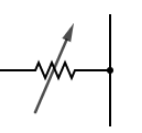
What does this symbol mean in electrical circuits?
A. Rheostat
B. Battery
C. Capacitor
D. Inductance
Answer
 Verified
534.3k+ views
Hint:In order to solve this question we need to understand electric circuits. An electrical circuit contains various electrical components which are used to have a control on electrical devices, for example a switch used in an electrical circuit is used to have a check on current. In this question we will discuss every component one by one and then will determine the correct answer.
Complete step by step answer:
Let’s start explaining each of the options.So first a rheostat, rheostat is an electrical device that is used to vary the direct voltage or DC voltage across circuits. It is used in various experiments, one of such is LED experiment where we need to vary intensity of light and also anode voltage so that we can calculate photoelectric current.Given symbol in question is the rheostat symbol.
Second is battery, A battery is an electrical device that is used to supply the required DC voltage in circuit. Inside a battery there are two plates on which potential difference is created due to which current flows.
Third is Capacitor, A capacitor is an electrical device that is used to store energy in the form of charge. It has two plates one is positively charged and other is negatively charged.
Fourth is an inductor, an inductor is an electrical device that is used to store electrical energy in the form of a magnetic field. It works on principle of Faraday's law of electromagnetic induction.
So the correct option is A.
Note:It should be remembered that inductor works on principle of Faraday’s law of electromagnetic induction which states that if flux due to magnetic field changes for a loop then it induces emf in that loop and due to which current flows in loop whose direction is determined from Lenz law, which states that current direction is such that it opposes the cause of its generation.
Complete step by step answer:
Let’s start explaining each of the options.So first a rheostat, rheostat is an electrical device that is used to vary the direct voltage or DC voltage across circuits. It is used in various experiments, one of such is LED experiment where we need to vary intensity of light and also anode voltage so that we can calculate photoelectric current.Given symbol in question is the rheostat symbol.
Second is battery, A battery is an electrical device that is used to supply the required DC voltage in circuit. Inside a battery there are two plates on which potential difference is created due to which current flows.
Third is Capacitor, A capacitor is an electrical device that is used to store energy in the form of charge. It has two plates one is positively charged and other is negatively charged.
Fourth is an inductor, an inductor is an electrical device that is used to store electrical energy in the form of a magnetic field. It works on principle of Faraday's law of electromagnetic induction.
So the correct option is A.
Note:It should be remembered that inductor works on principle of Faraday’s law of electromagnetic induction which states that if flux due to magnetic field changes for a loop then it induces emf in that loop and due to which current flows in loop whose direction is determined from Lenz law, which states that current direction is such that it opposes the cause of its generation.
Recently Updated Pages
Master Class 12 Economics: Engaging Questions & Answers for Success

Master Class 12 English: Engaging Questions & Answers for Success
Master Class 12 Social Science: Engaging Questions & Answers for Success
Master Class 12 Maths: Engaging Questions & Answers for Success
Master Class 12 Physics: Engaging Questions & Answers for Success
Master Class 9 General Knowledge: Engaging Questions & Answers for Success
Trending doubts
Explain the Treaty of Vienna of 1815 class 10 social science CBSE
Why is it 530 pm in india when it is 1200 afternoon class 10 social science CBSE
What is the full form of POSCO class 10 social science CBSE
Define Potential, Developed, Stock and Reserved resources
Which Country Has the Largest Border with India?
Complete the sentence with the most appropriate word class 10 english CBSE