




How does the moon accelerate as it orbits the earth?
Answer
 Verified
549.6k+ views
Hint: When an object moves in a circle at a constant speed, its direction constantly changes. A change in direction causes a change in velocity. This is because velocity is a vector quantity - it has an associated direction as well as a magnitude. A change in velocity results in acceleration, so an object moving in a circle is accelerating even though its speed may be constant.
Complete step by step answer:
Acceleration, in a physics format, does not necessarily mean that something is moving faster and faster - it also relates to a change in direction.
With the moon's orbit (and in fact any orbit, including Earth's orbit of the Sun), there are two competing forces: the force of gravity and inertia. The combined motions create the motion of the blue line in the diagram - the orbital path (which, in essence, is the falling of the object in orbit but never landing).
With the orbit being a circle, the velocity of the object is continually changing, and so the Moon experiences continual acceleration.
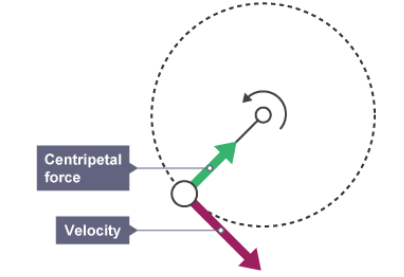
An object will only accelerate if a resultant force acts on it. For an object moving in a circle, this resultant force is the centripetal force that acts towards the middle of the circle.
Note:
Gravitational attraction provides the centripetal force needed to keep planets in orbit around the Sun and all types of satellites in orbit around the Earth. The Earth's gravity keeps the Moon orbiting us. It keeps changing the direction of the Moon's velocity. This means gravity makes the Moon accelerate all the time, even though its speed remains constant.
Complete step by step answer:
Acceleration, in a physics format, does not necessarily mean that something is moving faster and faster - it also relates to a change in direction.
With the moon's orbit (and in fact any orbit, including Earth's orbit of the Sun), there are two competing forces: the force of gravity and inertia. The combined motions create the motion of the blue line in the diagram - the orbital path (which, in essence, is the falling of the object in orbit but never landing).
With the orbit being a circle, the velocity of the object is continually changing, and so the Moon experiences continual acceleration.
An object will only accelerate if a resultant force acts on it. For an object moving in a circle, this resultant force is the centripetal force that acts towards the middle of the circle.
Note:
Gravitational attraction provides the centripetal force needed to keep planets in orbit around the Sun and all types of satellites in orbit around the Earth. The Earth's gravity keeps the Moon orbiting us. It keeps changing the direction of the Moon's velocity. This means gravity makes the Moon accelerate all the time, even though its speed remains constant.
Recently Updated Pages
Master Class 11 English: Engaging Questions & Answers for Success

Master Class 11 Maths: Engaging Questions & Answers for Success
Class 11 Question and Answer - Your Ultimate Solutions Guide
Master Class 11 Biology: Engaging Questions & Answers for Success
Master Class 11 Physics: Engaging Questions & Answers for Success
Master Class 11 Accountancy: Engaging Questions & Answers for Success
Trending doubts
Differentiate between an exothermic and an endothermic class 11 chemistry CBSE
One Metric ton is equal to kg A 10000 B 1000 C 100 class 11 physics CBSE
There are 720 permutations of the digits 1 2 3 4 5 class 11 maths CBSE
In what year Guru Nanak Dev ji was born A15 April 1469 class 11 social science CBSE
Difference Between Prokaryotic Cells and Eukaryotic Cells
Draw a diagram of a plant cell and label at least eight class 11 biology CBSE