




How does the Mitochondria make energy?
Answer
 Verified
528.3k+ views
Hint: An organelle is a subcellular structure that, like an organ in the body, has one or more specific jobs to perform in the cell. The nuclei, which store genetic information, mitochondria, which produce chemical energy, and ribosomes, which assemble proteins, are among the most important cell organelles.
Complete answer:
In most eukaryotic organisms, a mitochondrion is a double membrane-bound organelle. Mitochondria produce the majority of the cell's adenosine triphosphate (ATP), which is used as a chemical energy source. Kolliker (1880 CE) discovered mitochondria in the voluntary muscles of insects for the first time.
Some multicellular organisms' cells lack mitochondria (for example, mature mammalian red blood cells). Microsporidia, parabasalids, and diplomonads are among the unicellular organisms that have reduced or transformed their mitochondria into other structures.
Mitochondria are known as the cell's powerhouse because they are in charge of extracting energy from food via cellular respiration. Adenosine triphosphate is used to release the energy (ATP). It is the cell's energy currency. Below is a diagram of Mitochondria's structure.
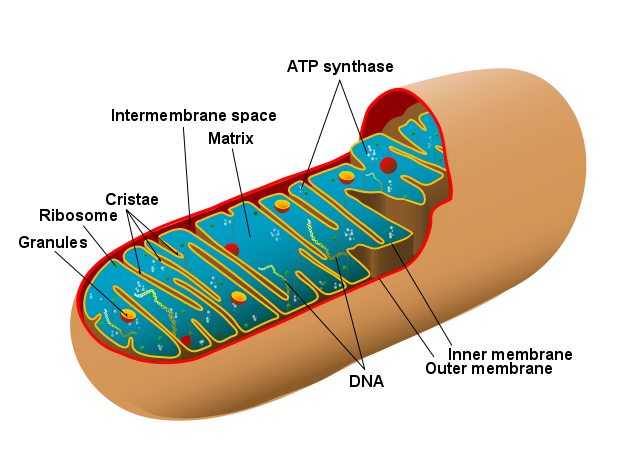
Thus, Mitochondria produce energy as part of the cellular respiration process. Mitochondria are membrane-bound cell organelles found in all eukaryotic cells' cytoplasms. Through cellular respiration, they extract energy from food in the form of ATP (Adenosine Triphosphate). Mitochondria produce energy (ATP) molecules in the cell by oxidizing glucose's major products with the help of specific proteins and enzymes. Therefore, mitochondria are known as the powerhouse of the cell.
Note:
The number of mitochondria in a cell varies dramatically depending on the organism, tissue, and cell type. A mature red blood cell has no mitochondria, whereas a liver cell can have up to 2000 mitochondria. The mitochondrion is divided into compartments that each perform a specific function. The outer membrane, intermembrane space, inner membrane, cristae, and matrix are examples of compartments or regions.
Complete answer:
In most eukaryotic organisms, a mitochondrion is a double membrane-bound organelle. Mitochondria produce the majority of the cell's adenosine triphosphate (ATP), which is used as a chemical energy source. Kolliker (1880 CE) discovered mitochondria in the voluntary muscles of insects for the first time.
Some multicellular organisms' cells lack mitochondria (for example, mature mammalian red blood cells). Microsporidia, parabasalids, and diplomonads are among the unicellular organisms that have reduced or transformed their mitochondria into other structures.
Mitochondria are known as the cell's powerhouse because they are in charge of extracting energy from food via cellular respiration. Adenosine triphosphate is used to release the energy (ATP). It is the cell's energy currency. Below is a diagram of Mitochondria's structure.
Thus, Mitochondria produce energy as part of the cellular respiration process. Mitochondria are membrane-bound cell organelles found in all eukaryotic cells' cytoplasms. Through cellular respiration, they extract energy from food in the form of ATP (Adenosine Triphosphate). Mitochondria produce energy (ATP) molecules in the cell by oxidizing glucose's major products with the help of specific proteins and enzymes. Therefore, mitochondria are known as the powerhouse of the cell.
Note:
The number of mitochondria in a cell varies dramatically depending on the organism, tissue, and cell type. A mature red blood cell has no mitochondria, whereas a liver cell can have up to 2000 mitochondria. The mitochondrion is divided into compartments that each perform a specific function. The outer membrane, intermembrane space, inner membrane, cristae, and matrix are examples of compartments or regions.
Recently Updated Pages
Master Class 11 English: Engaging Questions & Answers for Success

Master Class 11 Social Science: Engaging Questions & Answers for Success
Master Class 11 Maths: Engaging Questions & Answers for Success
Master Class 11 Biology: Engaging Questions & Answers for Success
Master Class 11 Physics: Engaging Questions & Answers for Success
Master Class 11 Chemistry: Engaging Questions & Answers for Success
Trending doubts
One Metric ton is equal to kg A 10000 B 1000 C 100 class 11 physics CBSE
Difference Between Prokaryotic Cells and Eukaryotic Cells
1 ton equals to A 100 kg B 1000 kg C 10 kg D 10000 class 11 physics CBSE
Find the value of the expression given below sin 30circ class 11 maths CBSE
Two of the body parts which do not appear in MRI are class 11 biology CBSE
What are hard magnetic materials class 11 physics CBSE