




What does the metamorphosis of a frog involve?
Answer
 Verified
561.9k+ views
Hint: Frogs are amphibians, which means they spend half of their lives in the ocean and the remainder of their lives on land. Frog metamorphosis is the transition of a fish-like creature with gills and a tail into a semi-aquatic frog. The transition of a frog from a fish-like shape to an adult frog is known as metamorphosis.
Complete answer:
Metamorphosis is a developmental phenomenon in which species, such as butterflies, amphibians, and a few marine animals, experience drastic physical changes shortly after birth. Metamorphosis is a mechanism that replaces an organism's whole body.
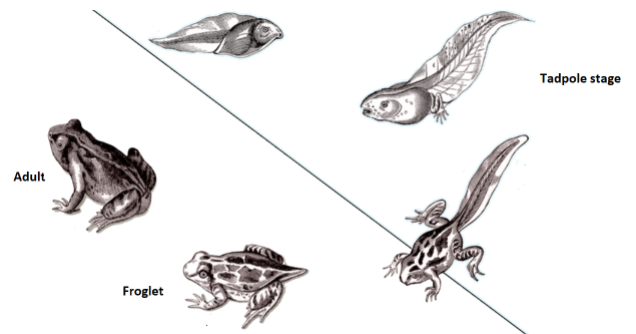
Frogs begin life as eggs that hatch into tadpoles. The tadpole starts swimming and feeding on algae after a week or more. Tadpoles consume plants and digest algae with a long, coiled intestine. They swim in a fish-like manner, with undulating body movements and a tail. Tadpoles have external gills as breathing organs.
Tadpoles lose their gills about four weeks and rely on their lungs to breathe. The hind limbs emerge at six to nine weeks, followed by the forelimbs. The organism may begin to consume insects and other plant matter, and the length of the intestine may shorten. The tail shortens over time, gradually being nothing more than a stub about twelve weeks, and then vanishing completely.
Note:
- Metamorphism is the product of hormonal changes.
- The maturation of enzymes and blood cells, as well as the remodeling of the nervous and digestive systems, are examples of these improvements.
- The hormone thyroxine, which is released by the thyroid gland, regulates metamorphosis in frogs.
Complete answer:
Metamorphosis is a developmental phenomenon in which species, such as butterflies, amphibians, and a few marine animals, experience drastic physical changes shortly after birth. Metamorphosis is a mechanism that replaces an organism's whole body.
Frogs begin life as eggs that hatch into tadpoles. The tadpole starts swimming and feeding on algae after a week or more. Tadpoles consume plants and digest algae with a long, coiled intestine. They swim in a fish-like manner, with undulating body movements and a tail. Tadpoles have external gills as breathing organs.
Tadpoles lose their gills about four weeks and rely on their lungs to breathe. The hind limbs emerge at six to nine weeks, followed by the forelimbs. The organism may begin to consume insects and other plant matter, and the length of the intestine may shorten. The tail shortens over time, gradually being nothing more than a stub about twelve weeks, and then vanishing completely.
Note:
- Metamorphism is the product of hormonal changes.
- The maturation of enzymes and blood cells, as well as the remodeling of the nervous and digestive systems, are examples of these improvements.
- The hormone thyroxine, which is released by the thyroid gland, regulates metamorphosis in frogs.
Recently Updated Pages
Master Class 11 English: Engaging Questions & Answers for Success

Master Class 11 Social Science: Engaging Questions & Answers for Success
Master Class 11 Maths: Engaging Questions & Answers for Success
Master Class 11 Biology: Engaging Questions & Answers for Success
Master Class 11 Physics: Engaging Questions & Answers for Success
Master Class 11 Chemistry: Engaging Questions & Answers for Success
Trending doubts
One Metric ton is equal to kg A 10000 B 1000 C 100 class 11 physics CBSE
Difference Between Prokaryotic Cells and Eukaryotic Cells
1 ton equals to A 100 kg B 1000 kg C 10 kg D 10000 class 11 physics CBSE
Find the value of the expression given below sin 30circ class 11 maths CBSE
Two of the body parts which do not appear in MRI are class 11 biology CBSE
What are hard magnetic materials class 11 physics CBSE