




What does the graph of the seventh root of unity look like on a unit circle?
Answer
 Verified
560.7k+ views
Hint: For calculating the position of seven roots of unity on a unit circle, we will us Euler’s form of complex numbers which is given by
$z=\left| z \right|{{e}^{i\theta }}$
Then we will plot those points on the Argand’s plane and join those points together to get the required figure.
For a complex number z,
$\left| {{z}^{n}} \right|={{\left| z \right|}^{n}}$
For ${{n}^{th}}$ roots of unity of a complex number, each root subtends an angle of $\dfrac{2\pi k}{n}$ at the center.
Complete step by step solution:
We have,
${{z}^{7}}=1$
Taking modulus on both sides,
$\left| {{z}^{7}} \right|=1$
As we know that $\left| {{z}^{n}} \right|={{\left| z \right|}^{n}}$
$\begin{align}
& \Rightarrow {{\left| z \right|}^{7}}=1 \\
& \Rightarrow \left| z \right|=1 \\
\end{align}$ This means that all the seven roots of unity lie on a circle centered at origin and of radius 1 unit. Now, using Euler’s representation for complex numbers,
$z=\left| z \right|{{e}^{i\theta }}$
$z=1\times {{e}^{\dfrac{i\left( 2\pi k \right)}{7}}}$
For different values of k, we will get different roots of unity.
For k=0
$z=1$ , lying on the real axis.
For k=1,
$z={{e}^{\dfrac{i2\pi }{7}}}$ , lying at an angle of $\dfrac{2\pi }{7}$ from the real axis in an anti-clockwise direction.
For k=2,
$z={{e}^{\dfrac{i4\pi }{7}}}$, lying at an angle of $\dfrac{4\pi }{7}$ from the real axis in an anti-clockwise direction.
.
.
.
For k=6,
$z={{e}^{\dfrac{i12\pi }{7}}}$, lying at an angle of $\dfrac{12\pi }{7}$ from the real axis in an anti-clockwise direction.
For k=7, we will return back to the first root of unity lying on the real axis.
Now, plotting these points on the Argand’s plane, we get
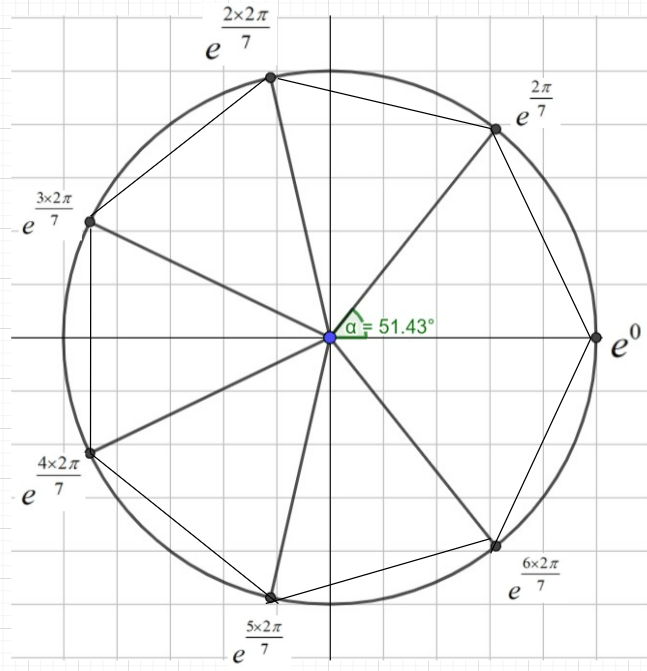
So, on joining the seven roots of unity lying on a circle of unit radius, we get a regular seven-sided polygon.
Note: Each ${{n}^{th}}$ root of unity subtends an equal angle at the center. On joining the roots, we get an n-sided regular polygon. All the n roots of unity always lie on a circle of radius unity. We must remember the formula $z=\left| z \right|{{e}^{i\theta }}$ and not make any mistakes while writing it. If we miss out the terms or add a negative sign, then we will not be able to reach the required results.
$z=\left| z \right|{{e}^{i\theta }}$
Then we will plot those points on the Argand’s plane and join those points together to get the required figure.
For a complex number z,
$\left| {{z}^{n}} \right|={{\left| z \right|}^{n}}$
For ${{n}^{th}}$ roots of unity of a complex number, each root subtends an angle of $\dfrac{2\pi k}{n}$ at the center.
Complete step by step solution:
We have,
${{z}^{7}}=1$
Taking modulus on both sides,
$\left| {{z}^{7}} \right|=1$
As we know that $\left| {{z}^{n}} \right|={{\left| z \right|}^{n}}$
$\begin{align}
& \Rightarrow {{\left| z \right|}^{7}}=1 \\
& \Rightarrow \left| z \right|=1 \\
\end{align}$ This means that all the seven roots of unity lie on a circle centered at origin and of radius 1 unit. Now, using Euler’s representation for complex numbers,
$z=\left| z \right|{{e}^{i\theta }}$
$z=1\times {{e}^{\dfrac{i\left( 2\pi k \right)}{7}}}$
For different values of k, we will get different roots of unity.
For k=0
$z=1$ , lying on the real axis.
For k=1,
$z={{e}^{\dfrac{i2\pi }{7}}}$ , lying at an angle of $\dfrac{2\pi }{7}$ from the real axis in an anti-clockwise direction.
For k=2,
$z={{e}^{\dfrac{i4\pi }{7}}}$, lying at an angle of $\dfrac{4\pi }{7}$ from the real axis in an anti-clockwise direction.
.
.
.
For k=6,
$z={{e}^{\dfrac{i12\pi }{7}}}$, lying at an angle of $\dfrac{12\pi }{7}$ from the real axis in an anti-clockwise direction.
For k=7, we will return back to the first root of unity lying on the real axis.
Now, plotting these points on the Argand’s plane, we get
So, on joining the seven roots of unity lying on a circle of unit radius, we get a regular seven-sided polygon.
Note: Each ${{n}^{th}}$ root of unity subtends an equal angle at the center. On joining the roots, we get an n-sided regular polygon. All the n roots of unity always lie on a circle of radius unity. We must remember the formula $z=\left| z \right|{{e}^{i\theta }}$ and not make any mistakes while writing it. If we miss out the terms or add a negative sign, then we will not be able to reach the required results.
Recently Updated Pages
Master Class 12 Economics: Engaging Questions & Answers for Success

Master Class 12 English: Engaging Questions & Answers for Success
Master Class 12 Social Science: Engaging Questions & Answers for Success
Master Class 12 Maths: Engaging Questions & Answers for Success
Master Class 12 Physics: Engaging Questions & Answers for Success
Master Class 11 Social Science: Engaging Questions & Answers for Success
Trending doubts
One Metric ton is equal to kg A 10000 B 1000 C 100 class 11 physics CBSE
Difference Between Prokaryotic Cells and Eukaryotic Cells
Two of the body parts which do not appear in MRI are class 11 biology CBSE
1 ton equals to A 100 kg B 1000 kg C 10 kg D 10000 class 11 physics CBSE
Draw a diagram of nephron and explain its structur class 11 biology CBSE
10 examples of friction in our daily life