




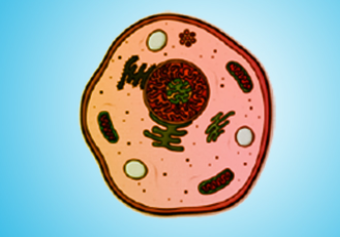
Does the figure represent a plant cell or an animal cell?
(a)Animal cell
(b)Plant cell
(c)Ambiguous
(d)Data insufficient
Answer
 Verified
592.8k+ views
Hint The cell is the fundamental unit of life. All the life functions are carried out through cells. The organisms are divided based on the number of cells present in them. Unicellular organisms are single-celled, while multicellular organisms possess a large number of cells.
Complete answer:
An animal cell is typically irregular and round in shape. This is primarily because of the absence of the cell wall, which is a characteristic feature of plant cells. Furthermore, animal cells don't have plastids as animals aren't autotrophs. The diagram represents the animal cell as it does not contain a cell wall. It also shows a centrally located nucleus and cell membrane as its outer boundary. The diagram doesn't exhibit a cell wall layer and a centrally located vacuole is also absent, which is the characteristics of a plant cell. Both plant and animal cells comprise membrane-bound organelles, such as the endoplasmic reticulum, mitochondria, the nucleus, Golgi apparatus, peroxisomes, lysosomes. They also have the same membranes, like cytoskeletal elements and cytosol. The plant cell could also be bigger than the animal cell.
Additional information:
The cell is the basic structure as well as a functional unit of life. These cells vary in their shapes, sizes, and structure as they need to complete particulars functions. Plant cells and animal cells have some common characteristics as both are eukaryotic cells. However, they differ as animals get to adapt to a more active and non-sedentary lifestyle. Moreover, animals need to acquire their own food, as they do not possess any of the specialized cell organelles like chloroplasts.
Plant cells are the building blocks of plants. Photosynthesis is the key function performed through plant cells. Photosynthesis occurs within the chloroplasts of the plant cell. It is the method of preparing food by the plants, by utilizing sunlight, carbon dioxide, and water. Energy is released within the sort of ATP within the procedure. A few plant cells help within the transport of water and nutrients from the roots and leaves to different parts of the plants.
So, the correct answer is ‘Animal cell’.
Note: Plant cells are eukaryotic cells that vary in various fundamental aspects from other eukaryotic organisms. Both plant and animal cells contain nuclei alongside similar organelles. One of the characteristic aspects of a plant cell is the presence of a cell wall outside the cell membrane. Animal cells are home in size from a couple of microscopic microns to a few millimeters. The largest well-known animal cell is the ostrich egg, which may stretch over 5.1 inches and weigh about 1.4 kilograms. This is in stark contrast to the neuron within the physical body, which is simply 100 microns across.
Complete answer:
An animal cell is typically irregular and round in shape. This is primarily because of the absence of the cell wall, which is a characteristic feature of plant cells. Furthermore, animal cells don't have plastids as animals aren't autotrophs. The diagram represents the animal cell as it does not contain a cell wall. It also shows a centrally located nucleus and cell membrane as its outer boundary. The diagram doesn't exhibit a cell wall layer and a centrally located vacuole is also absent, which is the characteristics of a plant cell. Both plant and animal cells comprise membrane-bound organelles, such as the endoplasmic reticulum, mitochondria, the nucleus, Golgi apparatus, peroxisomes, lysosomes. They also have the same membranes, like cytoskeletal elements and cytosol. The plant cell could also be bigger than the animal cell.
Additional information:
The cell is the basic structure as well as a functional unit of life. These cells vary in their shapes, sizes, and structure as they need to complete particulars functions. Plant cells and animal cells have some common characteristics as both are eukaryotic cells. However, they differ as animals get to adapt to a more active and non-sedentary lifestyle. Moreover, animals need to acquire their own food, as they do not possess any of the specialized cell organelles like chloroplasts.
Plant cells are the building blocks of plants. Photosynthesis is the key function performed through plant cells. Photosynthesis occurs within the chloroplasts of the plant cell. It is the method of preparing food by the plants, by utilizing sunlight, carbon dioxide, and water. Energy is released within the sort of ATP within the procedure. A few plant cells help within the transport of water and nutrients from the roots and leaves to different parts of the plants.
So, the correct answer is ‘Animal cell’.
Note: Plant cells are eukaryotic cells that vary in various fundamental aspects from other eukaryotic organisms. Both plant and animal cells contain nuclei alongside similar organelles. One of the characteristic aspects of a plant cell is the presence of a cell wall outside the cell membrane. Animal cells are home in size from a couple of microscopic microns to a few millimeters. The largest well-known animal cell is the ostrich egg, which may stretch over 5.1 inches and weigh about 1.4 kilograms. This is in stark contrast to the neuron within the physical body, which is simply 100 microns across.
Recently Updated Pages
Master Class 11 Social Science: Engaging Questions & Answers for Success

Master Class 11 English: Engaging Questions & Answers for Success
Master Class 11 Maths: Engaging Questions & Answers for Success
Master Class 11 Chemistry: Engaging Questions & Answers for Success
Master Class 11 Biology: Engaging Questions & Answers for Success
Master Class 11 Physics: Engaging Questions & Answers for Success
Trending doubts
One Metric ton is equal to kg A 10000 B 1000 C 100 class 11 physics CBSE
Difference Between Prokaryotic Cells and Eukaryotic Cells
How many of the following diseases can be studied with class 11 biology CBSE
Which of the following enzymes is used for carboxylation class 11 biology CBSE
Draw a diagram of a plant cell and label at least eight class 11 biology CBSE
Two of the body parts which do not appear in MRI are class 11 biology CBSE