




Why does the chamber of the heart have thick walls?
Answer
 Verified
544.5k+ views
Hint: The heart is a muscular organ about the size of a once fist, located just behind and slightly left of the breastbone. The heart pumps blood through the network of arteries and veins which together forms the cardiovascular system. The heart has four chambers two atria and two ventricles.
Complete answer:
The four chambers of the heart work in coordination as follows-
> The right atrium receives blood from the veins collecting deoxygenated blood from the whole body and pumps it to the right ventricle.
>The right ventricle receives the deoxygenated blood from the right atrium and pumps it to the lungs through the pulmonary artery, where it is loaded with oxygen.
>The left atrium receives oxygenated blood from the lungs through the pulmonary vein and pumps it to the left ventricle.
>The left ventricle (the strongest chamber) pumps oxygen-rich blood to the rest of the body through the aorta. The left ventricle’s vigorous contractions create our blood pressure and help in the transfer of blood to the whole body.
The ventricles of the heart have thicker muscular walls than the atria. This is because blood is pumped out of the heart at greater pressure from ventricles compared to the atria. Also, the arteries have high peripheral resistance against which blood is to be pumped by ventricles. Comparing both ventricles left ventricle has thicker walls than the right ventricle. Because left ventricle has to pump blood against more resistance provided by the aorta compared to the right ventricle which has to pump blood against a minor resistance pulmonary artery.
As the ventricles have thick muscular walls evident from the figure below it requires more oxygen compared to atrial muscle walls and are thus more prone to ischemia during reduce oxygen supply or hypoxia.
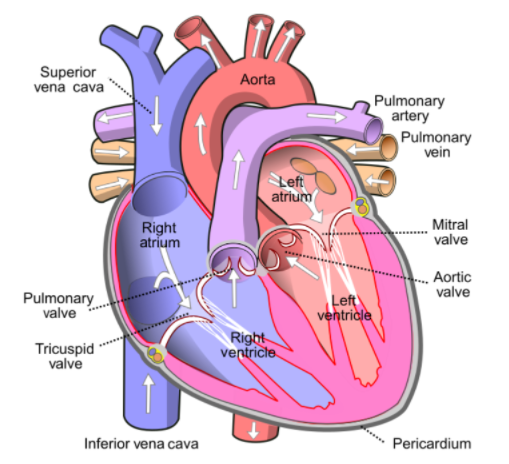
Thus, the chamber of the heart has thick walls because it has to pump blood against high resistance which is due to the muscular receiving arteries. The blood ejected from the left ventricle must have high pressure so that it can easily be transferred to all the parts of the body.
Note: The heart receives deoxygenated blood from the superior and inferior vena cava. This blood goes to the lungs through the pulmonary artery to the lungs for oxygenation. The oxygenated blood is received back to the heart through the pulmonary vein and then supplied to all parts of the body through the aorta.
Complete answer:
The four chambers of the heart work in coordination as follows-
> The right atrium receives blood from the veins collecting deoxygenated blood from the whole body and pumps it to the right ventricle.
>The right ventricle receives the deoxygenated blood from the right atrium and pumps it to the lungs through the pulmonary artery, where it is loaded with oxygen.
>The left atrium receives oxygenated blood from the lungs through the pulmonary vein and pumps it to the left ventricle.
>The left ventricle (the strongest chamber) pumps oxygen-rich blood to the rest of the body through the aorta. The left ventricle’s vigorous contractions create our blood pressure and help in the transfer of blood to the whole body.
The ventricles of the heart have thicker muscular walls than the atria. This is because blood is pumped out of the heart at greater pressure from ventricles compared to the atria. Also, the arteries have high peripheral resistance against which blood is to be pumped by ventricles. Comparing both ventricles left ventricle has thicker walls than the right ventricle. Because left ventricle has to pump blood against more resistance provided by the aorta compared to the right ventricle which has to pump blood against a minor resistance pulmonary artery.
As the ventricles have thick muscular walls evident from the figure below it requires more oxygen compared to atrial muscle walls and are thus more prone to ischemia during reduce oxygen supply or hypoxia.
Thus, the chamber of the heart has thick walls because it has to pump blood against high resistance which is due to the muscular receiving arteries. The blood ejected from the left ventricle must have high pressure so that it can easily be transferred to all the parts of the body.
Note: The heart receives deoxygenated blood from the superior and inferior vena cava. This blood goes to the lungs through the pulmonary artery to the lungs for oxygenation. The oxygenated blood is received back to the heart through the pulmonary vein and then supplied to all parts of the body through the aorta.
Recently Updated Pages
Master Class 11 English: Engaging Questions & Answers for Success

Master Class 11 Social Science: Engaging Questions & Answers for Success
Master Class 11 Maths: Engaging Questions & Answers for Success
Master Class 11 Biology: Engaging Questions & Answers for Success
Master Class 11 Physics: Engaging Questions & Answers for Success
Master Class 11 Chemistry: Engaging Questions & Answers for Success
Trending doubts
One Metric ton is equal to kg A 10000 B 1000 C 100 class 11 physics CBSE
Difference Between Prokaryotic Cells and Eukaryotic Cells
Find the value of the expression given below sin 30circ class 11 maths CBSE
1 ton equals to A 100 kg B 1000 kg C 10 kg D 10000 class 11 physics CBSE
Two of the body parts which do not appear in MRI are class 11 biology CBSE
What are hard magnetic materials class 11 physics CBSE