




How does the blood absorb oxygen in the lungs?
Answer
 Verified
497.7k+ views
Hint: Respiration is the process in which the gases such as carbon dioxide and oxygen are exchanged between the blood and external environment. During respiration, the complex substances (such as carbohydrates) are broken down to form simpler substances like water and carbon dioxide. Oxygen is utilized during this process. The synthesis of ATP takes place with the help of energy produced during this process.
Complete answer:
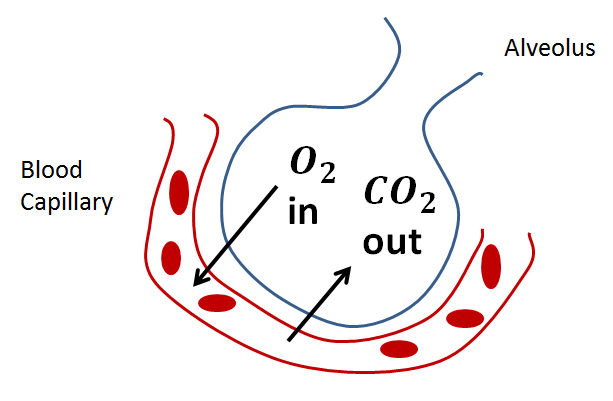
The respiratory system helps in respiration. It involves the exchange of gases between the lungs and body tissues. The alveoli of the lungs are responsible for the exchange of gases between the blood and surroundings. The following steps help the blood to absorb oxygen in the lungs:
When we breathe air, it reaches the alveoli of the lungs to supply oxygen. At the alveolar site, the partial pressure of oxygen is higher than the partial pressure of carbon dioxide. Hence when the impure blood reaches the alveolar capillaries, the oxygen binds with haemoglobin and forms oxyhaemoglobin in the capillary blood.
The oxyhaemoglobin is acidic in nature and thus it helps in the breakdown of sodium bicarbonate ($NaHCO_3$) present in blood. The carbon dioxide is released due to the breakdown of $NaHCO_3$.
Hence due to the high concentration of oxygen at the alveoli, the oxygen leaves the alveolar site and enters the red blood cells and binds with the haemoglobin. After that the pure blood which carries oxygen reaches to all cells and tissues of the body to supply oxygen there for various cellular activities. At the tissue level, the carbon dioxide diffuses into the blood and reaches the alveoli of the lungs from where it is exhaled out (released outside the body) through the nose.
Note:
The partial pressure gradient helps in the movement of gases i.e. from high partial pressure to low partial pressure. In the alveolar site, the gas exchange between the alveoli and the blood capillaries takes place by simple diffusion.
Complete answer:
The respiratory system helps in respiration. It involves the exchange of gases between the lungs and body tissues. The alveoli of the lungs are responsible for the exchange of gases between the blood and surroundings. The following steps help the blood to absorb oxygen in the lungs:
When we breathe air, it reaches the alveoli of the lungs to supply oxygen. At the alveolar site, the partial pressure of oxygen is higher than the partial pressure of carbon dioxide. Hence when the impure blood reaches the alveolar capillaries, the oxygen binds with haemoglobin and forms oxyhaemoglobin in the capillary blood.
The oxyhaemoglobin is acidic in nature and thus it helps in the breakdown of sodium bicarbonate ($NaHCO_3$) present in blood. The carbon dioxide is released due to the breakdown of $NaHCO_3$.
Hence due to the high concentration of oxygen at the alveoli, the oxygen leaves the alveolar site and enters the red blood cells and binds with the haemoglobin. After that the pure blood which carries oxygen reaches to all cells and tissues of the body to supply oxygen there for various cellular activities. At the tissue level, the carbon dioxide diffuses into the blood and reaches the alveoli of the lungs from where it is exhaled out (released outside the body) through the nose.
Note:
The partial pressure gradient helps in the movement of gases i.e. from high partial pressure to low partial pressure. In the alveolar site, the gas exchange between the alveoli and the blood capillaries takes place by simple diffusion.
Recently Updated Pages
Three beakers labelled as A B and C each containing 25 mL of water were taken A small amount of NaOH anhydrous CuSO4 and NaCl were added to the beakers A B and C respectively It was observed that there was an increase in the temperature of the solutions contained in beakers A and B whereas in case of beaker C the temperature of the solution falls Which one of the following statements isarecorrect i In beakers A and B exothermic process has occurred ii In beakers A and B endothermic process has occurred iii In beaker C exothermic process has occurred iv In beaker C endothermic process has occurred

Master Class 11 Social Science: Engaging Questions & Answers for Success
Master Class 11 Physics: Engaging Questions & Answers for Success
Master Class 11 Maths: Engaging Questions & Answers for Success
Master Class 11 Economics: Engaging Questions & Answers for Success
Master Class 11 Computer Science: Engaging Questions & Answers for Success
Three beakers labelled as A B and C each containing 25 mL of water were taken A small amount of NaOH anhydrous CuSO4 and NaCl were added to the beakers A B and C respectively It was observed that there was an increase in the temperature of the solutions contained in beakers A and B whereas in case of beaker C the temperature of the solution falls Which one of the following statements isarecorrect i In beakers A and B exothermic process has occurred ii In beakers A and B endothermic process has occurred iii In beaker C exothermic process has occurred iv In beaker C endothermic process has occurred
Master Class 11 Social Science: Engaging Questions & Answers for Success
Master Class 11 Physics: Engaging Questions & Answers for Success
Trending doubts
One Metric ton is equal to kg A 10000 B 1000 C 100 class 11 physics CBSE
There are 720 permutations of the digits 1 2 3 4 5 class 11 maths CBSE
State and prove Bernoullis theorem class 11 physics CBSE
Difference Between Prokaryotic Cells and Eukaryotic Cells
1 Quintal is equal to a 110 kg b 10 kg c 100kg d 1000 class 11 physics CBSE
Discuss the various forms of bacteria class 11 biology CBSE