




Does short-sightedness or long-sightedness imply that the eye has lost its ability to accommodate? If not, then explain what causes these eyes defects.
Answer
 Verified
604.5k+ views
Hint: The ability of the eye to accommodate refers to the ability of the eye to maintain an object in its focus. Short-sightedness or myopia refers to the condition when distant objects appear blurry whereas long-sightedness or hypermetropia refers to the condition when nearby objects appear blurry.
Complete step by step answer:
Try to explain short-sightedness and long-sightedness.
A person suffering from short-sightedness will be able to see the nearby objects clearly but will experience difficulty in seeing distant objects. A myopic eye however does not lose its ability to accommodate.
A person suffering from long-sightedness will be able to see the distant objects clearly but will experience difficulty in seeing objects in front of him or her. A hypermetropic eye does not lose its ability to accommodate.
So, neither of these effects imply a loss in the ability of the eye to accommodate. The eye defect that implies a loss in the eye’s ability to accommodate is termed as presbyopia.
Try to explain the cause of these eye defects.
Short-sightedness arises when the eyeball becomes elongated i.e., the length of the eye from its front to its back increases. This causes the light from the object to focus in front of the retina.
Long-sightedness arises when the eyeball becomes shortened i.e., the length of the eye from its front to its back decreases. This causes the light rays from the object to focus at the back of the retina.
For a better understanding, the diagrams given below depict the position of the image formed for a myopic and a hypermetropic eye when compared to normal vision.
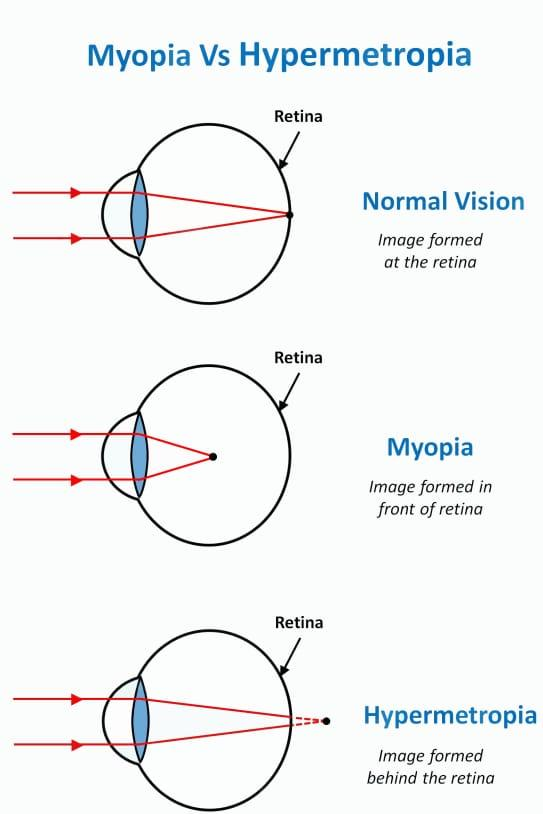
As you can see, for a myopic eye, the image gets focused in front of the retina and for a hypermetropic eye, the image gets focused behind the retina.
Note: The eye keeps an object in its focus by varying the shape of its lens. Long-sightedness and short-sightedness do not affect the lens’s ability to change its shape. But, presbyopia, a result of ageing, arises because of the hardening of the eye lens which in turn makes it difficult for the lens to change its shape.
Complete step by step answer:
Try to explain short-sightedness and long-sightedness.
A person suffering from short-sightedness will be able to see the nearby objects clearly but will experience difficulty in seeing distant objects. A myopic eye however does not lose its ability to accommodate.
A person suffering from long-sightedness will be able to see the distant objects clearly but will experience difficulty in seeing objects in front of him or her. A hypermetropic eye does not lose its ability to accommodate.
So, neither of these effects imply a loss in the ability of the eye to accommodate. The eye defect that implies a loss in the eye’s ability to accommodate is termed as presbyopia.
Try to explain the cause of these eye defects.
Short-sightedness arises when the eyeball becomes elongated i.e., the length of the eye from its front to its back increases. This causes the light from the object to focus in front of the retina.
Long-sightedness arises when the eyeball becomes shortened i.e., the length of the eye from its front to its back decreases. This causes the light rays from the object to focus at the back of the retina.
For a better understanding, the diagrams given below depict the position of the image formed for a myopic and a hypermetropic eye when compared to normal vision.
As you can see, for a myopic eye, the image gets focused in front of the retina and for a hypermetropic eye, the image gets focused behind the retina.
Note: The eye keeps an object in its focus by varying the shape of its lens. Long-sightedness and short-sightedness do not affect the lens’s ability to change its shape. But, presbyopia, a result of ageing, arises because of the hardening of the eye lens which in turn makes it difficult for the lens to change its shape.
Recently Updated Pages
Master Class 12 Business Studies: Engaging Questions & Answers for Success

Master Class 12 Chemistry: Engaging Questions & Answers for Success
Master Class 12 Biology: Engaging Questions & Answers for Success
Class 12 Question and Answer - Your Ultimate Solutions Guide
Master Class 11 English: Engaging Questions & Answers for Success
Master Class 11 Social Science: Engaging Questions & Answers for Success
Trending doubts
Which are the Top 10 Largest Countries of the World?
Draw a labelled sketch of the human eye class 12 physics CBSE
Differentiate between homogeneous and heterogeneous class 12 chemistry CBSE
Differentiate between Pyramid of energy and pyramid class 12 biology CBSE
Why is the cell called the structural and functional class 12 biology CBSE
Draw the diagram of the pyramid of energy Explain In class 12 biology CBSE