




How does shift depend upon the thickness AD or BC of the block?
Answer
 Verified
579.6k+ views
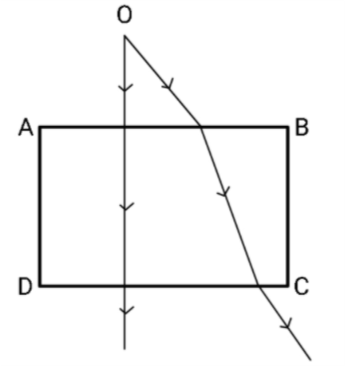
Hint: One of the rays is along the normal so it will go undeviated upon refraction. Another ray bends towards the normal in going inside the slab and bends away from the normal in coming out of the slab.
Complete answer:
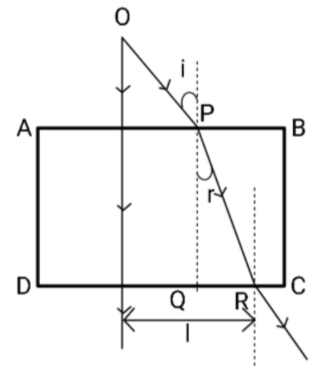
An object O is giving out rays, one ray travels along the normal, i.e., it makes a normal incidence (makes a right angle with the slab) and another ray suffers refraction in going from rarer to denser medium and then from denser to rarer medium. The shift we are talking about is the lateral displacement l, between the first and second ray. It has to depend on the angle of incidence, the medium of refraction and also on the length which it has to travel inside the slab.
Consider the triangle PQR, it is a right angled triangle, so we may write:
$QR = AD \tan r$.
As we have already fixed the angle of incidence i, r will be fixed. Thus, the distance QR can only change if AD changes. And as this distance plus the normal to normal distance will make required lateral displacement, it is quite obvious that as AD will increase, the shift will increase.
Note:
In the right angle triangle we wrote the base to be AD, as that is the length of the slab, so it will be the same throughout. We took the shift or lateral displacement as only due to the first refraction, i.e., by slab. We did not consider the shift due to the refraction from surface CD (although ‘l’ might look like to be marked there) for measuring lateral displacement.
Complete answer:
An object O is giving out rays, one ray travels along the normal, i.e., it makes a normal incidence (makes a right angle with the slab) and another ray suffers refraction in going from rarer to denser medium and then from denser to rarer medium. The shift we are talking about is the lateral displacement l, between the first and second ray. It has to depend on the angle of incidence, the medium of refraction and also on the length which it has to travel inside the slab.
Consider the triangle PQR, it is a right angled triangle, so we may write:
$QR = AD \tan r$.
As we have already fixed the angle of incidence i, r will be fixed. Thus, the distance QR can only change if AD changes. And as this distance plus the normal to normal distance will make required lateral displacement, it is quite obvious that as AD will increase, the shift will increase.
Note:
In the right angle triangle we wrote the base to be AD, as that is the length of the slab, so it will be the same throughout. We took the shift or lateral displacement as only due to the first refraction, i.e., by slab. We did not consider the shift due to the refraction from surface CD (although ‘l’ might look like to be marked there) for measuring lateral displacement.
Recently Updated Pages
Master Class 11 Computer Science: Engaging Questions & Answers for Success

Master Class 11 Business Studies: Engaging Questions & Answers for Success
Master Class 11 Economics: Engaging Questions & Answers for Success
Master Class 11 English: Engaging Questions & Answers for Success
Master Class 11 Maths: Engaging Questions & Answers for Success
Master Class 11 Biology: Engaging Questions & Answers for Success
Trending doubts
One Metric ton is equal to kg A 10000 B 1000 C 100 class 11 physics CBSE
There are 720 permutations of the digits 1 2 3 4 5 class 11 maths CBSE
Discuss the various forms of bacteria class 11 biology CBSE
Draw a diagram of a plant cell and label at least eight class 11 biology CBSE
State the laws of reflection of light
Explain zero factorial class 11 maths CBSE