




What does R indicate in EcoRI?
(a) Enzyme isolated from a strain of bacteria
(b) Genus of bacteria
(c) Sequence of enzyme
(d) Species of bacteria
Answer
 Verified
624.6k+ views
Hint: Hamilton Othanel Smith was awarded the Nobel Prize in Physiology or Medicine in 1978 for its discovery.
Correct step by step answer:
R is referred to as a restricted enzyme also called restriction endonuclease (a protein produced by bacteria that divides DNA) .
Restriction enzymes divide foreign DNA in the bacterial cell, at specific sites along the molecule. Later R enzymes are isolated from bacterial cells and used in the laboratory to manipulate those fragments of DNA that contain genes.
So, the correct answer is "enzymes isolated from a strain of bacteria".
Additional information:
- Bacteriophages are bacteria that use an R enzyme to defend against bacterial viruses.
- When a bacterium is infected by phage, it transfers its DNA into the bacterial cell so that it might be replicated.
- Replication of the phage DNA is prevented by cutting it into many pieces through restriction enzymes.
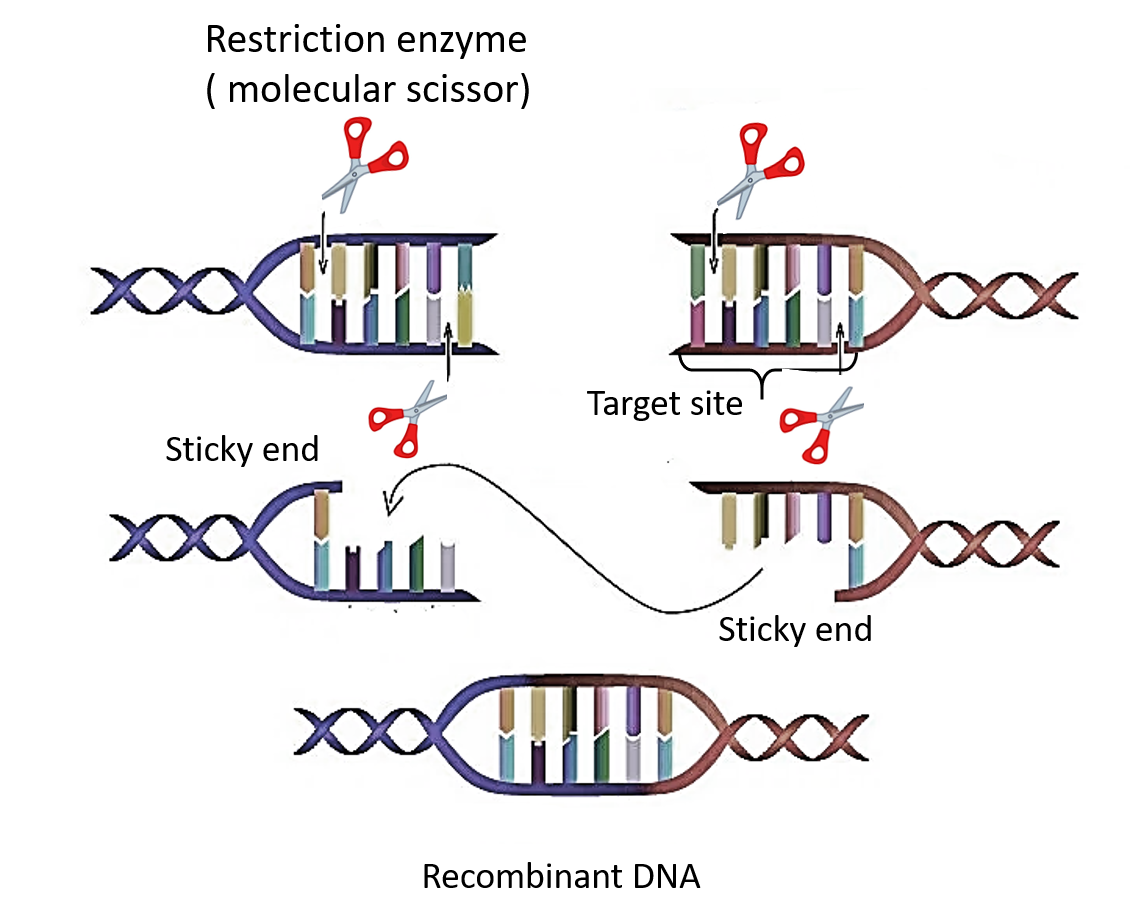
- For their ability to restrict, or limit, the number of strains of bacteriophage that can infect a bacterium, the enzymes are named restriction enzymes.
- A short, specific sequence of nucleotide bases was recognized by each restriction enzyme. These regions are called recognition sequences, or recognition sites, which are randomly distributed throughout the DNA.
- Different bacterial species make restriction enzymes to recognize different nucleotide sequences.
Note:
- Hamilton O. Smith: Discovery and use of ‘type II’ restriction enzymes.
- Werner Arber: Was awarded Nobel prize jointly with Hamilton O. Smith for the discovery of Restriction enzyme.
- Four types of restriction enzyme are-
Type I restriction enzyme
Type II restriction enzyme
Type IV restriction enzyme
Type III restriction enzyme
Correct step by step answer:
R is referred to as a restricted enzyme also called restriction endonuclease (a protein produced by bacteria that divides DNA) .
Restriction enzymes divide foreign DNA in the bacterial cell, at specific sites along the molecule. Later R enzymes are isolated from bacterial cells and used in the laboratory to manipulate those fragments of DNA that contain genes.
So, the correct answer is "enzymes isolated from a strain of bacteria".
Additional information:
- Bacteriophages are bacteria that use an R enzyme to defend against bacterial viruses.
- When a bacterium is infected by phage, it transfers its DNA into the bacterial cell so that it might be replicated.
- Replication of the phage DNA is prevented by cutting it into many pieces through restriction enzymes.
- For their ability to restrict, or limit, the number of strains of bacteriophage that can infect a bacterium, the enzymes are named restriction enzymes.
- A short, specific sequence of nucleotide bases was recognized by each restriction enzyme. These regions are called recognition sequences, or recognition sites, which are randomly distributed throughout the DNA.
- Different bacterial species make restriction enzymes to recognize different nucleotide sequences.
Note:
- Hamilton O. Smith: Discovery and use of ‘type II’ restriction enzymes.
- Werner Arber: Was awarded Nobel prize jointly with Hamilton O. Smith for the discovery of Restriction enzyme.
- Four types of restriction enzyme are-
Type I restriction enzyme
Type II restriction enzyme
Type IV restriction enzyme
Type III restriction enzyme
Recently Updated Pages
Master Class 12 Business Studies: Engaging Questions & Answers for Success

Master Class 12 Chemistry: Engaging Questions & Answers for Success
Master Class 12 Biology: Engaging Questions & Answers for Success
Class 12 Question and Answer - Your Ultimate Solutions Guide
Master Class 11 English: Engaging Questions & Answers for Success
Master Class 11 Social Science: Engaging Questions & Answers for Success
Trending doubts
Which are the Top 10 Largest Countries of the World?
Draw a labelled sketch of the human eye class 12 physics CBSE
Differentiate between homogeneous and heterogeneous class 12 chemistry CBSE
Differentiate between Pyramid of energy and pyramid class 12 biology CBSE
Why is the cell called the structural and functional class 12 biology CBSE
Draw the diagram of the pyramid of energy Explain In class 12 biology CBSE