




What does phenol form by reaction with $HCN$ and $HCl$.
Answer
 Verified
531.9k+ views
Hint: Phenol is an aromatic compound in which electrons are delocalized. When phenol is reacted with the mixture of $HCN$and $HCl$ it forms aldimine as the intermediate. The catalyst we use for this reaction is $ZnC{l_2}$. Thus we do hydrolysis of the intermediate product to get the final product.
Complete answer:
Phenol is an aromatic compound which contains hydroxyl groups. The mixture of $HCN$and $HCl$is reacted with phenol in the presence of a catalyst known as zinc chloride. Further an intermediate product is formed which on hydrolysis yields us $p - $hydroxybenzaldehyde. The whole reaction will take place in the following steps:
$1.$In the first stage of reaction, the mixture of hydrochloric acid and hydrogen cyanide is reacted to form a complex in the presence of the zinc chloride.
$HCl{\text{ + HCN }}\xrightarrow{{ZnC{l_2}}}{\text{ Cl - CH = NH}}$
The formed complex will further react with the phenol and form an intermediate product.
$2.$ Now the given complex will react with phenol and produce an intermediate product known as aldimine. Then the aldimine so formed will undergo hydrolysis.
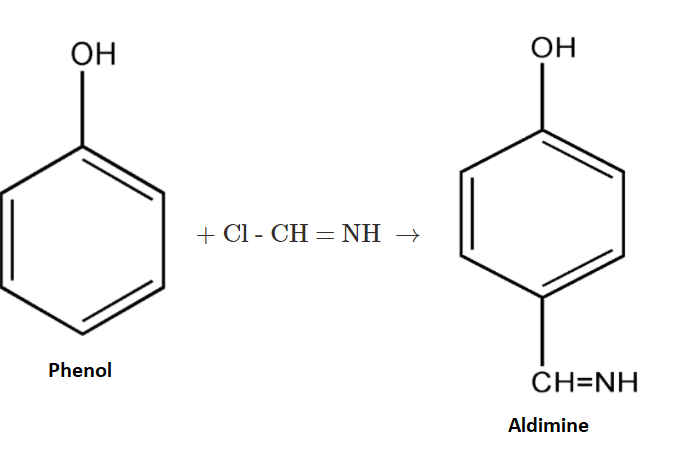
$3.$Now the formed intermediate, Aldimine, is further undergoing hydrolysis with ${H_3}{O^ + }$. On hydrolysis of the above intermediate we get $p - $hydroxybenzaldehyde as our main product.
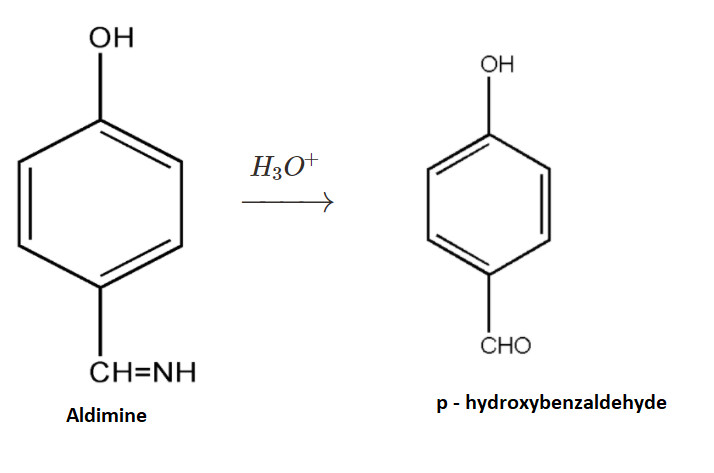
The product so formed is $p - $hydroxybenzaldehyde. The reaction is also known as the Gattermann Reaction used for synthesis of aromatic aldehydes.
Note:
The intermediate formed during the reaction is a result of zinc chloride. Here zinc chloride acts as a catalyst. We can use others like Aluminium Chloride in place of Zinc Chloride. On hydrolysis there is addition of oxygen and an amine group if formed as a by-product.
Complete answer:
Phenol is an aromatic compound which contains hydroxyl groups. The mixture of $HCN$and $HCl$is reacted with phenol in the presence of a catalyst known as zinc chloride. Further an intermediate product is formed which on hydrolysis yields us $p - $hydroxybenzaldehyde. The whole reaction will take place in the following steps:
$1.$In the first stage of reaction, the mixture of hydrochloric acid and hydrogen cyanide is reacted to form a complex in the presence of the zinc chloride.
$HCl{\text{ + HCN }}\xrightarrow{{ZnC{l_2}}}{\text{ Cl - CH = NH}}$
The formed complex will further react with the phenol and form an intermediate product.
$2.$ Now the given complex will react with phenol and produce an intermediate product known as aldimine. Then the aldimine so formed will undergo hydrolysis.
$3.$Now the formed intermediate, Aldimine, is further undergoing hydrolysis with ${H_3}{O^ + }$. On hydrolysis of the above intermediate we get $p - $hydroxybenzaldehyde as our main product.
The product so formed is $p - $hydroxybenzaldehyde. The reaction is also known as the Gattermann Reaction used for synthesis of aromatic aldehydes.
Note:
The intermediate formed during the reaction is a result of zinc chloride. Here zinc chloride acts as a catalyst. We can use others like Aluminium Chloride in place of Zinc Chloride. On hydrolysis there is addition of oxygen and an amine group if formed as a by-product.
Recently Updated Pages
Master Class 11 Social Science: Engaging Questions & Answers for Success

Master Class 11 English: Engaging Questions & Answers for Success
Master Class 11 Maths: Engaging Questions & Answers for Success
Master Class 11 Chemistry: Engaging Questions & Answers for Success
Master Class 11 Biology: Engaging Questions & Answers for Success
Master Class 11 Physics: Engaging Questions & Answers for Success
Trending doubts
One Metric ton is equal to kg A 10000 B 1000 C 100 class 11 physics CBSE
Difference Between Prokaryotic Cells and Eukaryotic Cells
Draw a diagram of a plant cell and label at least eight class 11 biology CBSE
Two of the body parts which do not appear in MRI are class 11 biology CBSE
Which gas is abundant in air class 11 chemistry CBSE
10 examples of friction in our daily life