




How does $ pH $ affect photosynthesis?
Answer
 Verified
584.1k+ views
Hint :Photosynthesis is the technique of converting light energy to chemical energy by green plants and other species. Light energy is absorbed and used by green plants during photosynthesis to turn water, $ C{O_2} $ , and minerals into oxygen and energy-rich organic compounds.
Complete Step By Step Answer:
Photosynthesis involves the activity of enzymes in plant cells, which work best at specific pH levels.
The $ pH $ of water is an indicator of how acidic or basic it is. The range of $ pH $ is $ 0 $ to $ 14 $ , with $ 7 $ being the neutral value. Acidity is indicated by a $ pH $ less than $ 7 $ , whereas a $ pH $ greater than $ 7 $ indicates a base.
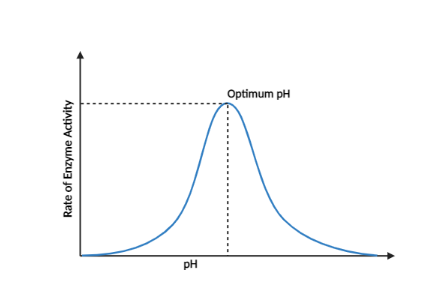
Each plant has a best or optimum $ pH $ for the activity of its enzymes. Enzymes in plants will denature, stop working, or slow down when the $ pH $ levels become too high or too low. Due to which they can no longer perform photosynthesis to their full capacity in the cell. If the $ pH $ is appropriate, the rate of photosynthesis will rise to its highest level.
As the $ pH $ of the plant moves away from the optimal $ pH $ , the rate of photosynthesis reduces.
For photosynthesis to take place effectively, the $ pH $ must be neutral. When the $ pH $ is $ 7 $ , the rate accelerates as rapidly as possible. The photosynthesis takes place at a slower pace when the $ pH $ is $ 5 $ (closer to rainwater than $ pH $ $ 7 $ ).
Note :
Plants' growth and survival can be affected by a low $ pH $ . Nutrient deficiencies, decreased harvest, and seedling growth rate are some of the negative effects of soil $ pH $ on plant growth. Plants require different soil conditions, and some species can grow at lower $ pH $ levels than others.
Complete Step By Step Answer:
Photosynthesis involves the activity of enzymes in plant cells, which work best at specific pH levels.
The $ pH $ of water is an indicator of how acidic or basic it is. The range of $ pH $ is $ 0 $ to $ 14 $ , with $ 7 $ being the neutral value. Acidity is indicated by a $ pH $ less than $ 7 $ , whereas a $ pH $ greater than $ 7 $ indicates a base.
Each plant has a best or optimum $ pH $ for the activity of its enzymes. Enzymes in plants will denature, stop working, or slow down when the $ pH $ levels become too high or too low. Due to which they can no longer perform photosynthesis to their full capacity in the cell. If the $ pH $ is appropriate, the rate of photosynthesis will rise to its highest level.
As the $ pH $ of the plant moves away from the optimal $ pH $ , the rate of photosynthesis reduces.
For photosynthesis to take place effectively, the $ pH $ must be neutral. When the $ pH $ is $ 7 $ , the rate accelerates as rapidly as possible. The photosynthesis takes place at a slower pace when the $ pH $ is $ 5 $ (closer to rainwater than $ pH $ $ 7 $ ).
Note :
Plants' growth and survival can be affected by a low $ pH $ . Nutrient deficiencies, decreased harvest, and seedling growth rate are some of the negative effects of soil $ pH $ on plant growth. Plants require different soil conditions, and some species can grow at lower $ pH $ levels than others.
Recently Updated Pages
Master Class 11 English: Engaging Questions & Answers for Success

Master Class 11 Physics: Engaging Questions & Answers for Success
Master Class 11 Computer Science: Engaging Questions & Answers for Success
Master Class 11 Chemistry: Engaging Questions & Answers for Success
Master Class 11 Social Science: Engaging Questions & Answers for Success
Master Class 11 Accountancy: Engaging Questions & Answers for Success
Trending doubts
Difference Between Prokaryotic Cells and Eukaryotic Cells
Two of the body parts which do not appear in MRI are class 11 biology CBSE
One Metric ton is equal to kg A 10000 B 1000 C 100 class 11 physics CBSE
10 examples of friction in our daily life
Draw a diagram of nephron and explain its structur class 11 biology CBSE
Draw a diagram of a plant cell and label at least eight class 11 biology CBSE