




How does nutrition take place in the bud of hydra?
Answer
 Verified
618.6k+ views
Hint:Freshwater living and small organisms constitute the genus Hydra. Hydra comes under the phylum Cnidaria. They are very simple organisms in terms of body structure.
Complete answer
Hydra is a simple freshwater polyp and belongs to the phylum Cnidaria. The body of hydra is differentiated into a long and tubular trunk and the mouth is surrounded by tentacles. Body cavity is present and the body wall is diploblastic.
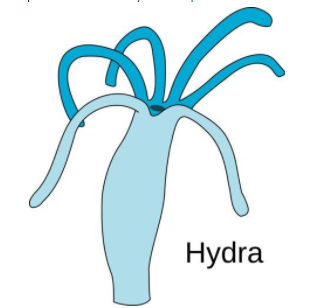
The tentacles present around the mouth help in the ingestion of food. The tentacles are long and they can catch the small aquatic organisms. Once captured, they kill the small aquatic organisms using their stinging cells which are present in the tentacle.
The prey is then pushed into the mouth and once it has reached the body cavity, various digestive juices help in digestion of the food. After digestion of food, it is absorbed through the walls of the cavity and assimilated in the cells.
Note:In hydra, holozoic mode of nutrition is seen. Holozoic nutrition involves ingestion of food which is either solid or liquid. They are also heterotrophic in nature, i.e. they cannot produce their own food.
Complete answer
Hydra is a simple freshwater polyp and belongs to the phylum Cnidaria. The body of hydra is differentiated into a long and tubular trunk and the mouth is surrounded by tentacles. Body cavity is present and the body wall is diploblastic.
The tentacles present around the mouth help in the ingestion of food. The tentacles are long and they can catch the small aquatic organisms. Once captured, they kill the small aquatic organisms using their stinging cells which are present in the tentacle.
The prey is then pushed into the mouth and once it has reached the body cavity, various digestive juices help in digestion of the food. After digestion of food, it is absorbed through the walls of the cavity and assimilated in the cells.
Note:In hydra, holozoic mode of nutrition is seen. Holozoic nutrition involves ingestion of food which is either solid or liquid. They are also heterotrophic in nature, i.e. they cannot produce their own food.
Recently Updated Pages
Master Class 11 Social Science: Engaging Questions & Answers for Success

Master Class 11 English: Engaging Questions & Answers for Success
Master Class 11 Maths: Engaging Questions & Answers for Success
Master Class 11 Chemistry: Engaging Questions & Answers for Success
Master Class 11 Biology: Engaging Questions & Answers for Success
Master Class 11 Physics: Engaging Questions & Answers for Success
Trending doubts
One Metric ton is equal to kg A 10000 B 1000 C 100 class 11 physics CBSE
Difference Between Prokaryotic Cells and Eukaryotic Cells
How many of the following diseases can be studied with class 11 biology CBSE
Which of the following enzymes is used for carboxylation class 11 biology CBSE
Two of the body parts which do not appear in MRI are class 11 biology CBSE
Draw a diagram of a plant cell and label at least eight class 11 biology CBSE