




Does it grow well in dry or moist conditions?
Answer
 Verified
600.3k+ views
Hint: The zygomycetes also known as the conjugation fungi are the division of fungi. Fungi are organisms that have a thallus body, and possess a definite cell wall of either cellulose or chitin or both but lack chlorophyll.
Complete answer:
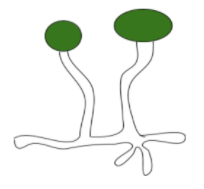
Thallus of zygomycetes is mycelial. Their hyphae are coenocytic i.e multinucleated and aseptate. Their cell is made up of chitin. One of the characteristic features of this division is the absence of any motile body. They do reproduce by asexual as well as sexual repodroduction. Asexual reproduction mainly occurs by formation of non-motile sporangiospores formed due to cleavage occuring in sporangia. Sexual reproduction takes place with the help of conjugation or gametangial copulation that occurs between two identical gametangia. Their gametes are non- motile and multinucleate. Sexual reproduction leads to the formation of diploid zygospore. This zygospore contains diploid nuclei and then divides by meiosis before it enters into a resting stage. On germination, this zygospore gives rise to a sporangium at the tip of it, which produces spores , called germ spores. Rhizopus and mucor are examples of this division. They are multi spored. Most of the saprophytic species that are responsible for causing any disease in plants and animals including human beings fall under this category. These grow very well in moist , dark and warm environmental conditions. In rainy seasons, they can be seen grown at very foodstuffs, clothes etc.
Note: Few species of rhizopus and mucor helps in alcoholic fermentation and in industrial production of several enzymes, lactic and citric acids. Zygomycetes are popularly known as conjugation fungi since they reproduce by conjugation in sexual reproduction.
Complete answer:
Thallus of zygomycetes is mycelial. Their hyphae are coenocytic i.e multinucleated and aseptate. Their cell is made up of chitin. One of the characteristic features of this division is the absence of any motile body. They do reproduce by asexual as well as sexual repodroduction. Asexual reproduction mainly occurs by formation of non-motile sporangiospores formed due to cleavage occuring in sporangia. Sexual reproduction takes place with the help of conjugation or gametangial copulation that occurs between two identical gametangia. Their gametes are non- motile and multinucleate. Sexual reproduction leads to the formation of diploid zygospore. This zygospore contains diploid nuclei and then divides by meiosis before it enters into a resting stage. On germination, this zygospore gives rise to a sporangium at the tip of it, which produces spores , called germ spores. Rhizopus and mucor are examples of this division. They are multi spored. Most of the saprophytic species that are responsible for causing any disease in plants and animals including human beings fall under this category. These grow very well in moist , dark and warm environmental conditions. In rainy seasons, they can be seen grown at very foodstuffs, clothes etc.
Note: Few species of rhizopus and mucor helps in alcoholic fermentation and in industrial production of several enzymes, lactic and citric acids. Zygomycetes are popularly known as conjugation fungi since they reproduce by conjugation in sexual reproduction.
Recently Updated Pages
Master Class 12 Economics: Engaging Questions & Answers for Success

Master Class 12 English: Engaging Questions & Answers for Success
Master Class 12 Social Science: Engaging Questions & Answers for Success
Master Class 12 Maths: Engaging Questions & Answers for Success
Master Class 12 Physics: Engaging Questions & Answers for Success
Master Class 9 General Knowledge: Engaging Questions & Answers for Success
Trending doubts
1 ton equals to A 100 kg B 1000 kg C 10 kg D 10000 class 11 physics CBSE
DNA is not present in A Nucleus B Mitochondria C Chloroplast class 11 biology CBSE
Draw a diagram of a plant cell and label at least eight class 11 biology CBSE
Draw a diagram showing the external features of fish class 11 biology CBSE
What is the weight in lbs of a 75 Kg person class 11 physics CBSE
Proton was discovered by A Thomson B Rutherford C Chadwick class 11 chemistry CBSE