




Where does fertilization take place in a woman? What helps the sperm to gain an entry into the ovum and how? What is the significance of the point of entry of the sperm?
Answer
 Verified
615.6k+ views
Hint: Fertilization can be defined as a biological process in which a diploid zygote is formed from haploid gametes. It takes place in the female reproductive part after the fusion of ovum and sperm. Only a single sperm fusion with an ovum.
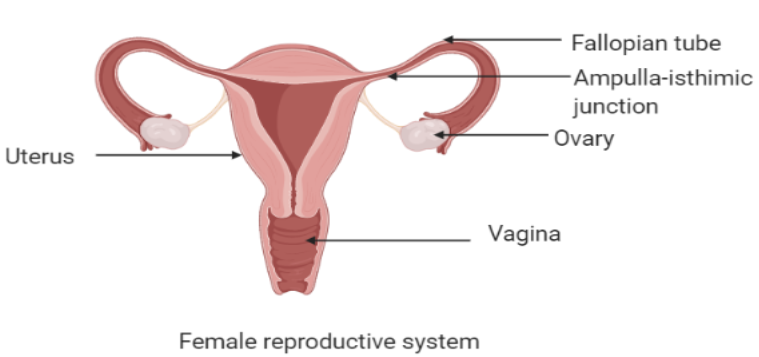
Complete step by step answer: The ampullary-isthmic junction of the fallopian tube is the site of fertilization in females. A hormone called progesterone is released by eggs when they are surrounded by the sperms. This causes the sperm to undergo the process of capacitation. Capacitation is a process in which sperm activity is increased and also shed some outer proteins. The increased activity of sperm helps it to penetrate into the outer layer of the egg called corona radiata and thus comes in contact with the zona pellucida layer of the ovum. As soon as the sperm comes in contact with the zona pellucida layer of the egg or ovum it blocks the entry of additional sperm by certain changes in the membrane so that only one sperm fertilizes the ovum. The zona pellucida layer of the ovum is digested by the sperm by releasing the enzyme called acrosome and hence the fusion of the sperm plasma membrane and egg plasma membrane take place. The cortical granules inside the eggs are fused with the plasma membrane by the release of calcium ions as a result of the fusion of the sperm plasma membrane and egg plasma membrane. The contents of these granules are released outside of the cell, toward the remains of the zona pellucida. Digestion of the zona pellucida takes place by the enzymes released by cortical granules thus making it unable to bind more sperms and forming a protective layer around the fertilized egg.
Note: Fertilization is of two types in vitro and in vivo fertilization. In vitro fertilization, the fusion of egg and sperm takes place outside the body whereas, in vivo, the process of fertilization takes place within the body.
Complete step by step answer: The ampullary-isthmic junction of the fallopian tube is the site of fertilization in females. A hormone called progesterone is released by eggs when they are surrounded by the sperms. This causes the sperm to undergo the process of capacitation. Capacitation is a process in which sperm activity is increased and also shed some outer proteins. The increased activity of sperm helps it to penetrate into the outer layer of the egg called corona radiata and thus comes in contact with the zona pellucida layer of the ovum. As soon as the sperm comes in contact with the zona pellucida layer of the egg or ovum it blocks the entry of additional sperm by certain changes in the membrane so that only one sperm fertilizes the ovum. The zona pellucida layer of the ovum is digested by the sperm by releasing the enzyme called acrosome and hence the fusion of the sperm plasma membrane and egg plasma membrane take place. The cortical granules inside the eggs are fused with the plasma membrane by the release of calcium ions as a result of the fusion of the sperm plasma membrane and egg plasma membrane. The contents of these granules are released outside of the cell, toward the remains of the zona pellucida. Digestion of the zona pellucida takes place by the enzymes released by cortical granules thus making it unable to bind more sperms and forming a protective layer around the fertilized egg.
Note: Fertilization is of two types in vitro and in vivo fertilization. In vitro fertilization, the fusion of egg and sperm takes place outside the body whereas, in vivo, the process of fertilization takes place within the body.
Recently Updated Pages
Master Class 12 Business Studies: Engaging Questions & Answers for Success

Master Class 12 Chemistry: Engaging Questions & Answers for Success
Master Class 12 Biology: Engaging Questions & Answers for Success
Class 12 Question and Answer - Your Ultimate Solutions Guide
Master Class 11 English: Engaging Questions & Answers for Success
Master Class 11 Social Science: Engaging Questions & Answers for Success
Trending doubts
Which are the Top 10 Largest Countries of the World?
Draw a labelled sketch of the human eye class 12 physics CBSE
The end of compass needle which points towards north class 12 physics CBSE
Differentiate between homogeneous and heterogeneous class 12 chemistry CBSE
Why is the cell called the structural and functional class 12 biology CBSE
When was the first election held in India a 194748 class 12 sst CBSE