




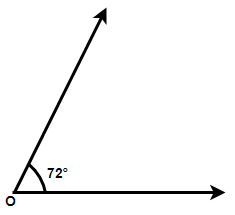
What does a 72 degree angle look like?
Answer
 Verified
563.1k+ views
Hint: First of all we will check if we can draw the given angle with the help of a compass or not. To do so we will divide 72 degrees by $\dfrac{15}{2}$ degrees. If 72 degrees gets completely divided with leaving any remainder then we can draw it with compass otherwise we need to use the protractor. Use the fact that 72 degrees is an acute angle so it will be less than 90 degrees.
Complete step-by-step solution:
Here we have been asked about the depiction of a 72 degree angle. First let us know if it can be drawn using a compass or we will need the help of a protractor.
Now, in geometry we can draw an angle with the help of a ruler and a compass if and only if it is a multiple of $\dfrac{15}{2}$ degrees. So let us see if 72 degrees is completely divisible by $\dfrac{15}{2}$ degrees or not.
$\begin{align}
& \Rightarrow 72\div \dfrac{15}{2}=72\times \dfrac{2}{15} \\
& \Rightarrow 72\div \dfrac{15}{2}=24\times \dfrac{2}{5} \\
& \Rightarrow 72\div \dfrac{15}{2}=\dfrac{48}{5} \\
\end{align}$
Clearly we can see that 48 is not divisible by 5 so we cannot draw 72 degrees with the help of a compass only. Therefore we need to use the protractor.
Now, we can see that 72 degrees is an acute angle so it will be less than 90 degrees. To draw it first we need to draw a straight horizontal ray. Now, we will fix a protractor at the starting point of the ray such that the point at which the vertical and horizontal line marked on the protractor overlaps with this starting point and the horizontal line on the protractor overlaps with the ray. Now, we will start at the right side and start moving along the curve of the protractor and mark the 72 degree point appearing before the 90 degree angle mark. Finally, we will join this point with the point at which the protractor was fixed to get the desired angle. The figure of a 72 degree angle is shown below.
Note: Note that you have to be careful while using protractor because the measure of angles are in both directions along the arc of the tool. If we have to draw an acute angle with the initial side of the angle extending in rightward direction then we move from right to left along the arc and if the initial side is extending towards left side then we move from left to right along the arc. However, we can work from one side only because we know that the sum of linear pairs of angles is 180 degrees.
Complete step-by-step solution:
Here we have been asked about the depiction of a 72 degree angle. First let us know if it can be drawn using a compass or we will need the help of a protractor.
Now, in geometry we can draw an angle with the help of a ruler and a compass if and only if it is a multiple of $\dfrac{15}{2}$ degrees. So let us see if 72 degrees is completely divisible by $\dfrac{15}{2}$ degrees or not.
$\begin{align}
& \Rightarrow 72\div \dfrac{15}{2}=72\times \dfrac{2}{15} \\
& \Rightarrow 72\div \dfrac{15}{2}=24\times \dfrac{2}{5} \\
& \Rightarrow 72\div \dfrac{15}{2}=\dfrac{48}{5} \\
\end{align}$
Clearly we can see that 48 is not divisible by 5 so we cannot draw 72 degrees with the help of a compass only. Therefore we need to use the protractor.
Now, we can see that 72 degrees is an acute angle so it will be less than 90 degrees. To draw it first we need to draw a straight horizontal ray. Now, we will fix a protractor at the starting point of the ray such that the point at which the vertical and horizontal line marked on the protractor overlaps with this starting point and the horizontal line on the protractor overlaps with the ray. Now, we will start at the right side and start moving along the curve of the protractor and mark the 72 degree point appearing before the 90 degree angle mark. Finally, we will join this point with the point at which the protractor was fixed to get the desired angle. The figure of a 72 degree angle is shown below.
Note: Note that you have to be careful while using protractor because the measure of angles are in both directions along the arc of the tool. If we have to draw an acute angle with the initial side of the angle extending in rightward direction then we move from right to left along the arc and if the initial side is extending towards left side then we move from left to right along the arc. However, we can work from one side only because we know that the sum of linear pairs of angles is 180 degrees.
Recently Updated Pages
Master Class 11 English: Engaging Questions & Answers for Success

Master Class 11 Social Science: Engaging Questions & Answers for Success
Master Class 11 Maths: Engaging Questions & Answers for Success
Master Class 11 Biology: Engaging Questions & Answers for Success
Master Class 11 Physics: Engaging Questions & Answers for Success
Master Class 11 Chemistry: Engaging Questions & Answers for Success
Trending doubts
Explain the Treaty of Vienna of 1815 class 10 social science CBSE
What is the full form of POSCO class 10 social science CBSE
Define Potential, Developed, Stock and Reserved resources
The diagonals of a rhombus are 10cm and 24cm Find the class 10 maths CBSE
Fill the blanks with proper collective nouns 1 A of class 10 english CBSE
What planets have no moons Which one has only one moon class 10 physics CBSE