




Do lenticels help in photosynthesis?
Answer
 Verified
536.1k+ views
Hint: Lenticels are the lens – shaped openings which are present on the periderm or bark (the outer layer; peri = outer & derma = skin) of the woody trees.
They facilitate the gaseous exchange between living cells & the exterior through the bark, which is otherwise impermeable to gases i.e., they help in transpiration. This also helps in vegetative reproduction. But lenticels do not help in photosynthesis.
Complete answer:
Lenticels occur in almost all types of phellem containing organs including stem, root, potato tuber etc. They are slightly raised spots on the surface of the stem.
Lenticels play a major role in transpiration. It facilitates the direct gaseous exchange of the gases between the environment & the internal tissue spaces of the organs (stems & some fruits). For example, in apple fruit, lenticels account for up to 21% of the transpiration.
They permit the entrance of oxygen & simultaneously the output of carbon dioxide & water vapor.
The lenticels connect the atmospheric air with the cortical tissue of the stem through the intercellular spaces present amongst the complementary cells. The lenticular transpiration is only 0.1% of the total transpiration.
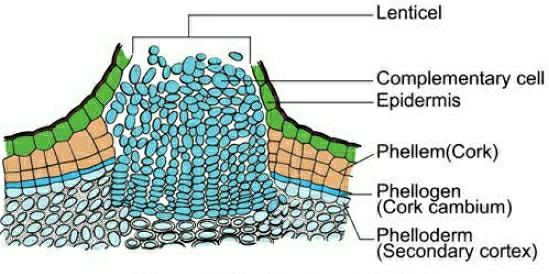
Lenticels also helps in vegetative reproduction. Lenticel formation usually begins beneath the stomatal complexes during primary growth preceding the development of the first periderm.
So, lenticels don’t help in photosynthesis.
Note:
Lenticels are the opening of fruits, stems, tubers, etc. that are filled up with loose connective cells & allow passage & exchange of gases. These don’t play any role in photosynthesis. This is due to the fact that these areas don’t have the pigment chlorophyll or cells that contain chlorophyll. They basically are gaps that facilitate water and gaseous exchange.
They facilitate the gaseous exchange between living cells & the exterior through the bark, which is otherwise impermeable to gases i.e., they help in transpiration. This also helps in vegetative reproduction. But lenticels do not help in photosynthesis.
Complete answer:
Lenticels occur in almost all types of phellem containing organs including stem, root, potato tuber etc. They are slightly raised spots on the surface of the stem.
Lenticels play a major role in transpiration. It facilitates the direct gaseous exchange of the gases between the environment & the internal tissue spaces of the organs (stems & some fruits). For example, in apple fruit, lenticels account for up to 21% of the transpiration.
They permit the entrance of oxygen & simultaneously the output of carbon dioxide & water vapor.
The lenticels connect the atmospheric air with the cortical tissue of the stem through the intercellular spaces present amongst the complementary cells. The lenticular transpiration is only 0.1% of the total transpiration.
Lenticels also helps in vegetative reproduction. Lenticel formation usually begins beneath the stomatal complexes during primary growth preceding the development of the first periderm.
So, lenticels don’t help in photosynthesis.
Note:
Lenticels are the opening of fruits, stems, tubers, etc. that are filled up with loose connective cells & allow passage & exchange of gases. These don’t play any role in photosynthesis. This is due to the fact that these areas don’t have the pigment chlorophyll or cells that contain chlorophyll. They basically are gaps that facilitate water and gaseous exchange.
Recently Updated Pages
Master Class 11 English: Engaging Questions & Answers for Success

Master Class 11 Social Science: Engaging Questions & Answers for Success
Master Class 11 Maths: Engaging Questions & Answers for Success
Master Class 11 Biology: Engaging Questions & Answers for Success
Master Class 11 Physics: Engaging Questions & Answers for Success
Master Class 11 Chemistry: Engaging Questions & Answers for Success
Trending doubts
One Metric ton is equal to kg A 10000 B 1000 C 100 class 11 physics CBSE
Difference Between Prokaryotic Cells and Eukaryotic Cells
Two of the body parts which do not appear in MRI are class 11 biology CBSE
Find the value of the expression given below sin 30circ class 11 maths CBSE
Draw a diagram of a plant cell and label at least eight class 11 biology CBSE
10 examples of friction in our daily life