




Do endocrine glands secrete hormones directly into the bloodstream?
Answer
 Verified
504.9k+ views
Hint: A gland is an organ, which synthesizes and releases substances, performing a particular function in the body. There are two kinds of glands, namely, the exocrine gland and endocrine gland. Hormones are produced only by endocrine glands, not by exocrine glands. Endocrine glands utilize the bloodstream for monitoring the body’s internal environment and communicate with one another through hormones.
Complete answer:
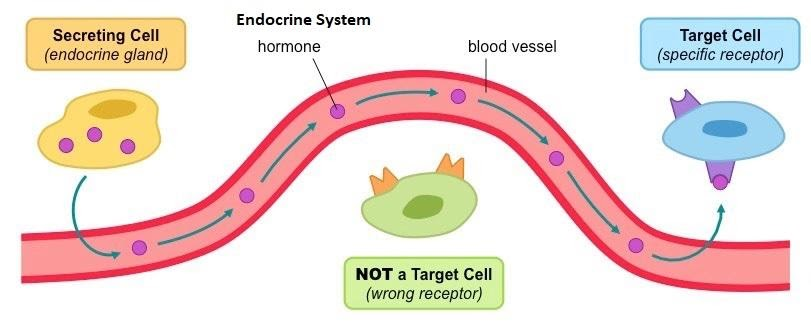
Fig: Working Flow of Endocrine System
Endocrine glands secrete and release hormones and products directly into the blood for the purpose of transportation into the effector organ. The effector organ can also be known as the target organ.
The pineal gland, pancreas, ovaries, testes, pituitary gland, parathyroid gland, thyroid gland, adrenal glands, and hypothalamus are the major glands in the endocrine system. Adrenal glands, being one of the important endocrine glands, are small structures attached to the top of each kidney. The glands release hormones into the bloodstream, which affect many parts of the human body.
In comparison to endocrine glands, some glands release hormones and products onto the epithelial surface with the aid of ducts. They are known as exocrine glands. Some of them include mammary gland, salivary gland, sebaceous gland, sweat gland, lacrimal gland, and mucous gland.
The pancreas is both exocrine and endocrine glands. Digestive fluids secreted by the pancreas pass through the pancreatic duct and release into the small intestine for digestion of food. But, the insulin synthesized by the pancreas is directly released into the bloodstream for regulation of blood glucose levels.
Note:
Hormones are chemical substances or messengers, which affect another part of the body. They aid in controlling and coordinating the functions of the body. Not all organs secreting hormones or hormone-like substances are part of the endocrine system. An example is a kidney, which secretes renin for controlling blood pressure, and erythropoietin for stimulating the blood marrow to produce red blood cells.
Complete answer:
Fig: Working Flow of Endocrine System
Endocrine glands secrete and release hormones and products directly into the blood for the purpose of transportation into the effector organ. The effector organ can also be known as the target organ.
The pineal gland, pancreas, ovaries, testes, pituitary gland, parathyroid gland, thyroid gland, adrenal glands, and hypothalamus are the major glands in the endocrine system. Adrenal glands, being one of the important endocrine glands, are small structures attached to the top of each kidney. The glands release hormones into the bloodstream, which affect many parts of the human body.
In comparison to endocrine glands, some glands release hormones and products onto the epithelial surface with the aid of ducts. They are known as exocrine glands. Some of them include mammary gland, salivary gland, sebaceous gland, sweat gland, lacrimal gland, and mucous gland.
The pancreas is both exocrine and endocrine glands. Digestive fluids secreted by the pancreas pass through the pancreatic duct and release into the small intestine for digestion of food. But, the insulin synthesized by the pancreas is directly released into the bloodstream for regulation of blood glucose levels.
Note:
Hormones are chemical substances or messengers, which affect another part of the body. They aid in controlling and coordinating the functions of the body. Not all organs secreting hormones or hormone-like substances are part of the endocrine system. An example is a kidney, which secretes renin for controlling blood pressure, and erythropoietin for stimulating the blood marrow to produce red blood cells.
Recently Updated Pages
Master Class 11 Social Science: Engaging Questions & Answers for Success

Master Class 11 English: Engaging Questions & Answers for Success
Master Class 11 Maths: Engaging Questions & Answers for Success
Master Class 11 Chemistry: Engaging Questions & Answers for Success
Master Class 11 Biology: Engaging Questions & Answers for Success
Master Class 11 Physics: Engaging Questions & Answers for Success
Trending doubts
One Metric ton is equal to kg A 10000 B 1000 C 100 class 11 physics CBSE
Difference Between Prokaryotic Cells and Eukaryotic Cells
How many of the following diseases can be studied with class 11 biology CBSE
Draw a diagram of a plant cell and label at least eight class 11 biology CBSE
Two of the body parts which do not appear in MRI are class 11 biology CBSE
Which gas is abundant in air class 11 chemistry CBSE