




Divide by Dhwajank method: \[4532\div 112\].
Answer
 Verified
549k+ views
Hint: Make three columns and fill the numbers in them as shown:

Now, first divide 45 by 11 and write the quotient below the horizontal line while writing the remainder above the horizontal line between the digits 5 and 3 just below them. In the next step, form a new number by subtracting the product of 2 and the quotient obtained from the number formed using the remainder and the digit 3. Apply this process till we reach the rightmost digit 2 to get the quotient and the remainder.
Complete step by step solution:
Here, we have been asked to divide the number 4532 by 112 using Dhwajank method.
Now, the Dhwajank method is a process in vedic mathematics used for the division of numbers. Let us understand this method by taking the example of the numbers given in the question.
Here, we have the numbers 4532 and 112 where 4532 is the dividend and 112 Is the divisor. Now, in the first step we form three columns and fill the given numbers as shown.
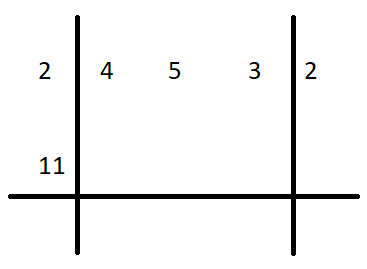
In the first column we have written the number 112 in such a way that 11 is called the main number, used for division and 2 is called the flag number, used for multiplication. Since one digit from the number 112 is written above so one digit from the number 45323 goes to the third column.
Now, we have to divide the first digit in column 2, i.e., 4, by 11. Since, 4 will not be divisible by 11 so we move a digit forward and consider the number 45. So, dividing 45 by 11 we have the quotient 4 and remainder 1. This can be written as: -
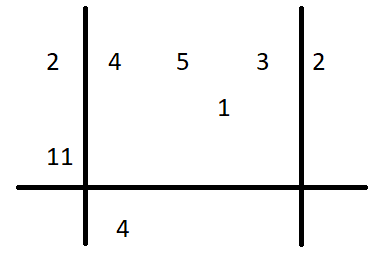
In the next step we have to form a new number which is obtained by taking the difference of the product of 2 and 4 and the number formed using the digit 1 and 3. So, we have,
\[\Rightarrow \] New number = \[13-\left( 4\times 2 \right)\]
\[\Rightarrow \] New number = 13 – 8
\[\Rightarrow \] New number = 5
Now, we have to divide 5 by 11. So, on dividing we will get 0 as the quotient and 5 as the remainder because 5 is smaller than 11 and cannot be divided. So, we have,
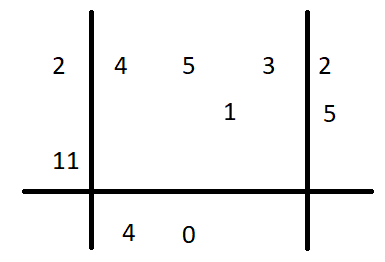
Again, we have to calculate the new number using the same approach. So, we have,
\[\Rightarrow \] New number = \[52-\left( 2\times 0 \right)\]
\[\Rightarrow \] New number = 52
Since, we have reached the last digit 2, so we can conclude that no further division is required and our quotient is 40 while remainder is 52.
Note: One may note that we can also write the numbers in the three columns as:-
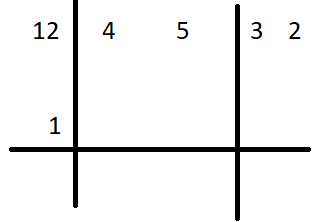
and use the same approach that we have used in the solution. The main thing you have to remember is that the number of digits that are present as the flag number in the first column will replace the same number of digits from the dividend in the second column to the third column. Remember that the new number that is found in each step must be positive. If it turns out to be negative then drop the quotient by one unit and then find the remainder and new number.
Now, first divide 45 by 11 and write the quotient below the horizontal line while writing the remainder above the horizontal line between the digits 5 and 3 just below them. In the next step, form a new number by subtracting the product of 2 and the quotient obtained from the number formed using the remainder and the digit 3. Apply this process till we reach the rightmost digit 2 to get the quotient and the remainder.
Complete step by step solution:
Here, we have been asked to divide the number 4532 by 112 using Dhwajank method.
Now, the Dhwajank method is a process in vedic mathematics used for the division of numbers. Let us understand this method by taking the example of the numbers given in the question.
Here, we have the numbers 4532 and 112 where 4532 is the dividend and 112 Is the divisor. Now, in the first step we form three columns and fill the given numbers as shown.
In the first column we have written the number 112 in such a way that 11 is called the main number, used for division and 2 is called the flag number, used for multiplication. Since one digit from the number 112 is written above so one digit from the number 45323 goes to the third column.
Now, we have to divide the first digit in column 2, i.e., 4, by 11. Since, 4 will not be divisible by 11 so we move a digit forward and consider the number 45. So, dividing 45 by 11 we have the quotient 4 and remainder 1. This can be written as: -
In the next step we have to form a new number which is obtained by taking the difference of the product of 2 and 4 and the number formed using the digit 1 and 3. So, we have,
\[\Rightarrow \] New number = \[13-\left( 4\times 2 \right)\]
\[\Rightarrow \] New number = 13 – 8
\[\Rightarrow \] New number = 5
Now, we have to divide 5 by 11. So, on dividing we will get 0 as the quotient and 5 as the remainder because 5 is smaller than 11 and cannot be divided. So, we have,
Again, we have to calculate the new number using the same approach. So, we have,
\[\Rightarrow \] New number = \[52-\left( 2\times 0 \right)\]
\[\Rightarrow \] New number = 52
Since, we have reached the last digit 2, so we can conclude that no further division is required and our quotient is 40 while remainder is 52.
Note: One may note that we can also write the numbers in the three columns as:-
and use the same approach that we have used in the solution. The main thing you have to remember is that the number of digits that are present as the flag number in the first column will replace the same number of digits from the dividend in the second column to the third column. Remember that the new number that is found in each step must be positive. If it turns out to be negative then drop the quotient by one unit and then find the remainder and new number.
Recently Updated Pages
Master Class 9 General Knowledge: Engaging Questions & Answers for Success

Master Class 9 Social Science: Engaging Questions & Answers for Success
Master Class 9 English: Engaging Questions & Answers for Success
Master Class 9 Maths: Engaging Questions & Answers for Success
Master Class 9 Science: Engaging Questions & Answers for Success
Class 9 Question and Answer - Your Ultimate Solutions Guide
Trending doubts
Difference Between Plant Cell and Animal Cell
Fill the blanks with the suitable prepositions 1 The class 9 english CBSE
Who is eligible for RTE class 9 social science CBSE
Which places in India experience sunrise first and class 9 social science CBSE
What is pollution? How many types of pollution? Define it
Name 10 Living and Non living things class 9 biology CBSE