




Distinguish between pollination and fertilisation. Mention the site and product of fertilisation in a flower. Draw a neat labelled diagram of a pistil showing pollen tube growth and its entry into the ovule.
Answer
 Verified
545.7k+ views
Hint: Plants use pollination and fertilisation to reproduce sexually. They are the two most common and natural ways of generating offspring. Both the male and female reproductive structures (anther and stigma) are involved in this process, which occurs in all bisexual flowers. As a result, all flowering plants' reproductive organs are termed flowers.
Complete answer:
Part A-
Part B-
Site of fertilization: Ovary
Product of fertilisation- zygote (fruit in case of plants).
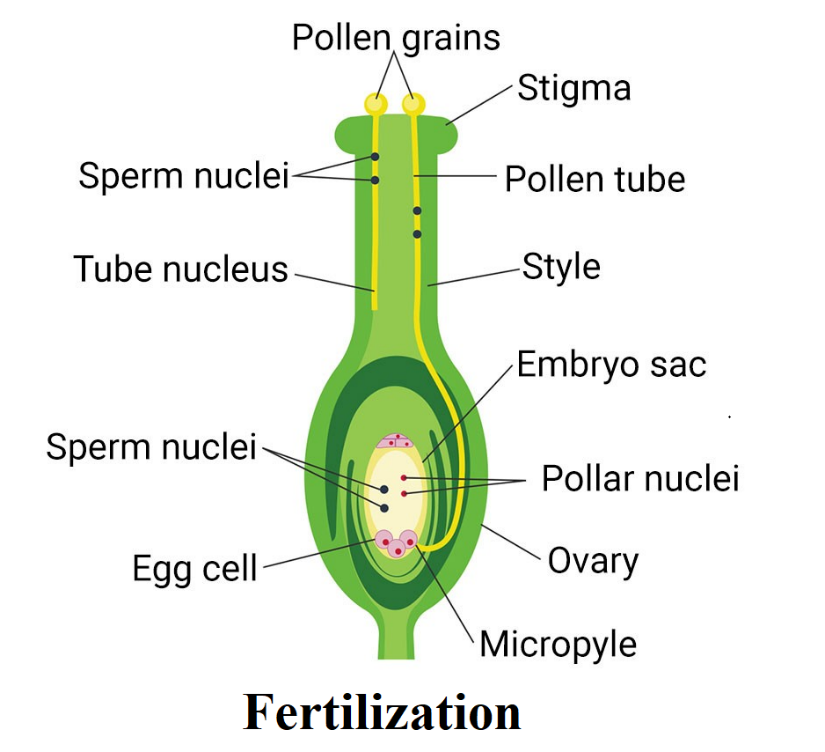
Note:
1. Pollination: is the biological process of pollen grains being transferred from a flower's male reproductive cell to its female reproductive cell. Pollen grains containing male genetic material are taken from the anther and transported to the stigma of a flower in this procedure. Pollen grains are transmitted between the anther and the stigma via a variety of vectors during pollination.
2. Fertilisation: Female and male gametes join together to produce a diploid zygote during fertilisation. This occurs after the carpel has been pollinated. The entire process of fertilisation takes place within the zygote in order for it to develop into a seed, and flowers, as the reproductive structures of angiosperms, play a key role.
Complete answer:
Part A-
| POLLINATION | FERTILISATION |
| It is the biological process of pollen grains being transferred from a flower's male reproductive cell to its female reproductive cell. | Female and male gametes join together to produce a diploid zygote during fertilisation. |
| Pollination is a process that occurs outside of the body. | Fertilization can occur on the inside or outside of the body. |
| Pollination occurs before fertilisation. | After pollination, fertilisation takes place. |
| Pollination happens from the stamen anthers to the ovary stigma. | The merger of female and male gametes is what it's all about. |
| Wind, water, birds, insects, and other creatures are all pollination agents. | The pollen tube that penetrates the ovule grows and fertilises the ovule. |
| Fertilization is the result of this procedure. | Seeds are formed as a result of this process. |
| It is not necessary to use the pollen tube. | Male gametes are transferred into an egg cell using pollen tubes. |
| Only flowering plants pollinate each other. | Fertilization is practised by nearly every living being on the globe, including plants, animals, birds, insects, humans, and so on. |
Part B-
Site of fertilization: Ovary
Product of fertilisation- zygote (fruit in case of plants).
Note:
1. Pollination: is the biological process of pollen grains being transferred from a flower's male reproductive cell to its female reproductive cell. Pollen grains containing male genetic material are taken from the anther and transported to the stigma of a flower in this procedure. Pollen grains are transmitted between the anther and the stigma via a variety of vectors during pollination.
2. Fertilisation: Female and male gametes join together to produce a diploid zygote during fertilisation. This occurs after the carpel has been pollinated. The entire process of fertilisation takes place within the zygote in order for it to develop into a seed, and flowers, as the reproductive structures of angiosperms, play a key role.
Recently Updated Pages
Master Class 10 Computer Science: Engaging Questions & Answers for Success

Master Class 10 Social Science: Engaging Questions & Answers for Success
Master Class 10 Science: Engaging Questions & Answers for Success
Class 10 Question and Answer - Your Ultimate Solutions Guide
Master Class 10 Maths: Engaging Questions & Answers for Success
Master Class 10 English: Engaging Questions & Answers for Success
Trending doubts
What is the Total Duration of Football Match?
Explain the Treaty of Vienna of 1815 class 10 social science CBSE
In football, which nation is called "La Roja"?
E Sathi Yojna? Complete Guide & Benefits
10 examples of evaporation in daily life with explanations
What is the full form of POSCO class 10 social science CBSE