



Distinguish between homologous and analogous organs.
Answer
 Verified
619.8k+ views
Hint: Out of both i.e homologous and analogous organs one has a similar embryonic origin; analogous organs have a similar function. Some of the organisms may be very closely related to each other, even though there is a minor genetic change caused by a major morphological difference to make them look quite different.
Complete answer:
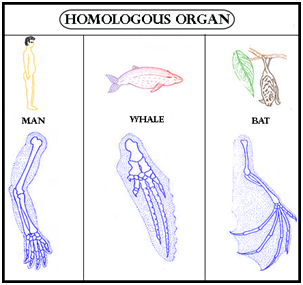
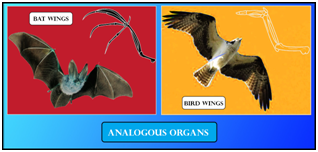
Similar traits are often either homologous or analogous. Homologous structures share an identical embryonic origin; analogous organs have an identical function. For instance, the bones within the front flipper of a whale are homologous to the bones within the human arm. These structures aren't analogous. The wings of a butterfly and therefore the wings of a bird are analogous but not homologous. Some structures are both analogous and homologous: the wings of a bird and therefore the wings of a bat are both homologous and analogous.
Note:
Some of the organisms could also be very closely related, even though a minor genetic change caused a serious morphological difference to make them look quite different. Similarly, unrelated organisms could also be distantly related, but appear considerably alike. This usually happens because of the reason that both of the organisms were in common adaptations that evolved within environmental conditions that were similar.
Complete answer:
Similar traits are often either homologous or analogous. Homologous structures share an identical embryonic origin; analogous organs have an identical function. For instance, the bones within the front flipper of a whale are homologous to the bones within the human arm. These structures aren't analogous. The wings of a butterfly and therefore the wings of a bird are analogous but not homologous. Some structures are both analogous and homologous: the wings of a bird and therefore the wings of a bat are both homologous and analogous.
| Homologous Structure | Analogous Structure |
| They show similar anatomy | They show Dissimilar anatomy |
| Dissimilar functions | Similar Functions |
| They are Inherited from a common ancestor | They are not inherited from ancestors |
| Develops in the related species. | These develop in unrelated species |
| These are the result of divergent evolution | These are the result of convergent evolution |
| They are developed as a result of the adaptation to a different environment | They are developed as a result of the adaptation to a similar environment |
| An arm of a human being, the leg of a dog, or a flipper of a whale or fish are all homologous structures | From wings of the birds, bats, and insects to fins in penguins and fishes are all analogous structures |
Note:
Some of the organisms could also be very closely related, even though a minor genetic change caused a serious morphological difference to make them look quite different. Similarly, unrelated organisms could also be distantly related, but appear considerably alike. This usually happens because of the reason that both of the organisms were in common adaptations that evolved within environmental conditions that were similar.
Recently Updated Pages
Which of the following graphs shows the variation of class 12 physics CBSE

Draw a labelled diagram of the human male reproductive class 12 biology CBSE
Describe the experiment to compare the emf of two cells class 12 physics CBSE
What is standard hydrogen electrode
What is conventional current and electric current class 12 physics CBSE
2Bromopentane is treated with an alcoholic KOH solution class 12 chemistry CBSE
Trending doubts
Draw a labelled sketch of the human eye class 12 physics CBSE
Which are the Top 10 Largest Countries of the World?
Draw ray diagrams each showing i myopic eye and ii class 12 physics CBSE
Which is the correct genotypic ratio of mendel dihybrid class 12 biology CBSE
Which is the strongest oxidising agent out of the following class 12 chemistry CBSE
Differentiate between homogeneous and heterogeneous class 12 chemistry CBSE