




How will you distinguish among the following pairs?
n – Butyl, sec. butyl and tert. Butyl alcohols
Answer
 Verified
572.7k+ views
Hint: Alcohols are classified as primary, secondary and tertiary. The alcohol group attached with only 1 carbon is termed as primary; alcohol attached to 2 other carbons is secondary and with 3 carbon atoms is tertiary alcohol. Alcohols are named as n, sec, and tert with their arrangement of the alcohol group. The Lucas test will distinguish among these.
Complete answer:
We have been given a pair of alcohols as n – Butyl, sec. butyl and tert. Butyl alcohols. In n – butyl alcohol, the OH group is attached with one carbon atom, so it is primary$1{}^\circ $ alcohol. In sec – butyl alcohol, the OH group is attached with two carbon atoms, so it is secondary $2{}^\circ $alcohol. In tert – butyl alcohol, the OH group is attached with three carbon atoms, so it is tertiary $3{}^\circ $alcohol.
These $1{}^\circ ,2{}^\circ ,3{}^\circ $alcohols are distinguished by Lucas reagent test. Lucas reagent is anhydrous zinc chloride and hydrochloric acid in the ratio 1:1 $ZnC{{l}_{2}}+HCl$. By reacting with Lucas reagent, alcohols form halides (alkyl chlorides) which have variable solubility. So, on reaction,
n – butyl alcohol is a primary alcohol, so it will have no reaction with Lucas reagent as:
$C{{H}_{3}}C{{H}_{2}}C{{H}_{2}}C{{H}_{2}}OH\xrightarrow{ZnC{{l}_{2}}+HCl}no\,reaction$
Sec – butyl alcohol, will form a turbid solution after 5 minutes due to the formation of secondary halide as:
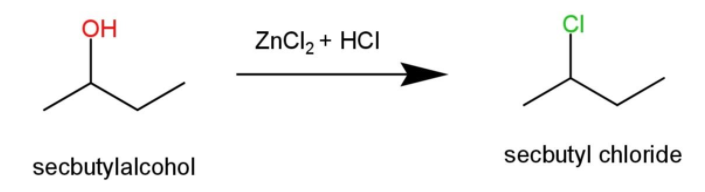
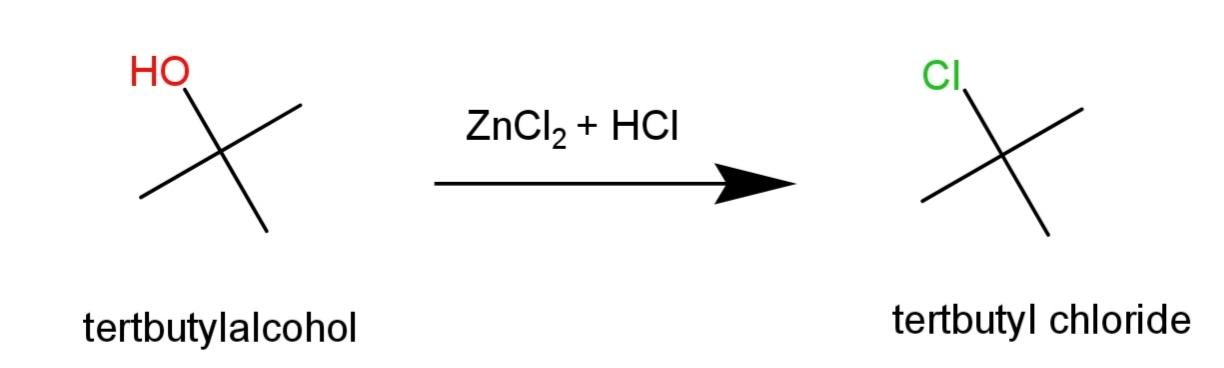
Tert – butyl alcohol will show immediate turbidity in the reaction as it is a tertiary halide as:
Hence, n – Butyl, sec – butyl and tert – Butyl alcohols can be distinguished by the turbidity formed on reaction with Lucas reagent that is $ZnC{{l}_{2}}+HCl$.
Note:
The decreasing order of the reaction of alcohols towards Lucas reagent is$3{}^\circ >2{}^\circ >1{}^\circ $ as tertiary alcohols will give immediate turbidity with Lucas reagent. This test is based on the fact that alcohols are soluble in Lucas reagent, but the halides are not soluble, so they will form a turbid solution with cloudiness.
Complete answer:
We have been given a pair of alcohols as n – Butyl, sec. butyl and tert. Butyl alcohols. In n – butyl alcohol, the OH group is attached with one carbon atom, so it is primary$1{}^\circ $ alcohol. In sec – butyl alcohol, the OH group is attached with two carbon atoms, so it is secondary $2{}^\circ $alcohol. In tert – butyl alcohol, the OH group is attached with three carbon atoms, so it is tertiary $3{}^\circ $alcohol.
These $1{}^\circ ,2{}^\circ ,3{}^\circ $alcohols are distinguished by Lucas reagent test. Lucas reagent is anhydrous zinc chloride and hydrochloric acid in the ratio 1:1 $ZnC{{l}_{2}}+HCl$. By reacting with Lucas reagent, alcohols form halides (alkyl chlorides) which have variable solubility. So, on reaction,
n – butyl alcohol is a primary alcohol, so it will have no reaction with Lucas reagent as:
$C{{H}_{3}}C{{H}_{2}}C{{H}_{2}}C{{H}_{2}}OH\xrightarrow{ZnC{{l}_{2}}+HCl}no\,reaction$
Sec – butyl alcohol, will form a turbid solution after 5 minutes due to the formation of secondary halide as:
Tert – butyl alcohol will show immediate turbidity in the reaction as it is a tertiary halide as:
Hence, n – Butyl, sec – butyl and tert – Butyl alcohols can be distinguished by the turbidity formed on reaction with Lucas reagent that is $ZnC{{l}_{2}}+HCl$.
Note:
The decreasing order of the reaction of alcohols towards Lucas reagent is$3{}^\circ >2{}^\circ >1{}^\circ $ as tertiary alcohols will give immediate turbidity with Lucas reagent. This test is based on the fact that alcohols are soluble in Lucas reagent, but the halides are not soluble, so they will form a turbid solution with cloudiness.
Recently Updated Pages
Which will be the least stable resonating structure class 11 chemistry CBSE

How many 5 digit telephone numbers can be construc-class-11-maths-CBSE
How do you find the angle of the resultant vector class 11 physics CBSE
Draw labelled diagram of the following i Gram seed class 11 biology CBSE
1 Quintal is equal to a 110 kg b 10 kg c 100kg d 1000 class 11 physics CBSE
What is the need and importance of classification class 11 biology CBSE
Trending doubts
Find the value of the expression given below sin 30circ class 11 maths CBSE
The teeth used for biting and cutting food are called class 11 biology CBSE
Bond order ofO2 O2+ O2 and O22 is in order A O2 langle class 11 chemistry CBSE
Frogs heart when taken out of the body continues to class 11 biology CBSE
Can anyone list 10 advantages and disadvantages of friction
Draw a diagram of a plant cell and label at least eight class 11 biology CBSE