




Distance from city P to city Q by two different routes are \[81km\] and \[85km\] . A car taking a longer route travels on the average \[2km/hr\] faster than taking the shorter route and completes the journey in \[15\] minutes less. Find the speed of two cars.
Answer
 Verified
545.7k+ views
Hint: We are given two different routes to travel from one city to another. Also given that when that car travels from these two different routes it takes different time slots. The difference in these time slots is 15min. but the time required to travel from a shorter route is 15min more than that from a longer route just because the speed on a longer route is more. Now in order to find the speed we will consider the speed of shorter route as \[x{\text{ }}km/hr\] and that of the longer route as \[x + 2{\text{ }}km/hr\]. Then using the formula for speed and time we will form an equation on solving which we will get the speeds of the cars.
Complete step-by-step answer:
Let’s draw a diagram first.
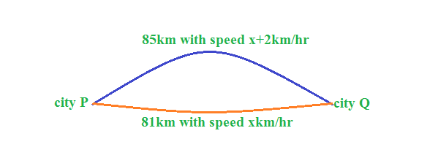
Let the speed on shorter route be \[x{\text{ }}km/hr\]
Given that the car taking longer route travels on the average \[2km/hr\] faster than taking the shorter route
So speed for longer route be \[x + 2{\text{ }}km/hr\]
Now the time difference is 15min. but we will take this in hours because the speeds are in km/hrs.
Now we know that,
\[speed = \dfrac{{dis\tan ce}}{{time}}\]
So we can modify it as,
\[time = \dfrac{{dis\tan ce}}{{speed}}\]
Now we will use this modified formula as
\[\dfrac{{15}}{{60}} = \dfrac{{81}}{x} - \dfrac{{85}}{{x + 2}}\]
Now we just have to solve this.
\[\dfrac{1}{4} = \dfrac{{81}}{x} - \dfrac{{85}}{{x + 2}}\]
On taking LCM on RHS
\[\dfrac{1}{4} = \dfrac{{81\left( {x + 2} \right) - 85x}}{{x\left( {x + 2} \right)}}\]
Now on multiplying we get,
\[\dfrac{1}{4} = \dfrac{{81x + 81 \times 2 - 85x}}{{{x^2} + 2x}}\]
On taking the like terms on one side and performing necessary operation we get,
\[\dfrac{1}{4} = \dfrac{{81x - 85x + 162}}{{{x^2} + 2x}}\]
\[\dfrac{1}{4} = \dfrac{{ - 4x + 162}}{{{x^2} + 2x}}\]
On cross multiplying we get,
\[{x^2} + 2x = 4\left( { - 4x + 162} \right)\]
Now multiplying 4 with the bracket,
\[{x^2} + 2x = - 16x + 648\]
Taking the terms on one side of the equation we get,
\[{x^2} + 2x + 16x - 648 = 0\]
On adding the like terms,
\[{x^2} + 18x - 648 = 0\]
This is if we observe a quadratic equation of the form \[a{x^2} + bx + c = 0\] so solving this with the quadratic equation method we get the values for x.
\[\dfrac{{ - b \pm \sqrt {{b^2} - 4ac} }}{{2a}}\]
Putting the values we get,
\[ = \dfrac{{ - 18 \pm \sqrt {{{18}^2} + 4 \times 1 \times 648} }}{{2 \times 1}}\]
Taking the square,
\[ = \dfrac{{ - 18 \pm \sqrt {324 + 4 \times 1 \times 648} }}{{2 \times 1}}\]
On multiplying the numbers we get,
\[ = \dfrac{{ - 18 \pm \sqrt {324 + 2529} }}{2}\]
On adding the numbers in bracket we get,
\[ = \dfrac{{ - 18 \pm \sqrt {2916} }}{2}\]
We know that 2916 is a perfect square of 54. So taking the root,
\[ = \dfrac{{ - 18 \pm 54}}{2}\]
Now we will get two roots as
\[ = \dfrac{{ - 18 + 54}}{2}or\dfrac{{ - 18 - 54}}{2}\]
But since the value of x is the speed parameter, it is not negative. So we will take the root with positive signs only.
\[ = \dfrac{{ - 18 + 54}}{2}\]
\[ = \dfrac{{36}}{2}\]
So value of x is \[ = 18km/hr\]
And that of other car is \[ = x + 2 = 18 + 2 = 20km/hr\]
Thus the speeds are \[ = 18km/hr\] and \[ = 20km/hr\].
So, the correct answer is “Thus the speeds are \[ 18km/hr\] and \[ 20km/hr\]”.
Note: Here note that when we form the equation speed of car taking shorter route is definitely less than speed of car taking longer route. That is time consumed by a car taking a longer route is less than that of taking a shorter route. Thus we should subtract the distance speed ratio of a car taking a shorter route from that of taking a longer route. Otherwise if reversed the answer will lose its way of solution.
Complete step-by-step answer:
Let’s draw a diagram first.
Let the speed on shorter route be \[x{\text{ }}km/hr\]
Given that the car taking longer route travels on the average \[2km/hr\] faster than taking the shorter route
So speed for longer route be \[x + 2{\text{ }}km/hr\]
Now the time difference is 15min. but we will take this in hours because the speeds are in km/hrs.
Now we know that,
\[speed = \dfrac{{dis\tan ce}}{{time}}\]
So we can modify it as,
\[time = \dfrac{{dis\tan ce}}{{speed}}\]
Now we will use this modified formula as
\[\dfrac{{15}}{{60}} = \dfrac{{81}}{x} - \dfrac{{85}}{{x + 2}}\]
Now we just have to solve this.
\[\dfrac{1}{4} = \dfrac{{81}}{x} - \dfrac{{85}}{{x + 2}}\]
On taking LCM on RHS
\[\dfrac{1}{4} = \dfrac{{81\left( {x + 2} \right) - 85x}}{{x\left( {x + 2} \right)}}\]
Now on multiplying we get,
\[\dfrac{1}{4} = \dfrac{{81x + 81 \times 2 - 85x}}{{{x^2} + 2x}}\]
On taking the like terms on one side and performing necessary operation we get,
\[\dfrac{1}{4} = \dfrac{{81x - 85x + 162}}{{{x^2} + 2x}}\]
\[\dfrac{1}{4} = \dfrac{{ - 4x + 162}}{{{x^2} + 2x}}\]
On cross multiplying we get,
\[{x^2} + 2x = 4\left( { - 4x + 162} \right)\]
Now multiplying 4 with the bracket,
\[{x^2} + 2x = - 16x + 648\]
Taking the terms on one side of the equation we get,
\[{x^2} + 2x + 16x - 648 = 0\]
On adding the like terms,
\[{x^2} + 18x - 648 = 0\]
This is if we observe a quadratic equation of the form \[a{x^2} + bx + c = 0\] so solving this with the quadratic equation method we get the values for x.
\[\dfrac{{ - b \pm \sqrt {{b^2} - 4ac} }}{{2a}}\]
Putting the values we get,
\[ = \dfrac{{ - 18 \pm \sqrt {{{18}^2} + 4 \times 1 \times 648} }}{{2 \times 1}}\]
Taking the square,
\[ = \dfrac{{ - 18 \pm \sqrt {324 + 4 \times 1 \times 648} }}{{2 \times 1}}\]
On multiplying the numbers we get,
\[ = \dfrac{{ - 18 \pm \sqrt {324 + 2529} }}{2}\]
On adding the numbers in bracket we get,
\[ = \dfrac{{ - 18 \pm \sqrt {2916} }}{2}\]
We know that 2916 is a perfect square of 54. So taking the root,
\[ = \dfrac{{ - 18 \pm 54}}{2}\]
Now we will get two roots as
\[ = \dfrac{{ - 18 + 54}}{2}or\dfrac{{ - 18 - 54}}{2}\]
But since the value of x is the speed parameter, it is not negative. So we will take the root with positive signs only.
\[ = \dfrac{{ - 18 + 54}}{2}\]
\[ = \dfrac{{36}}{2}\]
So value of x is \[ = 18km/hr\]
And that of other car is \[ = x + 2 = 18 + 2 = 20km/hr\]
Thus the speeds are \[ = 18km/hr\] and \[ = 20km/hr\].
So, the correct answer is “Thus the speeds are \[ 18km/hr\] and \[ 20km/hr\]”.
Note: Here note that when we form the equation speed of car taking shorter route is definitely less than speed of car taking longer route. That is time consumed by a car taking a longer route is less than that of taking a shorter route. Thus we should subtract the distance speed ratio of a car taking a shorter route from that of taking a longer route. Otherwise if reversed the answer will lose its way of solution.

Recently Updated Pages
Master Class 8 Social Science: Engaging Questions & Answers for Success

Master Class 8 English: Engaging Questions & Answers for Success
Class 8 Question and Answer - Your Ultimate Solutions Guide
Master Class 8 Maths: Engaging Questions & Answers for Success
Master Class 8 Science: Engaging Questions & Answers for Success
Master Class 9 General Knowledge: Engaging Questions & Answers for Success
Trending doubts
What is BLO What is the full form of BLO class 8 social science CBSE
Citizens of India can vote at the age of A 18 years class 8 social science CBSE
Full form of STD, ISD and PCO
Advantages and disadvantages of science
Right to vote is a AFundamental Right BFundamental class 8 social science CBSE
What are the 12 elements of nature class 8 chemistry CBSE