




Distance between centres of two stars is $10a$. The masses of these stars are $M$ and $16M$and their radii are $a$and$2a$, respectively. A body is fired straight from the surface of the large star towards the smaller star. What should be its minimum initial speed to reach the surface of the smaller star?
Answer
 Verified
619.5k+ views
Hint:We now that when a body is thrown from one surface to another surface, it is attracted towards both the surface due to their gravitational forces at some point between these two surfaces, the body experiences equilibrium condition when it is under equal gravitational force of both the surface. Here, we will use this concept first to find the distance of the body from surfaces of both stars to point at which the body is under equal influence of forces of both the stars which act in opposite directions. After that, we will use the law of conservation of energy to find the body's minimum initial speed to reach the surface of the smaller star.
Formulas used:
$F = \dfrac{{GMm}}{{{r^2}}}$ ,
where, $F$ is attractive force, $G$ is the gravitational constant, $M$ and $m$ are two masses separated by distance $r$ and $r$ is the distance between both masses
$E = - \dfrac{{GMm}}{{{r^{}}}}$,
where, $E$ is gravitational potential energy, $G$ is the gravitational constant, $M$ and $m$ are two masses separated by distance $r$ and $r$ is the distance between both masses
$K.E. = \dfrac{1}{2}m{v^2}$,
where, $K.E.$ is kinetic energy, $m$ is mass of the body and $v$ is velocity of the body
Complete step by step answer:
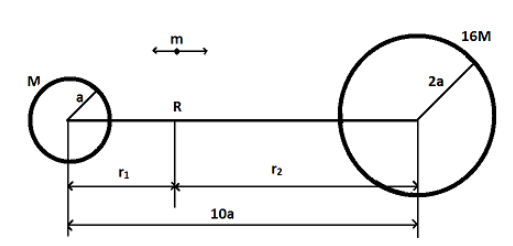
From the diagram, Let as consider that at point R, the body with mass $m$ experiences equilibrium condition when it is under equal gravitational force of both the surfaces. Attractive force of smaller star is given by $\dfrac{{GMm}}{{{r_1}^2}}$and that of the bigger star is given by $\dfrac{{16GMm}}{{{r_2}^2}}$
Now, at point R,
$
\dfrac{{GMm}}{{{r_1}^2}} = \dfrac{{16GMm}}{{{r_2}^2}} \\
\Rightarrow \left( {\dfrac{{{r_2}^2}}{{{r_1}^2}}} \right) = 16 \\
\Rightarrow {r_2} = 4{r_1} \\
$
The total distance between the stars is given as $10a$
$
\Rightarrow {r_1} + {r_2} = 10a \\
\Rightarrow {r_1} + 4{r_1} = 10a \\
\Rightarrow 5{r_1} = 10a \\
\Rightarrow {r_1} = 2a \\
\Rightarrow {r_2} = 8a \\
$
Now we will use the energy conservation between the surface of the bigger star and point R.
\[
\Rightarrow K.E{._{surface}} + P.E{._{surface}} = K.E{._R} + P.E{._R} \\
\Rightarrow \dfrac{1}{2}m{\left( {{v_{\min }}} \right)^2} + \left[ { - \dfrac{{16GMm}}{{2a}} - \dfrac{{GMm}}{{\left( {10a - 2a} \right)}}} \right] = 0 + \left( { - \dfrac{{16GMm}}{{{r_2}}} - \dfrac{{GMm}}{{{r_2}}}} \right) \\
\]
(Here, \[{v_{\min }}\] is the minimum initial speed of the body to reach the surface of the smaller star. Also, there is no kinetic energy at point R.
\[
\Rightarrow \dfrac{1}{2}m{\left( {{v_{\min }}} \right)^2} = \dfrac{{16GMm}}{{2a}} + \dfrac{{GMm}}{{8a}} - \dfrac{{16GMm}}{{8a}} - \dfrac{{GMm}}{{2a}} \\
\Rightarrow \dfrac{1}{2}m{\left( {{v_{\min }}} \right)^2} = \dfrac{{GMm}}{{2a}}\left( {16 + \dfrac{1}{4} - 4 - 1} \right) \\
\Rightarrow \dfrac{1}{2}m{\left( {{v_{\min }}} \right)^2} = \dfrac{{45GMm}}{{8a}} \\
\Rightarrow {v_{\min }} = \sqrt {\dfrac{{45GM}}{{4a}}} \\
\therefore {v_{\min }} = \dfrac{{3\sqrt 5 }}{2}\sqrt {\dfrac{{GM}}{a}} \\
\]
Thus, minimum initial speed of the body to reach the surface of the smaller star is \[\dfrac{{3\sqrt 5 }}{2}\sqrt {\dfrac{{GM}}{a}} \].
Note:Here, we have determined the minimum initial speed of the body to reach the surface of the smaller star when it is minimum initial speed of the body to reach the surface of the smaller star. From the obtained answer, it is clearly seen that this minimum velocity is dependent on the Gravitational constant \[G\], mass of the smaller star \[M\] and radius of the smaller star \[a\]. Also it is independent of the mass of the body \[m\].
Formulas used:
$F = \dfrac{{GMm}}{{{r^2}}}$ ,
where, $F$ is attractive force, $G$ is the gravitational constant, $M$ and $m$ are two masses separated by distance $r$ and $r$ is the distance between both masses
$E = - \dfrac{{GMm}}{{{r^{}}}}$,
where, $E$ is gravitational potential energy, $G$ is the gravitational constant, $M$ and $m$ are two masses separated by distance $r$ and $r$ is the distance between both masses
$K.E. = \dfrac{1}{2}m{v^2}$,
where, $K.E.$ is kinetic energy, $m$ is mass of the body and $v$ is velocity of the body
Complete step by step answer:
From the diagram, Let as consider that at point R, the body with mass $m$ experiences equilibrium condition when it is under equal gravitational force of both the surfaces. Attractive force of smaller star is given by $\dfrac{{GMm}}{{{r_1}^2}}$and that of the bigger star is given by $\dfrac{{16GMm}}{{{r_2}^2}}$
Now, at point R,
$
\dfrac{{GMm}}{{{r_1}^2}} = \dfrac{{16GMm}}{{{r_2}^2}} \\
\Rightarrow \left( {\dfrac{{{r_2}^2}}{{{r_1}^2}}} \right) = 16 \\
\Rightarrow {r_2} = 4{r_1} \\
$
The total distance between the stars is given as $10a$
$
\Rightarrow {r_1} + {r_2} = 10a \\
\Rightarrow {r_1} + 4{r_1} = 10a \\
\Rightarrow 5{r_1} = 10a \\
\Rightarrow {r_1} = 2a \\
\Rightarrow {r_2} = 8a \\
$
Now we will use the energy conservation between the surface of the bigger star and point R.
\[
\Rightarrow K.E{._{surface}} + P.E{._{surface}} = K.E{._R} + P.E{._R} \\
\Rightarrow \dfrac{1}{2}m{\left( {{v_{\min }}} \right)^2} + \left[ { - \dfrac{{16GMm}}{{2a}} - \dfrac{{GMm}}{{\left( {10a - 2a} \right)}}} \right] = 0 + \left( { - \dfrac{{16GMm}}{{{r_2}}} - \dfrac{{GMm}}{{{r_2}}}} \right) \\
\]
(Here, \[{v_{\min }}\] is the minimum initial speed of the body to reach the surface of the smaller star. Also, there is no kinetic energy at point R.
\[
\Rightarrow \dfrac{1}{2}m{\left( {{v_{\min }}} \right)^2} = \dfrac{{16GMm}}{{2a}} + \dfrac{{GMm}}{{8a}} - \dfrac{{16GMm}}{{8a}} - \dfrac{{GMm}}{{2a}} \\
\Rightarrow \dfrac{1}{2}m{\left( {{v_{\min }}} \right)^2} = \dfrac{{GMm}}{{2a}}\left( {16 + \dfrac{1}{4} - 4 - 1} \right) \\
\Rightarrow \dfrac{1}{2}m{\left( {{v_{\min }}} \right)^2} = \dfrac{{45GMm}}{{8a}} \\
\Rightarrow {v_{\min }} = \sqrt {\dfrac{{45GM}}{{4a}}} \\
\therefore {v_{\min }} = \dfrac{{3\sqrt 5 }}{2}\sqrt {\dfrac{{GM}}{a}} \\
\]
Thus, minimum initial speed of the body to reach the surface of the smaller star is \[\dfrac{{3\sqrt 5 }}{2}\sqrt {\dfrac{{GM}}{a}} \].
Note:Here, we have determined the minimum initial speed of the body to reach the surface of the smaller star when it is minimum initial speed of the body to reach the surface of the smaller star. From the obtained answer, it is clearly seen that this minimum velocity is dependent on the Gravitational constant \[G\], mass of the smaller star \[M\] and radius of the smaller star \[a\]. Also it is independent of the mass of the body \[m\].
Recently Updated Pages
Master Class 11 English: Engaging Questions & Answers for Success

Master Class 11 Physics: Engaging Questions & Answers for Success
Master Class 11 Computer Science: Engaging Questions & Answers for Success
Master Class 11 Chemistry: Engaging Questions & Answers for Success
Master Class 11 Social Science: Engaging Questions & Answers for Success
Master Class 11 Accountancy: Engaging Questions & Answers for Success
Trending doubts
Difference Between Prokaryotic Cells and Eukaryotic Cells
Two of the body parts which do not appear in MRI are class 11 biology CBSE
One Metric ton is equal to kg A 10000 B 1000 C 100 class 11 physics CBSE
10 examples of friction in our daily life
Draw a diagram of nephron and explain its structur class 11 biology CBSE
Draw a diagram of a plant cell and label at least eight class 11 biology CBSE