




Distal convoluted tubule is lined with
(a) Simple cuboidal epithelium
(b) Ciliated squamous epithelium
(c) Pseudostratified epithelium
(d) None of the above
Answer
 Verified
623.1k+ views
Hint: Distal convoluted tubule is a part of the nephron which is the structural and functional unit of the kidney. A distal convoluted tubule has the main role in conditional reabsorption of ions and is lined by specialized flat-cells.
Complete answer:
Distal convoluted tubules are lined with simple cuboidal epithelium. The simple cuboidal epithelium consists of a single layer of cube-like cells that provide protection and differentiates to perform secretory functions also. They also function in absorption. As distal convoluted epithelium has a function of conditional reabsorption so simple cuboidal epithelium helps in the absorption of sodium ions and water.
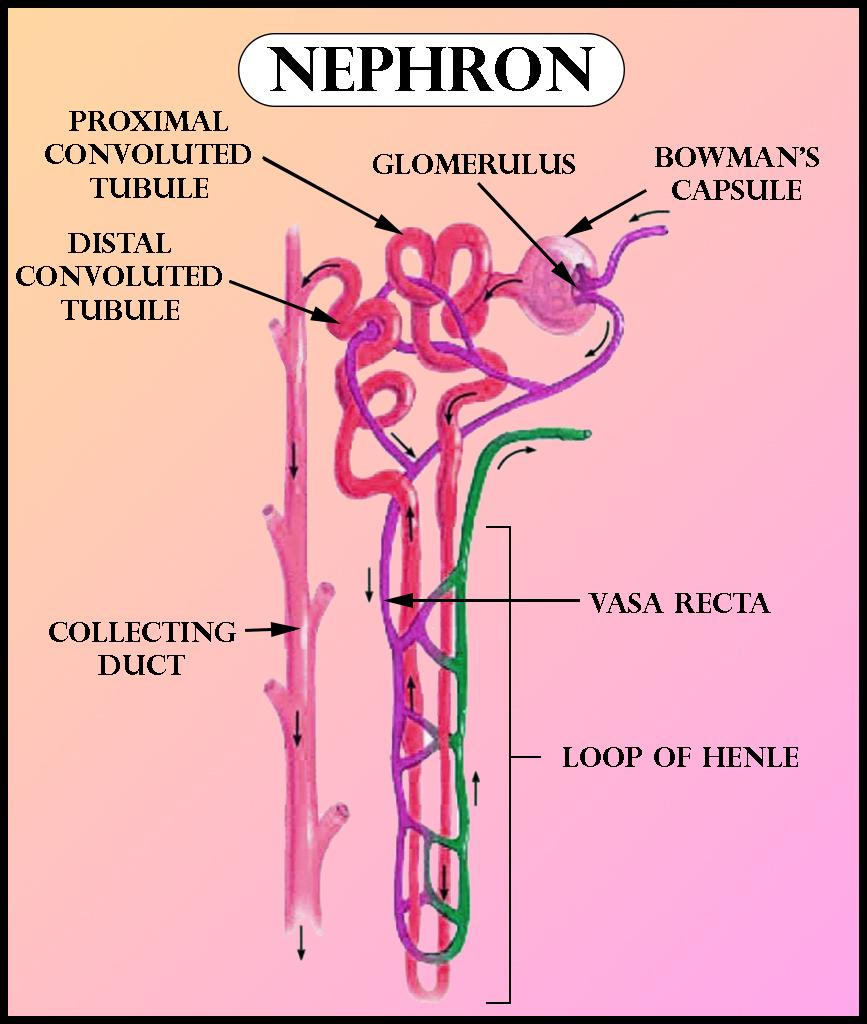
Additional Information: - Nephron in the kidney consists of 4 regions- Bowman's capsule, proximal convoluted tubule (PCT), a loop of Henle, and distal convoluted tubule (DCT).
- Bowman's capsule has the function of ultrafiltration which is the step in urine formation, proximal convoluted tubule is the region where 70-80% of electrolytes and water are reabsorbed. The loop of Henle has two parts-ascending and descending limbs. The ascending limb is impermeable to water and concentrates the filtrate whereas the descending limb is impermeable to electrolytes and thus dilutes the filtrate.
- Distal convoluted tubules conditionally reabsorbs water and sodium ions. Aldosterone hormone reabsorbs sodium ions actively and ADH reabsorbs water passively. DCT also reabsorbs bicarbonate.
So, the correct answer is `simple cuboidal epithelium`.
Note: Nephrons are of two types-juxtamedullary nephrons and cortical nephrons. Juxtamedullary nephrons run deep into the medulla and cortical nephrons run only a small part in the medulla. Juxtamedullary nephrons are only 15% of the total and cortical nephrons are about 85% of the total.
Complete answer:
Distal convoluted tubules are lined with simple cuboidal epithelium. The simple cuboidal epithelium consists of a single layer of cube-like cells that provide protection and differentiates to perform secretory functions also. They also function in absorption. As distal convoluted epithelium has a function of conditional reabsorption so simple cuboidal epithelium helps in the absorption of sodium ions and water.
Additional Information: - Nephron in the kidney consists of 4 regions- Bowman's capsule, proximal convoluted tubule (PCT), a loop of Henle, and distal convoluted tubule (DCT).
- Bowman's capsule has the function of ultrafiltration which is the step in urine formation, proximal convoluted tubule is the region where 70-80% of electrolytes and water are reabsorbed. The loop of Henle has two parts-ascending and descending limbs. The ascending limb is impermeable to water and concentrates the filtrate whereas the descending limb is impermeable to electrolytes and thus dilutes the filtrate.
- Distal convoluted tubules conditionally reabsorbs water and sodium ions. Aldosterone hormone reabsorbs sodium ions actively and ADH reabsorbs water passively. DCT also reabsorbs bicarbonate.
So, the correct answer is `simple cuboidal epithelium`.
Note: Nephrons are of two types-juxtamedullary nephrons and cortical nephrons. Juxtamedullary nephrons run deep into the medulla and cortical nephrons run only a small part in the medulla. Juxtamedullary nephrons are only 15% of the total and cortical nephrons are about 85% of the total.
Recently Updated Pages
Master Class 11 English: Engaging Questions & Answers for Success

Master Class 11 Social Science: Engaging Questions & Answers for Success
Master Class 11 Maths: Engaging Questions & Answers for Success
Master Class 11 Biology: Engaging Questions & Answers for Success
Master Class 11 Physics: Engaging Questions & Answers for Success
Master Class 11 Chemistry: Engaging Questions & Answers for Success
Trending doubts
One Metric ton is equal to kg A 10000 B 1000 C 100 class 11 physics CBSE
Difference Between Prokaryotic Cells and Eukaryotic Cells
Find the value of the expression given below sin 30circ class 11 maths CBSE
Difference between physical and chemical change class 11 chemistry CBSE
Two of the body parts which do not appear in MRI are class 11 biology CBSE
Draw a diagram of a plant cell and label at least eight class 11 biology CBSE