




Dissolving sugar in water is a chemical change. True or False?
A. True
B. False
Answer
 Verified
671.1k+ views
Hint: We should be knowing the basic difference between the physical change and chemical change so as to answer this question. Even we should be familiar with the reaction when sugar is dissolved in water.
Complete step-by-step answer:
Physical changes and changes affecting the form of a chemical substance but not a chemical composition. Physical changes are used to separate mixtures into their component compounds but cannot usually be used to separate compounds into chemical elements or similar compounds.
Chemical changes occur when a substance combines with another way to form a new substance called chemical synthesis or alternatively chemical decomposition into two or more different substances. These processes are called chemical reactions and in general are not reversible except by for the chemical reactions.
Dissolving sugar in water is a physical change because sugar molecules are dispersed within the water but the individual sugar molecules are unchanged.
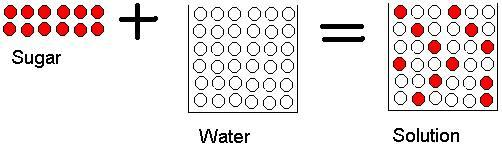
Therefore we can see that dissolving sugar in water is a physical change and the answer to this question is false. So Option B is a correct option.
Note: We should know that in a physical change the molecules are rearranged while their actual composition remains the same. In a chemical change the molecular composition of a substance completely changes and a new system is formed.
Some examples of physical changes: freezing of water, melting of wax, boiling of water etc.
Melting and burning of candle wax is an example of both physical and chemical change. Burning of wood is an example of both physical and chemical change.
Complete step-by-step answer:
Physical changes and changes affecting the form of a chemical substance but not a chemical composition. Physical changes are used to separate mixtures into their component compounds but cannot usually be used to separate compounds into chemical elements or similar compounds.
Chemical changes occur when a substance combines with another way to form a new substance called chemical synthesis or alternatively chemical decomposition into two or more different substances. These processes are called chemical reactions and in general are not reversible except by for the chemical reactions.
Dissolving sugar in water is a physical change because sugar molecules are dispersed within the water but the individual sugar molecules are unchanged.
Therefore we can see that dissolving sugar in water is a physical change and the answer to this question is false. So Option B is a correct option.
Note: We should know that in a physical change the molecules are rearranged while their actual composition remains the same. In a chemical change the molecular composition of a substance completely changes and a new system is formed.
Some examples of physical changes: freezing of water, melting of wax, boiling of water etc.
Melting and burning of candle wax is an example of both physical and chemical change. Burning of wood is an example of both physical and chemical change.
Recently Updated Pages
10 examples of evaporation in daily life with explanations

Explain the Treaty of Vienna of 1815 class 10 social science CBSE
A boat goes 24 km upstream and 28 km downstream in class 10 maths CBSE
Write any three differences between metals and nonmetals class 10 social science CBSE
Amit standing on a horizontal plane finds a bird flying class 10 maths CBSE
Two circles of radii 5 cm and 3 cm intersect at two class 10 maths CBSE
Trending doubts
Make a sketch of the human nerve cell What function class 10 biology CBSE
Differentiate between Xylem and phloem class 10 biology CBSE
Identify the feminine form of noun nephew a shenephew class 10 english CBSE
State and prove converse of BPT Basic Proportionality class 10 maths CBSE
Who is responsible for measuring the GDP in India AState class 10 social science CBSE
Identify the feminine form of the word Duke a Dukes class 10 english CBSE