




Discuss the main steps in the digestion of proteins as the food passes through different parts of the alimentary canal
Answer
 Verified
661.8k+ views
Hint: Protein digestion occurs in different organs by different enzymes acting on the polypeptides. They are broken down from complex polypeptides to amino acids through various steps and enzymes.
Complete answer:
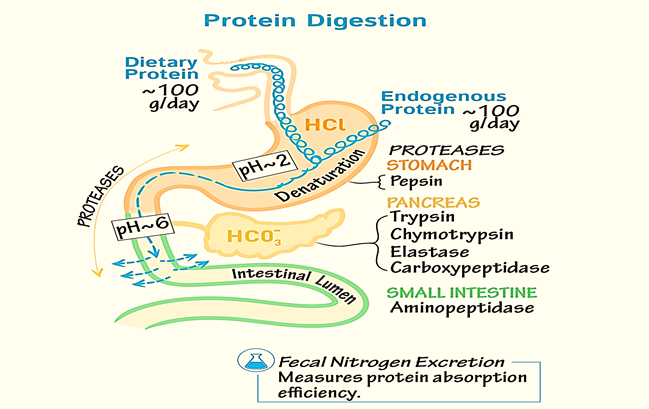
Protein digestion begins in the stomach and completes in the small intestine.
The enzymes that act upon and cause the breakdown of proteins are known as proteases.
Digestion in the stomach
The digestive secretions from the gastric glands present on the inner lining of the stomach walls is called gastric juice. The main components of the gastric juice include Hydrochloric acid ($\text{ HCl }$), pepsinogen, and rennin. The food entering the stomach becomes acidic on mixing with the gastric juice.
The acidic pH converts inactive pepsinogen into active pepsin which then converts the proteins into proteases and peptides.
${\ Proteins\xrightarrow { Pepsin } }{ Proteases }+{ Peptides } $
The enzyme rennin in the gastric juice plays an important role in the coagulation of milk.
Digestion in the small intestine
The partly digested food mixed with gastric juices from the stomach which enter the small intestine is known as chyme. The chyme is acted upon by three enzymes in the small intestine- the pancreatic juice, intestinal juice or succus entericus, and bile juice.
The action of pancreatic juice:
Pancreatic juice contains many inactive enzymes such as trypsinogen, chymotrypsinogen, and carboxypeptidases. The enzyme enterokinase that is secreted by the intestinal mucosa activates trypsinogen into trypsin.
${ { Trypsinogen }\xrightarrow { Enterokinase } }{ Trypsin }+{ Inactive\quad peptide }$
The activated trypsin, in turn, activates the other enzymes of the pancreatic juice.
Chymotrypsinogen gets converted to chymotrypsin, which is a proteolytic enzyme that breaks down proteins into peptides.
${ { Chymotrypsinogen }\xrightarrow { Trypsin } }{ Chymotrypsin }$
${ Proteins\xrightarrow { { Chymotrypsin } } }Peptides$
Carboxypeptidases are the enzymes that act on the carboxyl end of the peptide chain and release the last amino acids.
${ Peptides }{ \xrightarrow { { Carboxypeptidases } } }Smaller\quad peptide\quad chain+{ Amino\quad acids }$
The action of intestinal juice:
Intestinal juice contains many different enzymes. Pancreatic amylases digest polysaccharides into disaccharides which are further broken down to monosaccharides.
The proteases in intestinal juice hydrolyze peptides into dipeptides and finally into amino acids.
${ Dipeptides }{ \xrightarrow { Dipeptidases } }{ Peptides }$
Note:
Pancreatic juice also has lipase which breaks down fats into diglycerides and monoglycerides.
The nucleases are the enzymes that break down nucleic acids into nucleotides and nucleosides.
Bile juice that is seen in the intestine enters from the gallbladder and it is necessary for the emulsification of fat.
Complete answer:
Protein digestion begins in the stomach and completes in the small intestine.
The enzymes that act upon and cause the breakdown of proteins are known as proteases.
Digestion in the stomach
The digestive secretions from the gastric glands present on the inner lining of the stomach walls is called gastric juice. The main components of the gastric juice include Hydrochloric acid ($\text{ HCl }$), pepsinogen, and rennin. The food entering the stomach becomes acidic on mixing with the gastric juice.
The acidic pH converts inactive pepsinogen into active pepsin which then converts the proteins into proteases and peptides.
${\ Proteins\xrightarrow { Pepsin } }{ Proteases }+{ Peptides } $
The enzyme rennin in the gastric juice plays an important role in the coagulation of milk.
Digestion in the small intestine
The partly digested food mixed with gastric juices from the stomach which enter the small intestine is known as chyme. The chyme is acted upon by three enzymes in the small intestine- the pancreatic juice, intestinal juice or succus entericus, and bile juice.
The action of pancreatic juice:
Pancreatic juice contains many inactive enzymes such as trypsinogen, chymotrypsinogen, and carboxypeptidases. The enzyme enterokinase that is secreted by the intestinal mucosa activates trypsinogen into trypsin.
${ { Trypsinogen }\xrightarrow { Enterokinase } }{ Trypsin }+{ Inactive\quad peptide }$
The activated trypsin, in turn, activates the other enzymes of the pancreatic juice.
Chymotrypsinogen gets converted to chymotrypsin, which is a proteolytic enzyme that breaks down proteins into peptides.
${ { Chymotrypsinogen }\xrightarrow { Trypsin } }{ Chymotrypsin }$
${ Proteins\xrightarrow { { Chymotrypsin } } }Peptides$
Carboxypeptidases are the enzymes that act on the carboxyl end of the peptide chain and release the last amino acids.
${ Peptides }{ \xrightarrow { { Carboxypeptidases } } }Smaller\quad peptide\quad chain+{ Amino\quad acids }$
The action of intestinal juice:
Intestinal juice contains many different enzymes. Pancreatic amylases digest polysaccharides into disaccharides which are further broken down to monosaccharides.
The proteases in intestinal juice hydrolyze peptides into dipeptides and finally into amino acids.
${ Dipeptides }{ \xrightarrow { Dipeptidases } }{ Peptides }$
Note:
Pancreatic juice also has lipase which breaks down fats into diglycerides and monoglycerides.
The nucleases are the enzymes that break down nucleic acids into nucleotides and nucleosides.
Bile juice that is seen in the intestine enters from the gallbladder and it is necessary for the emulsification of fat.
Recently Updated Pages
If x a + bt + ct2 where x is in meters and t is in class 11 physics CBSE

A car covers the first half distance between two places class 11 physics CBSE
The resultant of two vectors overrightarrow P and overrightarrow class 11 physics CBSE
Find the value of cos 135 class 11 maths CBSE
A mass M is held in place by an applied force F and class 11 physics CBSE
A solution of glucose in water is labelled as 10 dfracwv class 11 chemistry CBSE
Trending doubts
One Metric ton is equal to kg A 10000 B 1000 C 100 class 11 physics CBSE
Find the value of the expression given below sin 30circ class 11 maths CBSE
Draw a diagram of nephron and explain its structur class 11 biology CBSE
10 examples of friction in our daily life
Proton was discovered by A Thomson B Rutherford C Chadwick class 11 chemistry CBSE
Bond order ofO2 O2+ O2 and O22 is in order A O2 langle class 11 chemistry CBSE