




Discuss the different types of teeth along with their structures and functions.
Answer
 Verified
618.3k+ views
Hint: Humans use teeth to chew and break food into simpler forms. Human adults have 32 teeth in a set. Human beings have four kinds of teeth that are different in structures and perform different roles in processing food.
Complete answer:
Human beings possess heterodont types of teeth. This means that the structure of all the teeth are different and all of these teeth perform different functions.
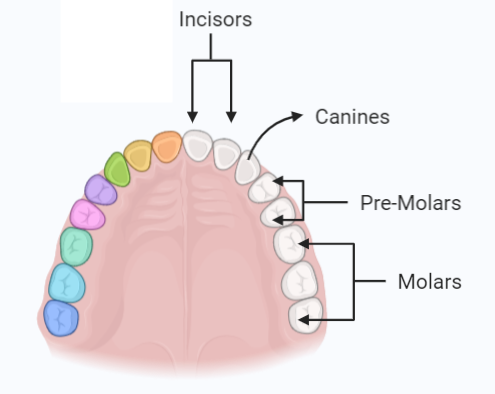
There are four different kinds of teeth found in humans. These four types are –
a. Incisors
b. Canines
c. Premolars
d. Molars
a. Incisors –
These are usually the flat-shaped teeth. These are the first teeth that erupt around the sixth or seventh month in babies. They are usually eight in number. These are used for cutting and biting the food.
b. Canines –
These are usually the pointed teeth, due to which they are the sharpest. These teeth usually erupt around the seventeenth or eighteenth months in babies. They are usually four in number. These are used for tearing and ripping apart the food.
c. Premolars –
These are usually the teeth with cusps. Premolars have two cusps on their surface. These teeth usually erupt for around ten years. They are usually eight in number. These are used for chewing and grinding the food.
d. Molars –
These are usually the teeth with cusps. Molars have three cusps on their surface. These teeth usually erupt around the twelfth to eighteen months. They are usually twelve in number. These are used for chewing and grinding the food. The first two molars are known as the deciduous molars. The third molars are known as wisdom teeth which appear late around the twenties and thirties.
Note:
The dental formula for the children, or the milk teeth or deciduous teeth or the temporary teeth is as follows –
$\begin{matrix}
2 & 1 & 0 & 2 \\
2 & 1 & 0 & 2 \\
\end{matrix}$
This dentition is found up to seven years of age in children.
The dental formula for teenagers is as follows –
$\begin{matrix}
2 & 1 & 2 & 2 \\
2 & 1 & 2 & 2 \\
\end{matrix}$
Finally, the dental formula for the adult teeth or the permanent set of teeth in humans is –
$\begin{matrix}
2 & 1 & 2 & 3 \\
2 & 1 & 2 & 3 \\
\end{matrix}$
Complete answer:
Human beings possess heterodont types of teeth. This means that the structure of all the teeth are different and all of these teeth perform different functions.
There are four different kinds of teeth found in humans. These four types are –
a. Incisors
b. Canines
c. Premolars
d. Molars
a. Incisors –
These are usually the flat-shaped teeth. These are the first teeth that erupt around the sixth or seventh month in babies. They are usually eight in number. These are used for cutting and biting the food.
b. Canines –
These are usually the pointed teeth, due to which they are the sharpest. These teeth usually erupt around the seventeenth or eighteenth months in babies. They are usually four in number. These are used for tearing and ripping apart the food.
c. Premolars –
These are usually the teeth with cusps. Premolars have two cusps on their surface. These teeth usually erupt for around ten years. They are usually eight in number. These are used for chewing and grinding the food.
d. Molars –
These are usually the teeth with cusps. Molars have three cusps on their surface. These teeth usually erupt around the twelfth to eighteen months. They are usually twelve in number. These are used for chewing and grinding the food. The first two molars are known as the deciduous molars. The third molars are known as wisdom teeth which appear late around the twenties and thirties.
Note:
The dental formula for the children, or the milk teeth or deciduous teeth or the temporary teeth is as follows –
$\begin{matrix}
2 & 1 & 0 & 2 \\
2 & 1 & 0 & 2 \\
\end{matrix}$
This dentition is found up to seven years of age in children.
The dental formula for teenagers is as follows –
$\begin{matrix}
2 & 1 & 2 & 2 \\
2 & 1 & 2 & 2 \\
\end{matrix}$
Finally, the dental formula for the adult teeth or the permanent set of teeth in humans is –
$\begin{matrix}
2 & 1 & 2 & 3 \\
2 & 1 & 2 & 3 \\
\end{matrix}$
Recently Updated Pages
Master Class 11 English: Engaging Questions & Answers for Success

Master Class 11 Social Science: Engaging Questions & Answers for Success
Master Class 11 Maths: Engaging Questions & Answers for Success
Master Class 11 Biology: Engaging Questions & Answers for Success
Master Class 11 Physics: Engaging Questions & Answers for Success
Master Class 11 Chemistry: Engaging Questions & Answers for Success
Trending doubts
One Metric ton is equal to kg A 10000 B 1000 C 100 class 11 physics CBSE
Difference Between Prokaryotic Cells and Eukaryotic Cells
Find the value of the expression given below sin 30circ class 11 maths CBSE
Difference between physical and chemical change class 11 chemistry CBSE
Two of the body parts which do not appear in MRI are class 11 biology CBSE
Draw a diagram of a plant cell and label at least eight class 11 biology CBSE