




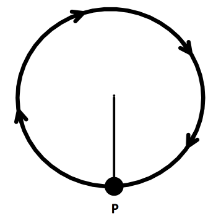
What is the direction of the velocity of the ball at point $P$ ?
A. \[ \to \]
B. \[ \leftarrow \]
C. \[ \downarrow \]
D. \[ \uparrow \]
Answer
 Verified
521.7k+ views
Hint: The direction of linear velocity in a circular motion always changes. Learn about circular motion, angular velocity and the relation between angular velocity and linear velocity to solve the problem.
Formula used:
The angular velocity of any body is related to linear velocity as,
\[v = w \times r\]
where, \[v\] is the linear velocity vector \[r\] is the radius vector or the position vector and \[w\] is the angular velocity vector.
Complete step by step answer:
We have given her a body which is rotating on a circular path with some angular velocity. Now, from the figure we can see that the direction of rotation is in clockwise direction. So, the angular velocity vector of the body must be inside the plane of paper, using the right hand screw rule. Now, the radius vector is along the radial direction away from the centre of the circular path. So, if we denote the angular velocity vector along the negative Z-axis and the radius vector in the X-Y plane along negative X axis, we can write,
\[v = w\hat k \times r( - \hat i)\]
So, performing the cross product we can have, \[v = wr( - \hat j)\]. So, that means the velocity vector will be along the negative Y-axis. So, if we redraw the diagram denoting the radius vector along X-axis we can see that the velocity vector is along the tangential direction.
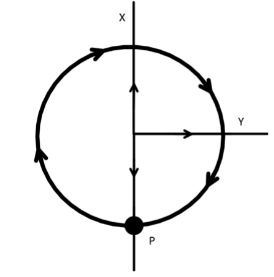
Hence, the velocity of the ball at $P$ is along \[ \leftarrow \] direction.
So, option B is the correct answer.
Note: If the ball is moving with constant angular velocity the magnitude of the linear acceleration will be a constant but as since the body is rotating the direction of the position vector is always changing as a result changing the direction of the linear velocity. The direction of linear velocity always acts in the tangential direction of the path.
Formula used:
The angular velocity of any body is related to linear velocity as,
\[v = w \times r\]
where, \[v\] is the linear velocity vector \[r\] is the radius vector or the position vector and \[w\] is the angular velocity vector.
Complete step by step answer:
We have given her a body which is rotating on a circular path with some angular velocity. Now, from the figure we can see that the direction of rotation is in clockwise direction. So, the angular velocity vector of the body must be inside the plane of paper, using the right hand screw rule. Now, the radius vector is along the radial direction away from the centre of the circular path. So, if we denote the angular velocity vector along the negative Z-axis and the radius vector in the X-Y plane along negative X axis, we can write,
\[v = w\hat k \times r( - \hat i)\]
So, performing the cross product we can have, \[v = wr( - \hat j)\]. So, that means the velocity vector will be along the negative Y-axis. So, if we redraw the diagram denoting the radius vector along X-axis we can see that the velocity vector is along the tangential direction.
Hence, the velocity of the ball at $P$ is along \[ \leftarrow \] direction.
So, option B is the correct answer.
Note: If the ball is moving with constant angular velocity the magnitude of the linear acceleration will be a constant but as since the body is rotating the direction of the position vector is always changing as a result changing the direction of the linear velocity. The direction of linear velocity always acts in the tangential direction of the path.
Recently Updated Pages
Master Class 11 Computer Science: Engaging Questions & Answers for Success

Master Class 11 Business Studies: Engaging Questions & Answers for Success
Master Class 11 Economics: Engaging Questions & Answers for Success
Master Class 11 English: Engaging Questions & Answers for Success
Master Class 11 Maths: Engaging Questions & Answers for Success
Master Class 11 Biology: Engaging Questions & Answers for Success
Trending doubts
One Metric ton is equal to kg A 10000 B 1000 C 100 class 11 physics CBSE
There are 720 permutations of the digits 1 2 3 4 5 class 11 maths CBSE
Discuss the various forms of bacteria class 11 biology CBSE
Draw a diagram of a plant cell and label at least eight class 11 biology CBSE
State the laws of reflection of light
Explain zero factorial class 11 maths CBSE