




Why dipole moment of \[{\text{P}}{{\text{F}}_2}{\text{C}}{{\text{l}}_3}\] is zero but that of \[{\text{P}}{{\text{F}}_{\text{3}}}{\text{C}}{{\text{l}}_{\text{2}}}\] is non-zero?
Answer
 Verified
657k+ views
Hint: \[{\text{P}}{{\text{F}}_{\text{3}}}{\text{C}}{{\text{l}}_{\text{2}}}\] and \[{\text{P}}{{\text{F}}_2}{\text{C}}{{\text{l}}_3}\] are the type of phosphorous Penta halide. The hybridization of these compounds is \[{\text{s}}{{\text{p}}^{\text{3}}}{\text{d}}\]. And the geometry is trigonal bipyramidal. Where the less electronegative atoms are in equatorial position and more electronegative atoms are in axial position.
Complete step by step answer:
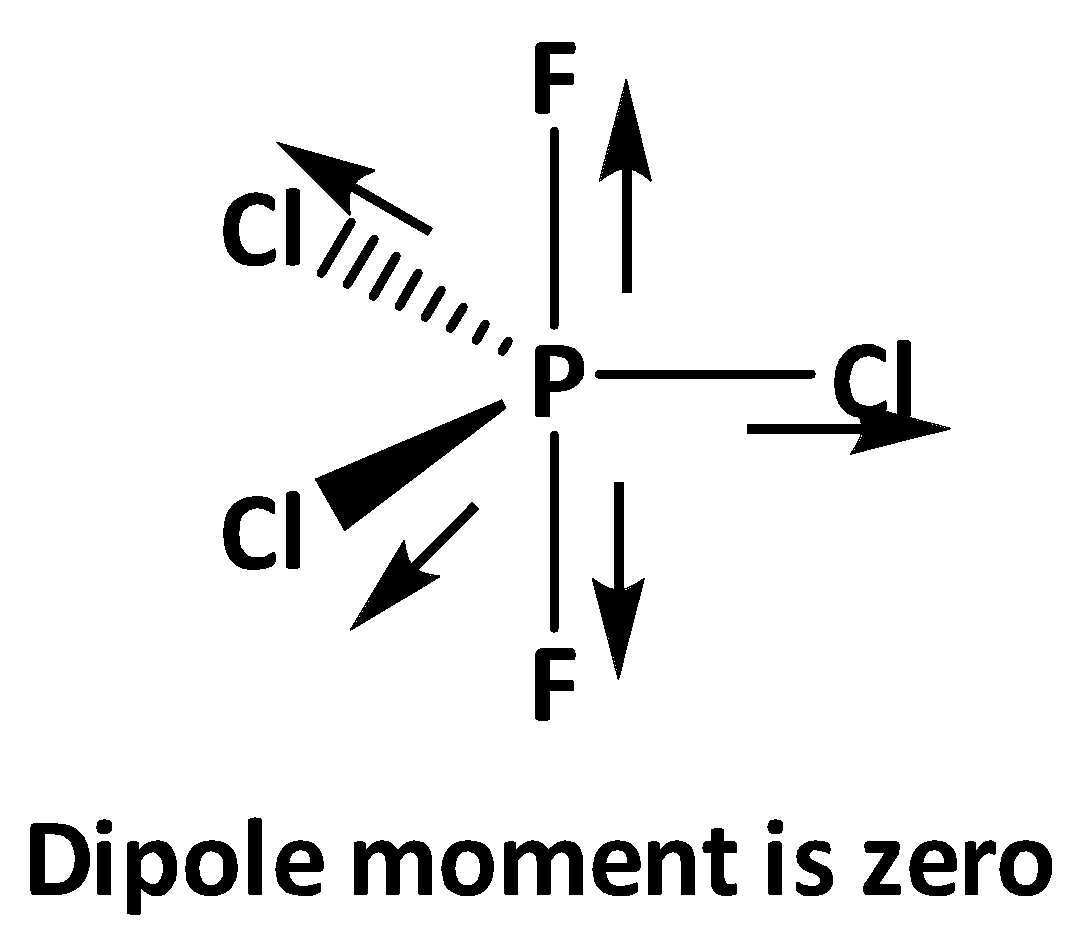
Now in the structures of \[{\text{P}}{{\text{F}}_{\text{3}}}{\text{C}}{{\text{l}}_{\text{2}}}\] and \[{\text{P}}{{\text{F}}_2}{\text{C}}{{\text{l}}_3}\] the axial positions are occupied by two fluorine atoms where the dipole moments of each \[{\text{P - F}}\] bonds nullify with each other. In case of equatorial bonds of \[{\text{P}}{{\text{F}}_2}{\text{C}}{{\text{l}}_3}\] all three \[{\text{P - Cl}}\] bond dipoles nullify with each other. Therefore in \[{\text{P}}{{\text{F}}_2}{\text{C}}{{\text{l}}_3}\] all the bond dipoles get cancel out and shows zero dipole moment.
On the other hand, for \[{\text{P}}{{\text{F}}_{\text{3}}}{\text{C}}{{\text{l}}_{\text{2}}}\] in the equatorial bonds two chlorine and one fluorine is present, as electronegativity of fluorine is greater than chlorine , the overall net dipole moment is to the direction of the \[{\text{P - F}}\] equatorial bond.
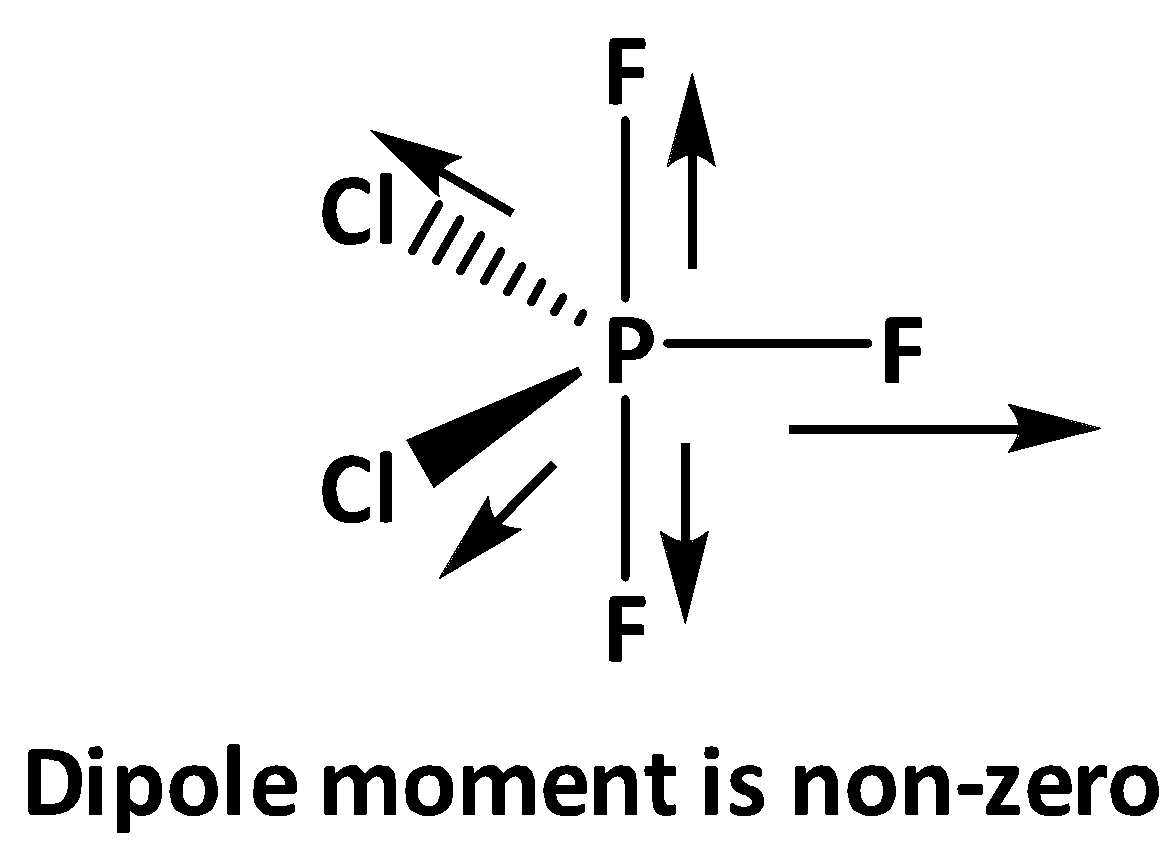
That is why \[{\text{P}}{{\text{F}}_{\text{3}}}{\text{C}}{{\text{l}}_{\text{2}}}\] shows a non-zero dipole moment. On the other hand, \[{\text{P}}{{\text{F}}_{\text{3}}}{\text{C}}{{\text{l}}_{\text{2}}}\]has no dipole moment.
Note:
Hybridization is the concept of mixing atomic orbitals into new hybrid orbitals (with different energies, shapes) suitable for pairing of electrons to form chemical bonds .Hybrid orbitals are the combination of standard atomic orbitals resulting in the formation of new atomic orbitals.
Complete step by step answer:
Now in the structures of \[{\text{P}}{{\text{F}}_{\text{3}}}{\text{C}}{{\text{l}}_{\text{2}}}\] and \[{\text{P}}{{\text{F}}_2}{\text{C}}{{\text{l}}_3}\] the axial positions are occupied by two fluorine atoms where the dipole moments of each \[{\text{P - F}}\] bonds nullify with each other. In case of equatorial bonds of \[{\text{P}}{{\text{F}}_2}{\text{C}}{{\text{l}}_3}\] all three \[{\text{P - Cl}}\] bond dipoles nullify with each other. Therefore in \[{\text{P}}{{\text{F}}_2}{\text{C}}{{\text{l}}_3}\] all the bond dipoles get cancel out and shows zero dipole moment.
On the other hand, for \[{\text{P}}{{\text{F}}_{\text{3}}}{\text{C}}{{\text{l}}_{\text{2}}}\] in the equatorial bonds two chlorine and one fluorine is present, as electronegativity of fluorine is greater than chlorine , the overall net dipole moment is to the direction of the \[{\text{P - F}}\] equatorial bond.
That is why \[{\text{P}}{{\text{F}}_{\text{3}}}{\text{C}}{{\text{l}}_{\text{2}}}\] shows a non-zero dipole moment. On the other hand, \[{\text{P}}{{\text{F}}_{\text{3}}}{\text{C}}{{\text{l}}_{\text{2}}}\]has no dipole moment.
Note:
Hybridization is the concept of mixing atomic orbitals into new hybrid orbitals (with different energies, shapes) suitable for pairing of electrons to form chemical bonds .Hybrid orbitals are the combination of standard atomic orbitals resulting in the formation of new atomic orbitals.
Recently Updated Pages
If x a + bt + ct2 where x is in meters and t is in class 11 physics CBSE

A car covers the first half distance between two places class 11 physics CBSE
The resultant of two vectors overrightarrow P and overrightarrow class 11 physics CBSE
Find the value of cos 135 class 11 maths CBSE
A mass M is held in place by an applied force F and class 11 physics CBSE
A solution of glucose in water is labelled as 10 dfracwv class 11 chemistry CBSE
Trending doubts
One Metric ton is equal to kg A 10000 B 1000 C 100 class 11 physics CBSE
Find the value of the expression given below sin 30circ class 11 maths CBSE
Draw a diagram of nephron and explain its structur class 11 biology CBSE
10 examples of friction in our daily life
Proton was discovered by A Thomson B Rutherford C Chadwick class 11 chemistry CBSE
Bond order ofO2 O2+ O2 and O22 is in order A O2 langle class 11 chemistry CBSE