




Differentiate whiplash flagellum from a tinsel flagellum
Answer
 Verified
627.6k+ views
Hint: Whiplash flagellum is known as acronematic flagella and the tinsel flagellum is also known as pantonematic flagellum. One of these bears has hair-like structures known as flimmer. They are found in fungal spores.
Complete answer:
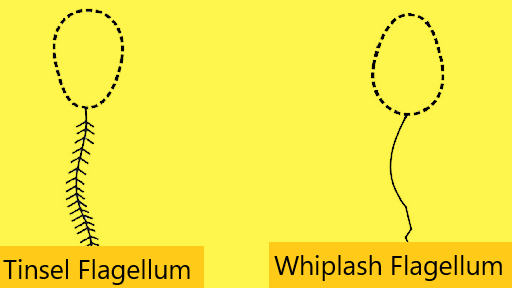
The differences between whiplash flagellum and the tinsel flagellum are in their structures. Whiplash flagellum has a smooth flagellar surface whereas the tinsel flagellum possesses hair-like projections that project out of the flagellar surface. The differences are summarized in the table below:
Additional Information:
The structure of eukaryotic flagella has the following component:
-Basal body
-Rootlets
-Basal Plate
-Shaft
The shaft of the flagella has three parts:
-The membrane covering which has been derived from the plasmalemma
-Matrix
-Axoneme
Note: The important point to remember is that these types of flagellar structures are found in the zoospores of fungi. It is also possible that a single spore can possess both tinsel and whiplash-type of flagella. Whiplash flagella can be further divided into two types one with a blunt end and the other with a non-blunt end. Whiplash flagellum is also known as a naked flagellum.
Complete answer:
The differences between whiplash flagellum and the tinsel flagellum are in their structures. Whiplash flagellum has a smooth flagellar surface whereas the tinsel flagellum possesses hair-like projections that project out of the flagellar surface. The differences are summarized in the table below:
| Whiplash Flagellum | Tinsel Flagellum |
| The Flagellar surface is smooth | The Flagellar surface bears hair-like projections |
| The flagella may have a narrow tip or blunt tip | The tip is not narrow, it is mostly covered by hairs |
| It is also known as acronematic or peitchgeisal flagellum | It is also known as pantonematic or flimmergeisel flagellum |
| Flagella is unbranched and has a 90-degree bend at the ends | Flagella are branched and no 90-degree bend is present. |
| Mastigonemes are absent | Mastigonemes are present |
| During the flagellar movement, the bent end shows back and forth whipping movement and therefore these flagella are known as whiplash flagella | The tinsel flagellum has numerous hair-like structures which look similar to the tinsels of aluminum Christmas tree and therefore they are known as a tinsel flagellum |
Additional Information:
The structure of eukaryotic flagella has the following component:
-Basal body
-Rootlets
-Basal Plate
-Shaft
The shaft of the flagella has three parts:
-The membrane covering which has been derived from the plasmalemma
-Matrix
-Axoneme
Note: The important point to remember is that these types of flagellar structures are found in the zoospores of fungi. It is also possible that a single spore can possess both tinsel and whiplash-type of flagella. Whiplash flagella can be further divided into two types one with a blunt end and the other with a non-blunt end. Whiplash flagellum is also known as a naked flagellum.
Recently Updated Pages
Master Class 11 English: Engaging Questions & Answers for Success

Master Class 11 Social Science: Engaging Questions & Answers for Success
Master Class 11 Maths: Engaging Questions & Answers for Success
Master Class 11 Biology: Engaging Questions & Answers for Success
Master Class 11 Physics: Engaging Questions & Answers for Success
Master Class 11 Chemistry: Engaging Questions & Answers for Success
Trending doubts
One Metric ton is equal to kg A 10000 B 1000 C 100 class 11 physics CBSE
Difference Between Prokaryotic Cells and Eukaryotic Cells
Two of the body parts which do not appear in MRI are class 11 biology CBSE
Find the value of the expression given below sin 30circ class 11 maths CBSE
Draw a diagram of a plant cell and label at least eight class 11 biology CBSE
10 examples of friction in our daily life