




Differentiate between producers and consumers
Answer
 Verified
633.6k+ views
Hint: Producers are those organisms which make their own food by photosynthesis for example plants. These occupy the first trophic level. Consumers are those which depend on producers.
Complete answer:
> Producers:
- Producers are organisms that make their own food.
- They are autotrophs.
- They can convert inorganic substances into organic substances.
- They occupy the first trophic level in the food chain.
- They play a primary role in the food chain.
- They are green photosynthetic plants.
- They entrap solar energy through chlorophyll to synthesise organic food from inorganic raw materials.
- They are also known as “converters” or “transducers”.
- Examples of producers are algae, phytoplankton.
> Consumers:
- Consumers are organisms that need to eat other organisms to obtain energy.
- They are heterotrophs.
- They can not convert inorganic substances to organic substances.
- They do not occupy the first trophic level rather occupy other trophic levels.
- They play a secondary role in the food chain.
- They are not photosynthetic.
- They do not synthesize food by trapping solar energy.
- They are known as “obtainers”.
- Examples of consumers are grasshoppers, frogs etc.
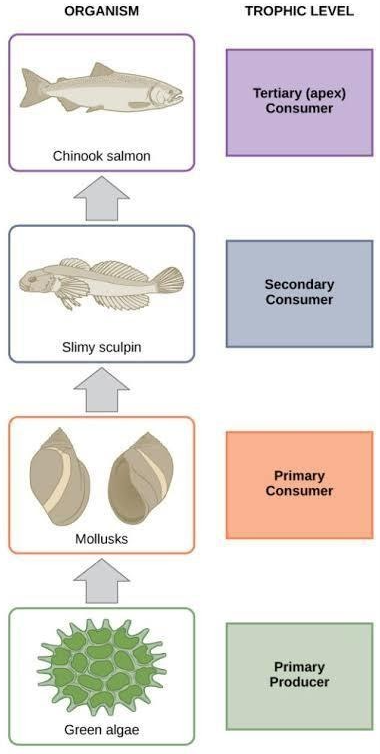
Note: Each step in a food chain is known as trophic levels. There are various trophic levels in the food chain. The first trophic level is occupied by producers and others are occupied by consumers.
Consumers are further classified as:
> Primary consumers :- they eat producers for energy . For example rabbits.
> Secondary consumers :- they eat primary consumers for energy . For example, snakes.
> Tertiary consumers:- they eat secondary consumers for energy. For example eagle
Complete answer:
> Producers:
- Producers are organisms that make their own food.
- They are autotrophs.
- They can convert inorganic substances into organic substances.
- They occupy the first trophic level in the food chain.
- They play a primary role in the food chain.
- They are green photosynthetic plants.
- They entrap solar energy through chlorophyll to synthesise organic food from inorganic raw materials.
- They are also known as “converters” or “transducers”.
- Examples of producers are algae, phytoplankton.
> Consumers:
- Consumers are organisms that need to eat other organisms to obtain energy.
- They are heterotrophs.
- They can not convert inorganic substances to organic substances.
- They do not occupy the first trophic level rather occupy other trophic levels.
- They play a secondary role in the food chain.
- They are not photosynthetic.
- They do not synthesize food by trapping solar energy.
- They are known as “obtainers”.
- Examples of consumers are grasshoppers, frogs etc.
Note: Each step in a food chain is known as trophic levels. There are various trophic levels in the food chain. The first trophic level is occupied by producers and others are occupied by consumers.
Consumers are further classified as:
> Primary consumers :- they eat producers for energy . For example rabbits.
> Secondary consumers :- they eat primary consumers for energy . For example, snakes.
> Tertiary consumers:- they eat secondary consumers for energy. For example eagle
Recently Updated Pages
The given figure shows two endocrine glands marked class 11 biology NEET_UG

Match columnI with columnII and select the correct class 11 biology NEET
Match column I with column II and select the correct class 11 biology NEET_UG
Which floral family has left 9 right + 1 arrangement class 11 biology NEET_UG
Which is not a variety of sheep A Lohi B Beetal C Nellore class 11 biology NEET_UG
Match column I with column II and select the correct class 11 biology NEET_UG
Trending doubts
One Metric ton is equal to kg A 10000 B 1000 C 100 class 11 physics CBSE
Draw a diagram of a plant cell and label at least eight class 11 biology CBSE
Difference Between Prokaryotic Cells and Eukaryotic Cells
Draw a well labelled diagram of reflex arc and explain class 11 biology CBSE
Two of the body parts which do not appear in MRI are class 11 biology CBSE
1 ton equals to A 100 kg B 1000 kg C 10 kg D 10000 class 11 physics CBSE