




Differentiate between hypocotyl and epicotyl.
Answer
 Verified
625.2k+ views
Hint: Seed is a ripened ovule that contains the embryo or the miniature of the plant body. Seeds of different plants vary in size and shape. However, the general plan of the structural organization remains almost the same.
Complete answer: 1. Hypocotyl: The part of the embryonic axis between the radicle and the point of attachment of cotyledons is called the hypocotyl. It terminates with the radicle.
2. Epicotyl: The part of the embryonic axis between the plumule and the point of the attachment of cotyledons is called epicotyl. It terminates with the plumule.
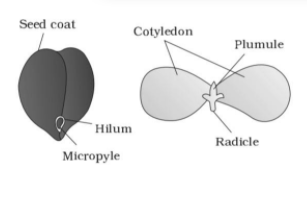
Every seed has an outer covering called the seed coat.
It develops from the integuments of the ovule. The outer coat is called testa and the inner layer is called tegmen. If only one covering is present in the seed it is called testa.
The testa is hard and leathery whereas tegmen is thin and membranous.

The outer surface of the seed shows a scar or mark of attachment with the seed stalk. It is called a hilum. There is a small pore called micropyle, which represents the micropyle of the ovule.
Some seeds also show the place of origin of seed coats (chalaza) and the part of funiculus fused with seed wall (raphe). The seed coat encloses an embryo which is differentiated into radicle, plumule, and cotyledons.
So, the correct answer is “Option D”.
Note: Cotyledon store reserve food material or serve as photosynthetic organs in young seedlings. In beans (in dicotyledons) they reserve food material in the form of carbohydrates and proteins to provide nourishment to the embryonal axis at the time of seed germination and growth of young seedlings. In monocotyledons, they are known as scutellum which helps in the translocation of nutrients from the endosperm to the growing embryo at the time of germination and seedling growth.
Complete answer: 1. Hypocotyl: The part of the embryonic axis between the radicle and the point of attachment of cotyledons is called the hypocotyl. It terminates with the radicle.
2. Epicotyl: The part of the embryonic axis between the plumule and the point of the attachment of cotyledons is called epicotyl. It terminates with the plumule.
Every seed has an outer covering called the seed coat.
It develops from the integuments of the ovule. The outer coat is called testa and the inner layer is called tegmen. If only one covering is present in the seed it is called testa.
The testa is hard and leathery whereas tegmen is thin and membranous.
The outer surface of the seed shows a scar or mark of attachment with the seed stalk. It is called a hilum. There is a small pore called micropyle, which represents the micropyle of the ovule.
Some seeds also show the place of origin of seed coats (chalaza) and the part of funiculus fused with seed wall (raphe). The seed coat encloses an embryo which is differentiated into radicle, plumule, and cotyledons.
So, the correct answer is “Option D”.
Note: Cotyledon store reserve food material or serve as photosynthetic organs in young seedlings. In beans (in dicotyledons) they reserve food material in the form of carbohydrates and proteins to provide nourishment to the embryonal axis at the time of seed germination and growth of young seedlings. In monocotyledons, they are known as scutellum which helps in the translocation of nutrients from the endosperm to the growing embryo at the time of germination and seedling growth.
Recently Updated Pages
Master Class 12 Business Studies: Engaging Questions & Answers for Success

Master Class 12 Chemistry: Engaging Questions & Answers for Success
Master Class 12 Biology: Engaging Questions & Answers for Success
Class 12 Question and Answer - Your Ultimate Solutions Guide
Master Class 11 English: Engaging Questions & Answers for Success
Master Class 11 Social Science: Engaging Questions & Answers for Success
Trending doubts
Which are the Top 10 Largest Countries of the World?
Draw a labelled sketch of the human eye class 12 physics CBSE
Differentiate between homogeneous and heterogeneous class 12 chemistry CBSE
Differentiate between Pyramid of energy and pyramid class 12 biology CBSE
Why is the cell called the structural and functional class 12 biology CBSE
Draw the diagram of the pyramid of energy Explain In class 12 biology CBSE