




Differentiate between ecosystem and biosphere.
Answer
 Verified
657.6k+ views
Hint: Both an ecosystem and a biosphere include the living and nonliving components of earth. It’s important to consider that an ecosystem is a part of the biosphere and the biosphere is one of the layers from four layers of the planet Earth.
Complete answer:
-Taxonomy for organizing life on earth is as follows:
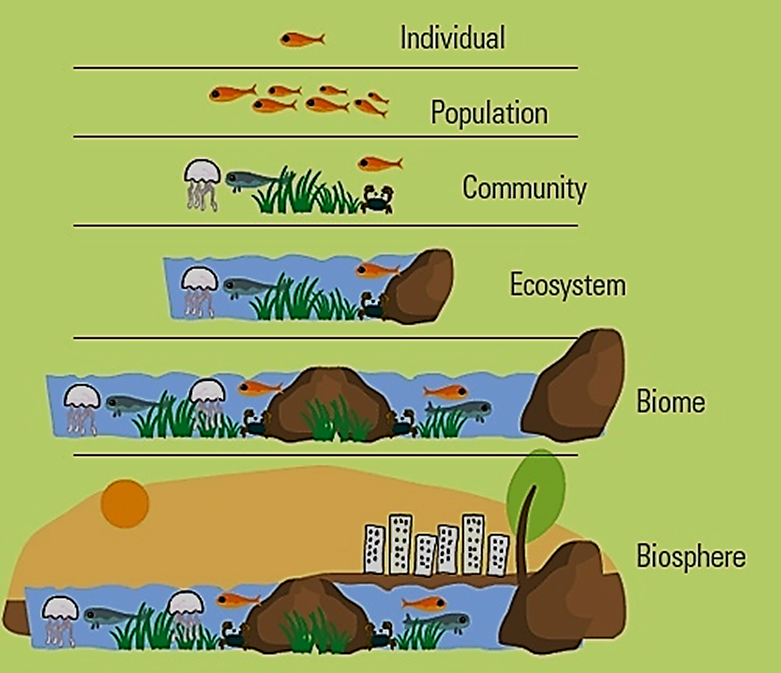
Individual < Population < Community < Ecosystem < Biome < Biosphere < Earth
-Thus, the ecosystem can be defined as a part/area of the biosphere which includes the living and non-living components of the earth that interact within and among themself to maintain the balance in an ecosystem. For example a pond, forest, lake, etc.
-A biosphere is referred to the combination of all ecosystems on Earth, which include all living components, non-living components, and their relationships. It is one of the four layers of earth that is the atmosphere (air), lithosphere (land), biosphere (living and nonliving components and their relationships), and hydrosphere (water), which together sustain life on earth.
Figure 1: Hierarchy of distribution of sources on earth.
Additional Information:
1) An individual in the taxonomy refers to a single organism of any origin.
2) Population refers to a group of organisms of the same origin that are having the same individuals.
3) A community is a group of mixed populations of different species that are having individuals of different origins.
4) Biome refers to the area and not the individuals, a biome is defined as an area occupied by certain organisms having similar non-living components like temperature, precipitation, and vegetation.
Note: An ecosystem can be as small as a tree to as big as a biosphere. An ecosystem includes an area having living and nonliving components without any boundary definition. And thus it forms a part of the biosphere. Similarly, habitat forms a part of the biome, where habitat is defined as the physical environment of a particular species and biome is a geographical area that includes a group of habitats having similar physical conditions like temperature, precipitation, etc.
Complete answer:
-Taxonomy for organizing life on earth is as follows:
Individual < Population < Community < Ecosystem < Biome < Biosphere < Earth
-Thus, the ecosystem can be defined as a part/area of the biosphere which includes the living and non-living components of the earth that interact within and among themself to maintain the balance in an ecosystem. For example a pond, forest, lake, etc.
-A biosphere is referred to the combination of all ecosystems on Earth, which include all living components, non-living components, and their relationships. It is one of the four layers of earth that is the atmosphere (air), lithosphere (land), biosphere (living and nonliving components and their relationships), and hydrosphere (water), which together sustain life on earth.
Figure 1: Hierarchy of distribution of sources on earth.
Additional Information:
1) An individual in the taxonomy refers to a single organism of any origin.
2) Population refers to a group of organisms of the same origin that are having the same individuals.
3) A community is a group of mixed populations of different species that are having individuals of different origins.
4) Biome refers to the area and not the individuals, a biome is defined as an area occupied by certain organisms having similar non-living components like temperature, precipitation, and vegetation.
Note: An ecosystem can be as small as a tree to as big as a biosphere. An ecosystem includes an area having living and nonliving components without any boundary definition. And thus it forms a part of the biosphere. Similarly, habitat forms a part of the biome, where habitat is defined as the physical environment of a particular species and biome is a geographical area that includes a group of habitats having similar physical conditions like temperature, precipitation, etc.
Recently Updated Pages
Class 10 Question and Answer - Your Ultimate Solutions Guide

Master Class 10 Computer Science: Engaging Questions & Answers for Success
Master Class 10 General Knowledge: Engaging Questions & Answers for Success
Master Class 12 Economics: Engaging Questions & Answers for Success
Master Class 12 Social Science: Engaging Questions & Answers for Success
Master Class 12 English: Engaging Questions & Answers for Success
Trending doubts
Explain the Treaty of Vienna of 1815 class 10 social science CBSE
The slogan Jai Hind was given by A Lal Bahadur Shastri class 10 social science CBSE
10 examples of evaporation in daily life with explanations
What is the full form of POSCO class 10 social science CBSE
Identify the feminine form of noun nephew a shenephew class 10 english CBSE
CSIR full form?