




What is the difference between x – intercepts, zeros and roots?
Answer
 Verified
558.3k+ views
Hint: For solving this question you should know about the x – intercepts of a line and the zeros and roots of a polynomial. The x – intercept of a line or graph is the point where the line cuts to the x – axis and this point is known as intercept point. And the zeros and roots both are the same.
Complete step-by-step answer:
According to our questions we have to distinguish between x – intercepts, zeros and roots.
So, as we know that the line is always in the form of \[y=mx+c\] and if we make any line which cuts to the x – axis and y -axis. Then the points where the line cuts to both those points are respectively known as the x – intercept point and y – intercept point. And both will always be different from one another.
If we take an example then we can understand it smoothly.
Eg. (1) Determine the x and y – intercepts of the line - \[y=\dfrac{1}{2}x-3\].
For solving this we will determine the values of y at different points of x.
So, if we take \[x=6\]
\[y=\dfrac{1}{2}\left( 6 \right)-3=3-3=0\]
The point is (6, 0).
And if we take \[x=0\]
Then \[y=0-3=-3\]
The point is (0, -3)
If we make graph for this:
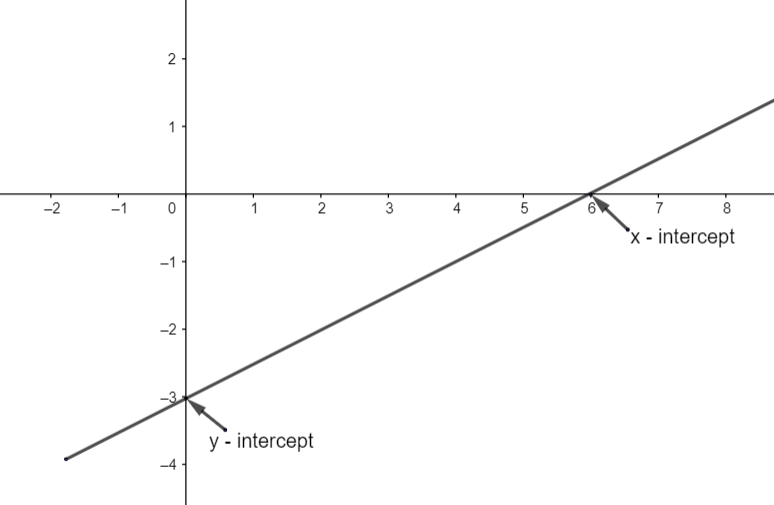
x – intercept is (6, 0)
and y – intercept is (0, -3)
The zeros and roots are the same. And the zeros and roots of a functions f is a value \[{{x}_{0}}\] at which \[f\left( {{x}_{0}} \right)\] will be equal to zero.
It means roots or zero of a function \[f\left( x \right)\] is \[x={{x}_{0}}\] if \[f\left( {{x}_{0}} \right)=0\].
Then \[{{x}_{0}}\] will be a root for this.
And the x – intercepts are equal to zeros and roots of \[y=f\left( x \right)\], if the x – intercepts are the points at which \[y=0\] means the appear exactly at \[f\left( x \right)=0\], i.e., where x is a root of the function.
Here, the root of the \[y=\dfrac{1}{2}x-3\] is x – intercept which is 6.
At this point y = 0.
Note: For calculating the intercepts of any function we plot it on a graph or we can also calculate by the general form of that function and satisfy that at random points. But the roots of a function will be equal to x – intercept if the \[y=0\] at that value of x. Then the value of x will be a root for this.
Complete step-by-step answer:
According to our questions we have to distinguish between x – intercepts, zeros and roots.
So, as we know that the line is always in the form of \[y=mx+c\] and if we make any line which cuts to the x – axis and y -axis. Then the points where the line cuts to both those points are respectively known as the x – intercept point and y – intercept point. And both will always be different from one another.
If we take an example then we can understand it smoothly.
Eg. (1) Determine the x and y – intercepts of the line - \[y=\dfrac{1}{2}x-3\].
For solving this we will determine the values of y at different points of x.
So, if we take \[x=6\]
\[y=\dfrac{1}{2}\left( 6 \right)-3=3-3=0\]
The point is (6, 0).
And if we take \[x=0\]
Then \[y=0-3=-3\]
The point is (0, -3)
If we make graph for this:
x – intercept is (6, 0)
and y – intercept is (0, -3)
The zeros and roots are the same. And the zeros and roots of a functions f is a value \[{{x}_{0}}\] at which \[f\left( {{x}_{0}} \right)\] will be equal to zero.
It means roots or zero of a function \[f\left( x \right)\] is \[x={{x}_{0}}\] if \[f\left( {{x}_{0}} \right)=0\].
Then \[{{x}_{0}}\] will be a root for this.
And the x – intercepts are equal to zeros and roots of \[y=f\left( x \right)\], if the x – intercepts are the points at which \[y=0\] means the appear exactly at \[f\left( x \right)=0\], i.e., where x is a root of the function.
Here, the root of the \[y=\dfrac{1}{2}x-3\] is x – intercept which is 6.
At this point y = 0.
Note: For calculating the intercepts of any function we plot it on a graph or we can also calculate by the general form of that function and satisfy that at random points. But the roots of a function will be equal to x – intercept if the \[y=0\] at that value of x. Then the value of x will be a root for this.
Recently Updated Pages
Master Class 12 Economics: Engaging Questions & Answers for Success

Master Class 12 English: Engaging Questions & Answers for Success
Master Class 12 Social Science: Engaging Questions & Answers for Success
Master Class 12 Maths: Engaging Questions & Answers for Success
Master Class 12 Physics: Engaging Questions & Answers for Success
Master Class 10 English: Engaging Questions & Answers for Success
Trending doubts
Explain the Treaty of Vienna of 1815 class 10 social science CBSE
Who Won 36 Oscar Awards? Record Holder Revealed
Why is it 530 pm in india when it is 1200 afternoon class 10 social science CBSE
Make a sketch of the human nerve cell What function class 10 biology CBSE
What is the full form of POSCO class 10 social science CBSE
Define Potential, Developed, Stock and Reserved resources