



What is the difference between supplementary angle and linear pair?
Answer
 Verified
541.5k+ views
Hint:There are different ways angles can be identified and calculated depending upon the geometry. The properties for parallel lines, line crossing parallel lines, common arm between angles or different angles drawn separately can be presented. There are types of angles and supplementary angle and linear pair are two of them. They may differ on some algebraic properties and in geometric representation.
Complete answer:
There are types of angles and supplementary angle and linear pair are two of them. They may differ on some algebraic properties and in geometric representation. The linear pair has a sum of angles as $ {180^ \circ }$ and there exists a common arm between them.
LINEAR PAIR:
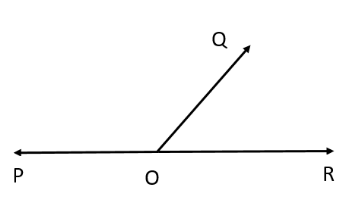
The angles x and y are linear pairs as they lie on a straight line. there exists a common arm in between the two angles.
SUPPLEMENTARY ANGLES: The supplementary angle has a sum of angles as $ {180^ \circ }$ and there is no existence of a common arm between them.
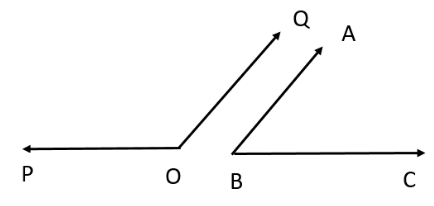
The angle POQ and angle ABC are known as supplementary angles as they dont share a common arm. Supplementary angles can be placed so they form a linear pair (straight line), or they may be two separate angles. Linear pair can be said to be a pair of two supplementary angles. But two supplementary angles might or might not form a linear pair.They just have to "supplement" each other, that is their sum should be $ {180^ \circ }$.
Note:There are four linear pairs formed by two intersecting lines. Each pair form supplementary angles because their sum is $ {180^ \circ }$. There can exist two angles that add up to $ {180^ \circ }$ , but that cannot form a linear pair. For example, two different angles in a parallelogram that are sharing a common side.
Complete answer:
There are types of angles and supplementary angle and linear pair are two of them. They may differ on some algebraic properties and in geometric representation. The linear pair has a sum of angles as $ {180^ \circ }$ and there exists a common arm between them.
LINEAR PAIR:
The angles x and y are linear pairs as they lie on a straight line. there exists a common arm in between the two angles.
SUPPLEMENTARY ANGLES: The supplementary angle has a sum of angles as $ {180^ \circ }$ and there is no existence of a common arm between them.
The angle POQ and angle ABC are known as supplementary angles as they dont share a common arm. Supplementary angles can be placed so they form a linear pair (straight line), or they may be two separate angles. Linear pair can be said to be a pair of two supplementary angles. But two supplementary angles might or might not form a linear pair.They just have to "supplement" each other, that is their sum should be $ {180^ \circ }$.
Note:There are four linear pairs formed by two intersecting lines. Each pair form supplementary angles because their sum is $ {180^ \circ }$. There can exist two angles that add up to $ {180^ \circ }$ , but that cannot form a linear pair. For example, two different angles in a parallelogram that are sharing a common side.
Recently Updated Pages
Master Class 11 Social Science: Engaging Questions & Answers for Success

Master Class 11 Chemistry: Engaging Questions & Answers for Success
Master Class 12 Business Studies: Engaging Questions & Answers for Success
Master Class 12 Chemistry: Engaging Questions & Answers for Success
Master Class 12 Biology: Engaging Questions & Answers for Success
Class 12 Question and Answer - Your Ultimate Solutions Guide
Trending doubts
What is the situation called when no party gets the class 9 social science CBSE
Find the sum of series 1 + 2 + 3 + 4 + 5 + + 100 class 9 maths CBSE
Fill the blanks with the suitable prepositions 1 The class 9 english CBSE
Difference Between Plant Cell and Animal Cell
What is pollution? How many types of pollution? Define it
Name 10 Living and Non living things class 9 biology CBSE