




Difference between shape and geometry of a molecule.
Answer
 Verified
598.5k+ views
Hint: When the atoms of a molecule are arranged in a three-dimensional structure it gives the molecular geometry of that molecule. Various geometrical parameters like bond length, torsional angles, molecular bond angles, etc., that determine the shape of a molecule and the position of the atoms in it.
Complete answer:
When the arrangement of bond pairs and lone pairs around the central atom in a molecule and the coordination number of the molecule is depicted by the geometry of the molecule.
Whereas the lone pairs around the central atom in a molecule are not depicted in the shape of the molecule.
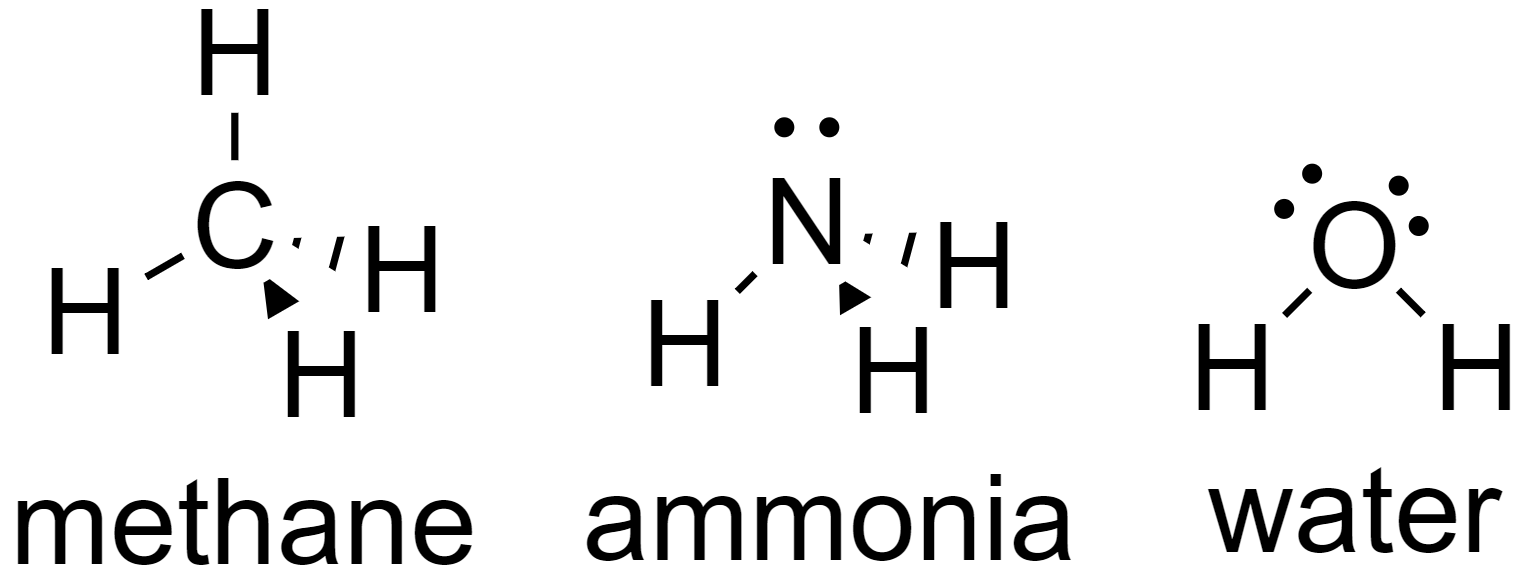
Let us take an example of molecules having coordination number 4, water (${{H}_{2}}O$), ammonia ($N{{H}_{3}}$), and methane ($C{{H}_{4}}$).
Since all of these molecules have coordination number 4, they all have tetrahedral shapes.
Now due to the presence of lone pairs on water (${{H}_{2}}O$) and ammonia ($N{{H}_{3}}$), the geometry of these molecules is different whereas since there are no lone pairs on methane ($C{{H}_{4}}$), it will have an equivalent tetrahedral geometry.
Ammonia ($N{{H}_{3}}$) has a trigonal pyramidal shape.
Water (${{H}_{2}}O$) has a bent v-shape.
Note:
It should be noted that the geometry of a molecule can be determined using the VSEPR model. The VSEPR model of arrangement helps in increasing the stability of the molecule and decreasing its energy.
Now, the formula $A{{X}_{n}}{{E}_{m}}$ can be used while applying the VSEPR theory to represent the number of electron pairs around a central atom.
Where the central atom is represented by A, ligand bonded to the central atom is represented by X, and lone pairs are represented by E.
Now, the molecular geometry of the compound according to the steric number and the $A{{X}_{n}}{{E}_{m}}$ formula is
Complete answer:
When the arrangement of bond pairs and lone pairs around the central atom in a molecule and the coordination number of the molecule is depicted by the geometry of the molecule.
Whereas the lone pairs around the central atom in a molecule are not depicted in the shape of the molecule.
Let us take an example of molecules having coordination number 4, water (${{H}_{2}}O$), ammonia ($N{{H}_{3}}$), and methane ($C{{H}_{4}}$).
Since all of these molecules have coordination number 4, they all have tetrahedral shapes.
Now due to the presence of lone pairs on water (${{H}_{2}}O$) and ammonia ($N{{H}_{3}}$), the geometry of these molecules is different whereas since there are no lone pairs on methane ($C{{H}_{4}}$), it will have an equivalent tetrahedral geometry.
Ammonia ($N{{H}_{3}}$) has a trigonal pyramidal shape.
Water (${{H}_{2}}O$) has a bent v-shape.
Note:
It should be noted that the geometry of a molecule can be determined using the VSEPR model. The VSEPR model of arrangement helps in increasing the stability of the molecule and decreasing its energy.
Now, the formula $A{{X}_{n}}{{E}_{m}}$ can be used while applying the VSEPR theory to represent the number of electron pairs around a central atom.
Where the central atom is represented by A, ligand bonded to the central atom is represented by X, and lone pairs are represented by E.
Now, the molecular geometry of the compound according to the steric number and the $A{{X}_{n}}{{E}_{m}}$ formula is
| STERIC NUMBER | $A{{X}_{n}}{{E}_{m}}$ | MOLECULAR GEOMETRY |
| 2 | $A{{X}_{2}}{{E}_{0}}$ | Linear |
| 3 | $A{{X}_{3}}{{E}_{0}}$ | Trigonal Planar |
| 3 | $A{{X}_{2}}{{E}_{1}}$ | Bent |
| 4 | $A{{X}_{4}}{{E}_{0}}$ | Tetrahedral |
| 4 | $A{{X}_{3}}{{E}_{1}}$ | Trigonal Pyramidal |
| 4 | $A{{X}_{2}}{{E}_{2}}$ | Bent |
| 5 | $A{{X}_{5}}{{E}_{0}}$ | Trigonal Bipyramidal |
| 5 | $A{{X}_{4}}{{E}_{1}}$ | Seesaw |
| 5 | $A{{X}_{3}}{{E}_{2}}$ | T-Shaped |
| 5 | $A{{X}_{2}}{{E}_{3}}$ | Linear. |
Recently Updated Pages
Which will be the least stable resonating structure class 11 chemistry CBSE

How many 5 digit telephone numbers can be construc-class-11-maths-CBSE
How do you find the angle of the resultant vector class 11 physics CBSE
Draw labelled diagram of the following i Gram seed class 11 biology CBSE
1 Quintal is equal to a 110 kg b 10 kg c 100kg d 1000 class 11 physics CBSE
What is the need and importance of classification class 11 biology CBSE
Trending doubts
Find the value of the expression given below sin 30circ class 11 maths CBSE
One Metric ton is equal to kg A 10000 B 1000 C 100 class 11 physics CBSE
10 examples of friction in our daily life
Draw a diagram of a plant cell and label at least eight class 11 biology CBSE
Difference between physical and chemical change class 11 chemistry CBSE
Proton was discovered by A Thomson B Rutherford C Chadwick class 11 chemistry CBSE