




Diethyl amine is treated with ${{H}_{2}}S{{O}_{5}}$(Caro’s acid) to give,
1. Tetraethyl hydrazine
2. Diethyl ether
3. Diethyl hydroxyl amine
4. Ethyl alcohol and ethyl amine
Answer
 Verified
569.1k+ views
Hint: To answer this question, we need to recall that the reaction between secondary amines and Caro’s acid (peroxy mono sulphuric acid). Diethyl amine is a secondary amine as the amine group ($N{{H}_{2}}$) is linked to a secondary carbon atom.
Complete answer:
In the general reaction of amines, we saw that the reaction between secondary amines and Caro’s acid (peroxy mono sulphuric acid) leads to the formation of Dialkyl hydroxylamine as the final product. Caro’s acid is one of the strongest oxidising agents. It oxides the Dialkyl amine and itself reduces to sulphuric acid. It works as an –OH donor.
General reaction of Amine with Caro’s acid- (R is the alkyl group)
$R-NH-R\text{+ }{{\text{H}}_{2}}S{{O}_{5}}\text{ }\to \text{ R}-N(OH)-R+\text{ }{{\text{H}}_{2}}S{{O}_{4}}$
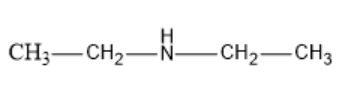
Let us first see the structure of diethylamine:
Structure of Caro’s acid (peroxy mono sulphuric acid):
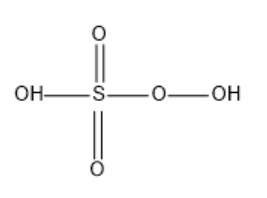
In Caro’s acid we can see that there are two free hydroxyl groups one attached to Sulphur and the other attached to oxygen.
Now, the chemical reaction between Diethylamine and Caro’s acid (peroxy mono sulphuric acid) at 373K results in the formation of Diethyl hydroxyl amine and Sulphuric acid.
${{C}_{2}}{{H}_{5}}-NH-{{C}_{2}}{{H}_{5}}\text{ + }{{\text{H}}_{2}}S{{O}_{5}}\text{ }\xrightarrow{373K}\text{ }{{C}_{2}}{{H}_{5}}-N(OH)-{{C}_{2}}{{H}_{5}}+\text{ }{{\text{H}}_{2}}S{{O}_{4}}$
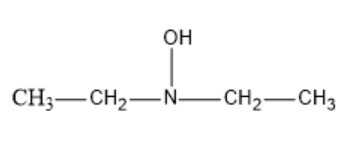
We can observe that the –H attached to nitrogen in diethyl amine is substituted by –OH in the product to form Diethyl hydroxyl amine.
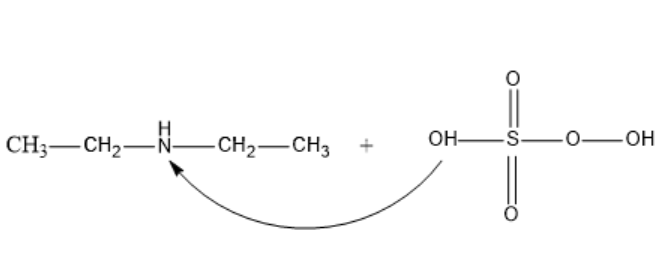
In the structural formula, let’s understand that the – OH group attacks the Diethylamine on the Nitrogen atom and displaces the –H.
The resultant structure formed of Diethyl hydroxyl amine will be:
The structural chemical reaction is-
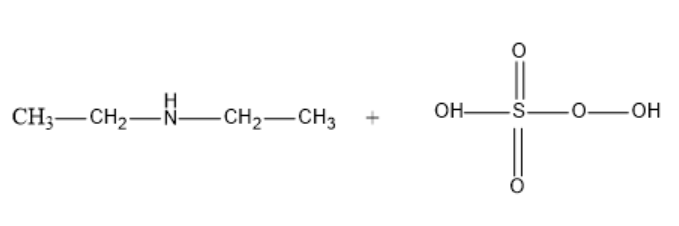
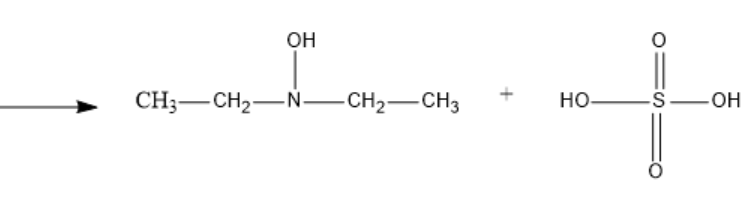
So, the correct answer is “Option 3”.
Note:
Caro’s acid is formed by the reaction between Hydrogen peroxide (${{H}_{2}}{{O}_{2}}$) and sulphuric acid (${{H}_{2}}S{{O}_{4}}$). So, it has peroxy in its IUPAC name. Caro’s acid is a clear, colourless solution and has an oily uniformity. It also has the ability to destroy alcohols, phenols, aldehydes and ketones.
Complete answer:
In the general reaction of amines, we saw that the reaction between secondary amines and Caro’s acid (peroxy mono sulphuric acid) leads to the formation of Dialkyl hydroxylamine as the final product. Caro’s acid is one of the strongest oxidising agents. It oxides the Dialkyl amine and itself reduces to sulphuric acid. It works as an –OH donor.
General reaction of Amine with Caro’s acid- (R is the alkyl group)
$R-NH-R\text{+ }{{\text{H}}_{2}}S{{O}_{5}}\text{ }\to \text{ R}-N(OH)-R+\text{ }{{\text{H}}_{2}}S{{O}_{4}}$
Let us first see the structure of diethylamine:
Structure of Caro’s acid (peroxy mono sulphuric acid):
In Caro’s acid we can see that there are two free hydroxyl groups one attached to Sulphur and the other attached to oxygen.
Now, the chemical reaction between Diethylamine and Caro’s acid (peroxy mono sulphuric acid) at 373K results in the formation of Diethyl hydroxyl amine and Sulphuric acid.
${{C}_{2}}{{H}_{5}}-NH-{{C}_{2}}{{H}_{5}}\text{ + }{{\text{H}}_{2}}S{{O}_{5}}\text{ }\xrightarrow{373K}\text{ }{{C}_{2}}{{H}_{5}}-N(OH)-{{C}_{2}}{{H}_{5}}+\text{ }{{\text{H}}_{2}}S{{O}_{4}}$
We can observe that the –H attached to nitrogen in diethyl amine is substituted by –OH in the product to form Diethyl hydroxyl amine.
In the structural formula, let’s understand that the – OH group attacks the Diethylamine on the Nitrogen atom and displaces the –H.
The resultant structure formed of Diethyl hydroxyl amine will be:
The structural chemical reaction is-
So, the correct answer is “Option 3”.
Note:
Caro’s acid is formed by the reaction between Hydrogen peroxide (${{H}_{2}}{{O}_{2}}$) and sulphuric acid (${{H}_{2}}S{{O}_{4}}$). So, it has peroxy in its IUPAC name. Caro’s acid is a clear, colourless solution and has an oily uniformity. It also has the ability to destroy alcohols, phenols, aldehydes and ketones.
Recently Updated Pages
Which will be the least stable resonating structure class 11 chemistry CBSE

How many 5 digit telephone numbers can be construc-class-11-maths-CBSE
How do you find the angle of the resultant vector class 11 physics CBSE
Draw labelled diagram of the following i Gram seed class 11 biology CBSE
What is the need and importance of classification class 11 biology CBSE
The way in which the sparrows expressed their sorrow class 11 english CBSE
Trending doubts
One Metric ton is equal to kg A 10000 B 1000 C 100 class 11 physics CBSE
Find the value of the expression given below sin 30circ class 11 maths CBSE
1 Quintal is equal to a 110 kg b 10 kg c 100kg d 1000 class 11 physics CBSE
Draw a diagram of nephron and explain its structur class 11 biology CBSE
10 examples of friction in our daily life
Proton was discovered by A Thomson B Rutherford C Chadwick class 11 chemistry CBSE